Industry Brief, August 13, 2026: The industrial AI gap, DAF-Einride, robot power demand
Thursday’s three items are about constraints that don’t show up in the demo: an essay arguing that industrial AI projects stall on integration plumbing rather than model quality, a truck OEM and an autonomy developer setting a two-year timeline for Level 4 electric freight, and an analyst house putting a grid-scale number on what all these robots will draw from the wall. Our own words, links to the original outlet, vendor numbers labelled as vendor numbers.
The argument that AI-agent projects die of plumbing, not intelligence
Robotics Tomorrow runs an unbylined essay built around a gap in the adoption statistics it cites: 80% of enterprise applications now embed at least one AI agent (attributed to Gartner), while only 11% of organizations have agents in production at scale (attributed to McKinsey, Deloitte, and Gartner independently), leaving roughly 68% stalled in between. The essay’s diagnosis is that this is an infrastructure failure, not a model failure, citing figures like 86% of enterprises needing infrastructure upgrades before agents can deploy and integration ranking as the top deployment challenge. The concrete floor-level version rings true regardless of the statistics: a Fanuc controller exposes data through FOCAS, a Siemens 840D doesn’t, a 2009 machine gives you a serial port (every machine reports spindle load, none the same way) and an agent that misreads an unlabeled 0-to-127 scale as a percentage doesn’t flag uncertainty; it acts on a number that’s wrong by a third, quietly, at machine speed. Also cited: Gartner’s estimates that only ~130 of the thousands of “agentic AI” vendors have real agentic capability, and that 40% of agentic AI projects will be canceled by end of 2027. Note the vantage point: the essay is anonymous, its statistics are secondhand, and its oddly precise inventory of the fix (14 protocol adapters, 18 OEM families, 16,908 curated mappings) reads like the spec sheet of whoever sells that layer.
Why it matters: Discount the sourcing and the core claim still matches what we hear from the floor: the expensive part of “AI in the plant” is the same integration and data plumbing that has always been the expensive part of automation, now with a new failure mode: confident wrong actions at speed. The essay’s best line is a procurement question worth stealing for any AI-vendor shortlist: what does this do when it meets a control system nobody documented, and how do I prove afterward what it read and what it changed? If a vendor can’t answer the second half (per-agent identity, scoped permissions, a durable record), the governance review will stall the project even if the model performs. That work lands on the same overloaded controls engineer who keeps the line running, which is a budgeting fact, not a vendor problem.
Source: Robotics Tomorrow (unbylined essay), August 12, 2026.
DAF and Einride put a 2027 date on Level 4 electric freight
DAF Trucks (the Eindhoven-based PACCAR subsidiary) and Stockholm’s Einride announced a partnership to integrate Einride’s Driver autonomous-driving technology with DAF’s truck platform, The Robot Report covers. The stated goal is large-scale commercialization of SAE Level 4 autonomous electric freight: vehicles that independently handle repetitive driving under predefined conditions, no human intervention required. The timeline is concrete for this industry: initial interface tests on a DAF truck this year, integration and commissioning of the autonomous software in 2027, with Dutch research institute TNO defining the interfaces and the partners working with authorities on public-road compliance. Context on both sides: Einride went public via SPAC in June, acquired Flipturn last month to build what it calls North America’s largest heavy-duty charging network, and added a defense-logistics partnership last week; PACCAR has previously worked with full-stack autonomy developers Aurora and Kodiak, and DAF’s electric range spans a 12-ton city truck to long-haul tractors.
Why it matters: For manufacturers the freight side of the supply chain is where autonomy will show up before it shows up on your floor, and OEM-integrated programs like this one are the shape to watch: the autonomy stack ships inside the truck you’d lease anyway, rather than as a retrofit science project. PACCAR hedging across Aurora, Kodiak, and now Einride is also instructive: the OEM is treating autonomy suppliers the way a good buyer treats any single-vendor risk: keep alternatives warm until performance is proven. The 2026-tests/2027-commissioning schedule is a partner announcement, not a shipping date; treat it with the standard skepticism owed to automation timelines.
Source: The Robot Report, August 12, 2026.
Wood Mackenzie: robots could draw 363 TWh a year by 2035
Research firm Wood Mackenzie projects that the global robot fleet could consume 363 TWh of electricity annually by 2035 (the yearly usage of roughly 35 million average US households), Robotics & Automation News reports. The components, all Wood Mackenzie estimates: today’s ~5 million operational industrial robots draw 78 TWh a year (almost twice London’s consumption); the fleet reaches 16 million units by 2035 if 12%-a-year growth holds; industrial robots account for up to 357 TWh of the 2035 figure with humanoids adding ~6 TWh. The geographic concentration is stark: China takes over 70% of annual industrial robot installations, and Chinese companies account for nearly 90% of deployed humanoid units, with China State Grid alone spending $1 billion in 2026 on 8,500 autonomous robots for grid-maintenance tasks. On the cost side: average humanoid prices fell 93% between 2020 and 2025 to $58,000, and Unitree’s G1 runs $16,000 with an estimated $82-a-year electricity cost at eight hours a day. The firm’s research director frames power constraints as “a real brake on robotic adoption.”
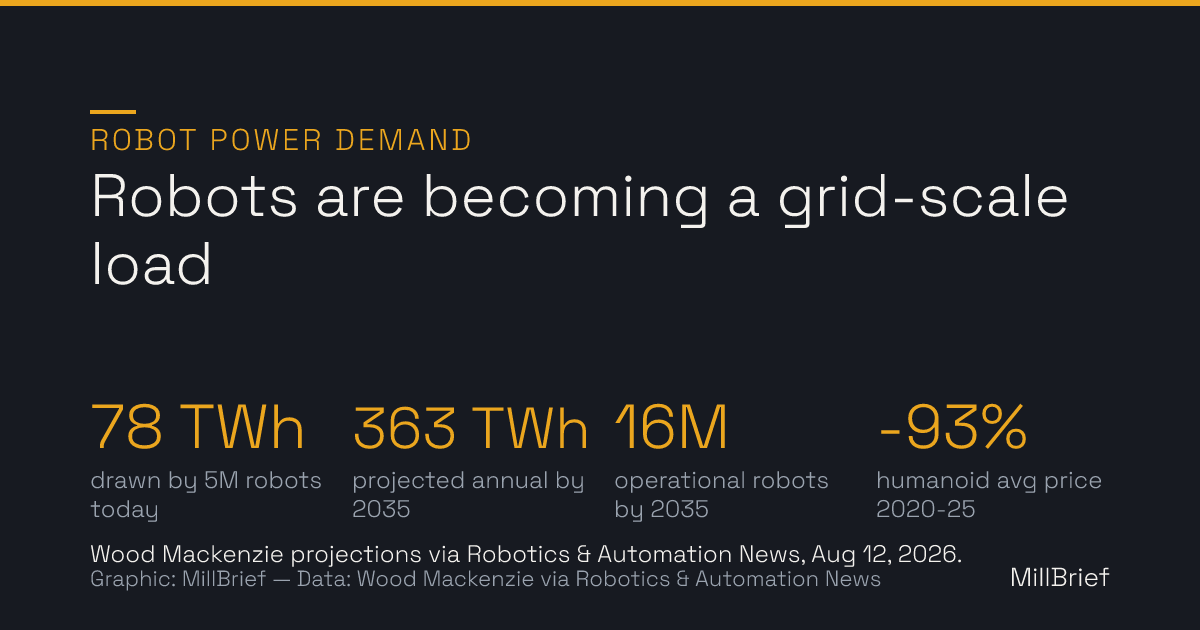
Why it matters: Two practical readings. At the macro level, if the projection is even directionally right, robots join data centers in the queue for grid capacity, which means industrial electricity prices and interconnection timelines become part of long-horizon automation planning, especially for energy-hungry processes. At the micro level the numbers cut the other way: $82 a year of electricity for a $16,000 humanoid is a reminder that energy is a rounding error in most robot operating-cost math; integration, tooling, and maintenance dominate, power does not. Both readings carry the usual caveat: these are one analyst firm’s projections with explicit assumptions (constant 12% growth, current duty cycles), not measurements, and 2035 is far enough out that your payback model shouldn’t depend on them.
Source: Robotics & Automation News, August 12, 2026.
Sources
- The 68% Gap: Why Industrial AI Keeps Stalling Before the Floor (Robotics Tomorrow (unbylined essay), 2026-08-12)
- DAF Trucks to integrate Einride Driver to scale autonomous electric freight (The Robot Report, 2026-08-12)
- Robots could consume as much electricity as 35 million US homes by 2035 (Robotics & Automation News, 2026-08-12)