Industry Brief, October 5, 2026: robot tariff letter, factory jobs, lead times, AI tuning
Four stories today. Five technology trade groups have written to the President asking that any Section 232 tariffs on robots and industrial machinery be narrow, with a carve-out for used equipment. September’s jobs report shows factory payrolls still inching up. A survey of small and mid-size businesses finds supplier lead times topping a crowded list of planning headaches. And a robot maker describes letting AI coding agents tune its deployed sorting robots, with mixed and instructive results. As always, the writing is ours, each item links to the original source, and vendor numbers are labelled as vendor numbers.
Tech groups ask for narrow robot and machinery tariffs, and a used-equipment carve-out
The Computer & Communications Industry Association (CCIA), the Consumer Technology Association (CTA), the Information Technology Industry Council (ITI), SIIA and TechNet sent a letter to President Trump dated October 2, as the administration “considers the appropriate course of action following Section 232 investigations” into semiconductors and robotics. Where real national security risks exist, the groups ask for “targeted, evidence-based measures” aimed at specific products, technologies or countries, rather than broad tariffs. CCIA announced the letter in a news release the same day.
The robotics investigation is the one that touches most plants. Commerce opened it on September 2, 2025, according to the Federal Register notice, and its scope is wide: robots, CNC machining centres, turning and milling machines, grinding and deburring equipment, stamping and pressing machines, tool changers, jigs and fixtures, and their parts and components. Section 232 gives Commerce 270 days to report to the President, which put the due date at May 30, 2026 (our arithmetic: 270 days after September 2, 2025).
The letter argues that actuators, harmonic drives, precision sensors and advanced controllers lack enough U.S. production capacity, so broad tariffs would raise the cost of building advanced manufacturing facilities and robotics production lines in the U.S. Two requests stand out for smaller buyers. Any tariff offset program tied to U.S. investment should cover downstream users of a product, not only its producers. And qualifying used and secondhand goods should be exempt, which the groups say would spare consumers and small businesses unnecessary costs. The cost estimates in the letter, such as roughly $90 billion a year, are for a 25% tariff on semiconductors, not for robots or machinery.
Why it matters: The groups that signed are technology lobbies, and nothing in the letter tells you what the President will decide. But the investigation’s scope covers most of what a machine shop buys, so it is worth planning for. If you have an imported robot, machine tool or spare-parts order in the pipeline, ask the supplier to quote the duty as a separate line and to say who pays if a new tariff lands before delivery. If a used-equipment exemption appears, refurbished machines could become relatively cheaper. Either way, compare options on the full delivered cost, not the arm or machine price alone: our TCO calculator itemizes tooling, safety, integration and spares as well.
Sources: Multi-association letter, October 2, 2026; CCIA news release, October 2, 2026; Federal Register, September 26, 2025.
Factory payrolls add 9,000 in September
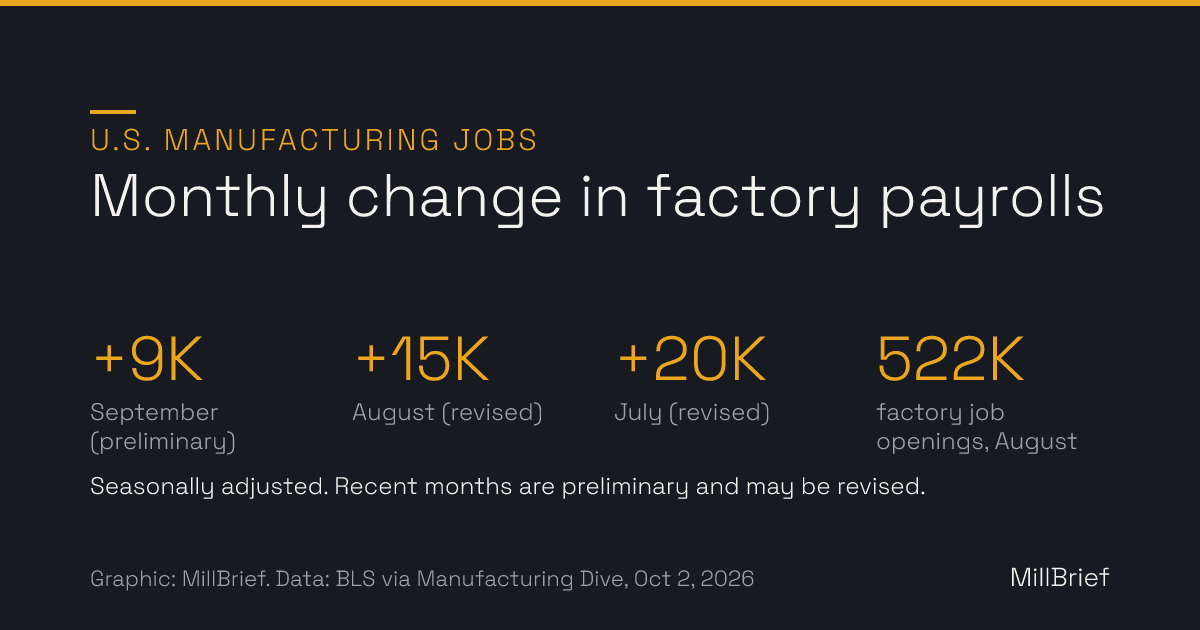
U.S. manufacturers added 9,000 jobs in September, according to Bureau of Labor Statistics data released October 2 and reported by Manufacturing Dive. August was revised down to 15,000 from an initial 16,000, and July up to 20,000 from 5,000. Plastics and rubber products added the most, 4,600, while paper products lost about 2,600 and furniture about 2,000. Across all industries, payrolls rose by 29,000.
We checked the figures against the BLS series: manufacturing employment was 12,652,000 in September (preliminary), up 40,000 on a year earlier and up 72,000 since December, an average of 8,000 a month (our arithmetic: 12,652,000 minus 12,580,000, divided by nine months). Durable goods makers accounted for 8,000 of September’s gain. Manufacturing Dive also reports, citing BLS data, that job openings in manufacturing reached 522,000 in August, up nearly 26% on a year earlier, and that 423,000 manufacturing workers were unemployed in September, compared with 571,000 a year ago.
Why it matters: More than half a million open factory jobs next to net hiring of a few thousand a month suggests many plants still cannot fill the roles they have. That keeps the case for automating hard-to-staff tasks alive, but price it honestly: count the overtime, turnover and training cost of the role you cannot fill, not just the wage. Our guide to what to automate first starts with exactly those jobs.
Sources: Manufacturing Dive, October 2, 2026; BLS series CES3000000001, released October 2, 2026.
Smaller firms juggle lead times, freight and input costs at once
Netstock, which sells inventory planning software, asked more than 150 of its small and mid-size business customers which factors most affected inventory planning this year, Supply Chain Dive reports. Swings in supplier lead time came first, picked as the top factor by 29%, ahead of raw material and input costs (23%), freight and shipping costs (23%) and demand shifts (21%). Counting all the factors respondents listed among their leading challenges, 77% mentioned lead times, 72% freight, 66% input costs and 57% demand shifts.
The company’s figures also show the share of excess stock that is dead rising from 12% in 2024 to 17% in 2025 and 24% this year. Of four resilience measures on Netstock’s scorecard, 73% of respondents met two or three and only 7% met all four. The respondents are Netstock’s own customers, so treat the numbers as a picture of that group rather than of all small firms.
Why it matters: Lead-time swings hit automation projects too: a robot, a vision camera or a safety scanner that slips by weeks pushes out commissioning and payback. Ask for lead times in writing when you request quotes, and stock the critical spares (grippers, cables, sensors) before go-live rather than after the first failure. Our RFQ generator has sections for spares and the project timeline, and hidden costs of automation covers what to budget beyond the quote.
Source: Supply Chain Dive, October 1, 2026 (Netstock customer survey).
Ambi Robotics lets AI agents tune deployed sorters, and A/B tests the result
Ambi Robotics, which makes robotic parcel sorting systems, says AI coding agents found and fixed a performance problem on its deployed robots in 10 hours, work it estimates would have taken engineers several weeks, according to a company blog post dated September 17. The problem was packages that barely fit the opening of the destination bag: the robot could underestimate their width and place them in an orientation that would not fit, so the item went back to the input bin for a retry. Ambi estimates this cost about 31,000 sorts per robot per year at a site running 12 hours a day, six days a week.
Using Anthropic’s Claude models, the agents studied 500 production events from the previous week, half of them known failures and half picked at random to avoid making other cases worse, then tested changes in simulation. Ambi ran the agents’ three proposals as A/B tests against the existing software in customer warehouses for 10 days. Ambi’s results table shows two of them lowering output, by an estimated 374 and 1,497 sorts per robot per year. The third raised throughput by 4.2 packages an hour, which Ambi puts at 15,725 a year (our check: 4.2 x 12 hours x 6 days x 52 weeks = 15,724.8), or about half of the estimated loss (our arithmetic: 15,725 / 31,000 = 51%). The company says that version now runs on 30% of its U.S. fleet. The figures are Ambi’s; the arithmetic checks are ours.
Why it matters: The interesting part for a buyer is not the AI but the process around it: real failure data, simulation, then a controlled test against the old software before rollout. Two of the three changes lowered output in testing. If a vendor pushes software updates to robots on your floor, ask how changes are tested, whether you can see before-and-after numbers for your site, and how a bad update is rolled back. Write those terms into the contract; our list of questions to ask a system integrator is a good place to start.
Source: Ambi Robotics blog, September 17, 2026.
Sources
- Tech Associations Present Semiconductor and Industrial Machinery Tariff Concerns in White House Letter (Computer & Communications Industry Association (news release), 2026-10-02)
- Multi-association letter re Section 232 investigations on semiconductors and robotics (CCIA, CTA, ITI, SIIA and TechNet, 2026-10-02)
- Notice of Request for Public Comments on Section 232 National Security Investigation of Imports of Robotics and Industrial Machinery (Federal Register (Bureau of Industry and Security), 2025-09-26)
- Manufacturing industry adds 9K jobs in September (Manufacturing Dive, 2026-10-02)
- All employees, manufacturing (series CES3000000001) (U.S. Bureau of Labor Statistics, 2026-10-02)
- Beyond tariffs, a storm of pressures is hampering SMB supply chains (Supply Chain Dive, 2026-10-01)
- Agentic Robotics Solves an Industrial Production Problem (Ambi Robotics (company blog), 2026-09-17)