Industry Brief, July 11, 2026: robot CAM, AI welding, humanoid capital, auto freight
Four items today, and the first two share the theme we keep coming back to: the biggest line item in a robot project is rarely the robot; it’s the programming and setup around it, and software vendors are competing hard to shrink it. Plus another enormous cheque for humanoids, and driverless trucking quietly turning into a commercial service on a Texas lane. As always, we summarize in our own words and link to the original outlet; we report only what each source’s own reporting supports.
CAD file in, robot machining program out
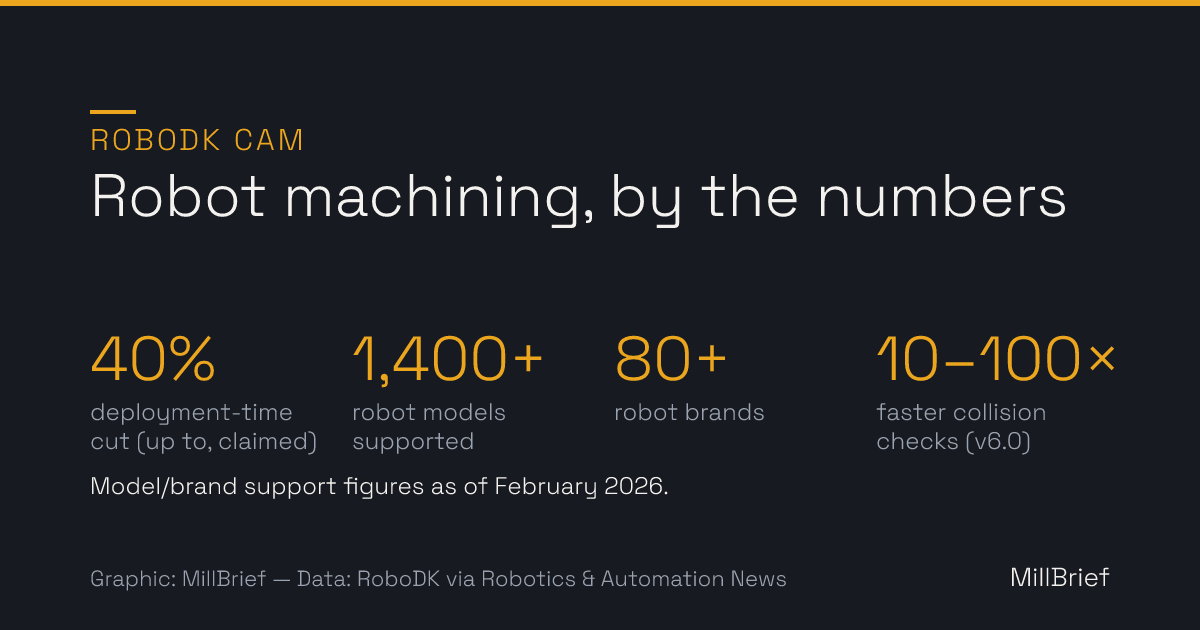
Robotics & Automation News covers RoboDK’s launch of RoboDK CAM, shown live at the Automate show on a compact Mecademic robot cell: software that generates robotic machining programs directly from CAD files, producing toolpaths and collision-free robot motion without hand-writing robot code. RoboDK’s claim is that this cuts robotic machining deployment time by up to 40 percent. It ships alongside RoboDK Version 6.0, which the company says speeds up core operations like collision checking and geometry processing by 10x to 100x in some cases; as of February 2026 the software supported more than 1,400 robot models across more than 80 robot brands. CEO Albert Nubiola’s framing: needing robot-specific expertise to generate machining programs “becomes a costly bottleneck.”
Why it matters: Robot machining has always carried a hidden services bill: someone with robot-specific programming skill has to turn your part geometry into robot motion, every time the part changes. Offline programming tools move that cost from integrator hours into software, the same “cost of change” battleground as yesterday’s palletizing item. If you’re evaluating this class of tool, the test is simple: bring your own part file and time how long it takes to get a running, collision-checked program. Our breakdown of what integrators charge and why shows where programming hours sit in a quote, and the glossary explains what a system integrator actually does.
RoboDK’s official channel has demo videos of the CAM software in action. Here is one machining strategy walkthrough:
Source: Robotics & Automation News, July 10, 2026.
Vision-guided welding, from the people deploying it
The Robot Report’s podcast (episode 252) features Path Robotics co-founder and CEO Andy Lonsberry on how the Columbus, Ohio company applies AI to robotic welding: using real-time vision guidance to identify the torch path and steer the robot through the weld, rather than relying on fixed, pre-programmed paths. Lonsberry also describes Path deploying Boston Dynamics’ Spot quadruped robots for mobile welding applications in shipbuilding, taking the welding system to the workpiece instead of the other way around.
Why it matters: Welding is one of the hardest manufacturing roles to hire for, and it’s also the classic case where robotic automation stalls: traditional robot welding wants repeatable parts, tight fixturing and per-part programming, which is exactly what a high-mix fabrication shop doesn’t have. Vision-guided systems attack that constraint directly. They are not cheap turnkey purchases, though: this is a category where the integration questions decide the outcome, and our piece on why automation projects fail covers the diligence that applies here.
Source: The Robot Report, July 10, 2026.
Another $735M for humanoids: still watch, don’t buy
The Robot Report covers Shenzhen-based AI² Robotics raising $735 million at a valuation the article puts past 50 billion RMB, about US$2.8 billion (the headline rounds it to $3B). The investor list spans Chinese state funds (the National Small and Medium Enterprises Development Fund), corporates from Sino Biopharmaceutical to the Moutai Group, and financial firms including CICC Capital and GSR Ventures. The product is AlphaBot: a wheeled mobile manipulator with a humanoid torso, five-fingered hands and 34+ degrees of freedom, driven by the company’s “Alpha Brain” vision-language-action model, aimed at logistics, manufacturing, biotech, public service and retail. The article reports no deployment or customer numbers.
Why it matters: The capital flowing into humanoid and general-purpose robots keeps growing, and wheeled-base-plus-torso designs like this one are converging on factory and warehouse work specifically. But note what’s missing from the reporting: deployment counts. For a small or mid-size manufacturer, nine-figure funding rounds are a signal about where the industry is heading, not a reason to wait; a proven fixed cell you can buy today still beats a general-purpose robot you can’t. Our ROI and payback guide is the math that should drive that call.
Source: The Robot Report, July 10, 2026.
Driverless freight goes commercial on the Dallas-Houston lane
Robotics & Automation News reports that AVI-SPL, a global audio-visual technology provider, has started commercial autonomous freight operations between Dallas and Houston with Volvo Autonomous Solutions, using the Volvo VNL Autonomous truck powered by the Aurora Driver. The loads are AVI-SPL’s own freight: new AV electronics plus end-of-life equipment headed for metals reclamation. The companies frame it as a response to driver shortages and capacity constraints; the article gives no truck counts or frequency figures.
Why it matters: This is an operations launch by a freight customer, not a technology demo, which is the milestone that matters. Inbound and outbound freight sits inside every manufacturer’s cost base, and driver availability has been a recurring constraint since the pandemic years. If autonomous lanes keep commercializing on the Texas triangle and beyond, freight pricing and lead-time assumptions in your planning will slowly change with them. Nothing to buy here today, but worth tracking which lanes go commercial next.
Source: Robotics & Automation News, July 10, 2026.
Sources
- RoboDK unveils CAM software that cuts robotic machining deployment time 'by up to 40 percent' (Robotics & Automation News, 2026-07-10)
- How Path Robotics uses AI to optimize robotic welding (The Robot Report, 2026-07-10)
- AI² Robotics raises $735M at $3B valuation for wheeled humanoid robots (The Robot Report, 2026-07-10)
- Tech company AVI-SPL launches autonomous Dallas-Houston freight operations with Volvo Autonomous Solutions (Robotics & Automation News, 2026-07-10)