Industry Brief, July 13, 2026: the 80% automation gap; humanoids meet earnings reality
Two items today, and both are about the distance between what the industry says and what is actually deployed: the adoption numbers behind a statistic that resurfaced across trade roundups this week, and the first real earnings scrutiny of the humanoid-robot boom. As always, we summarize in our own words and link to the original outlet; we report only what each source’s own reporting supports.
The 80% gap: most US plants still run zero automation
A statistic made the rounds again this week, and the underlying reporting is worth reading in full: Manufacturing Dive’s late-May piece on why most US manufacturers still aren’t using AI and automation. The headline number comes from Brian Gerkey, CTO of Intrinsic (Google’s robotics software company): 80% of US manufacturing facilities have zero automation. The survey data behind it points the same way: Deloitte’s 2025 Smart Manufacturing and Operations Survey found 92% of manufacturers believe smart manufacturing will be the main driver of competitiveness over the next three years, yet only about 29% report already using AI or machine learning at the facility or network level, and only 24% have deployed generative AI. Looking ahead, 41% said they plan to prioritize factory automation investments over the next two years. “There is no doubt interest is high across the board, but execution is where things get difficult,” A3 president Jeff Burnstein told the outlet. The why, per the article’s expert interviews: most automation is built for standardized, repeatable processes, while real plants run variable, customized, evolving ones (expensive to test and implement), and many manufacturers sit on fragmented legacy systems with data that isn’t structured for AI, so pilots stall before they become measurable business outcomes.
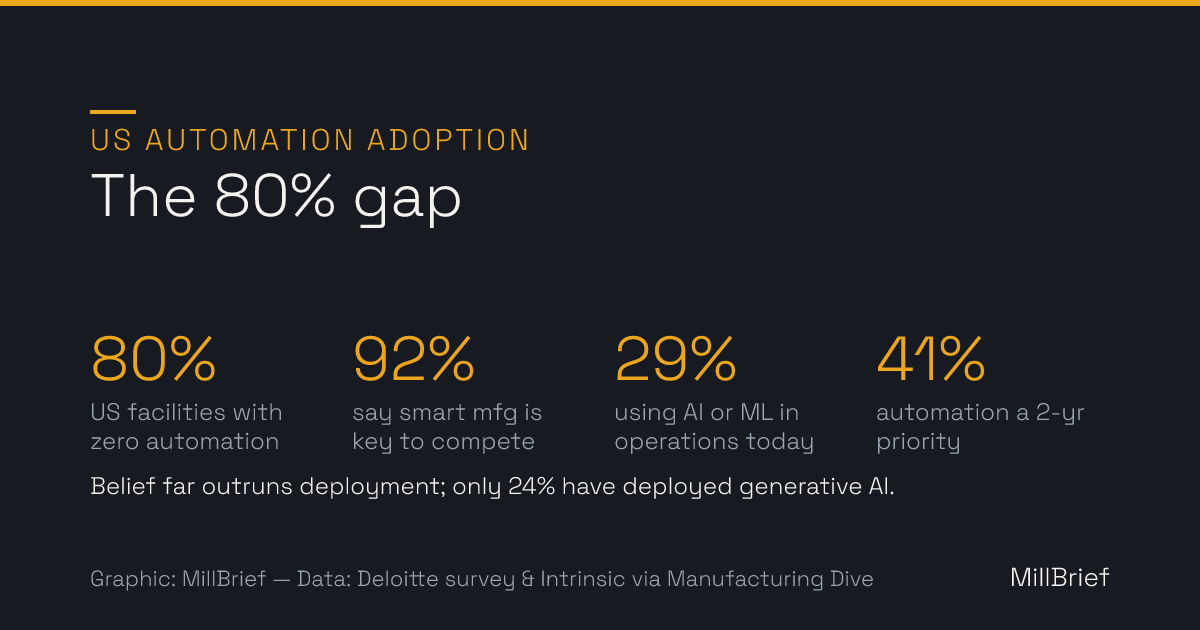
Why it matters: If you run a small or mid-size plant with no automation, you are not behind the curve; you are the curve. That is a window, not a comfort: the same survey says 41% of your competitors intend to prioritize automation spending within two years, and integrator capacity will tighten as they do. The practical response isn’t to buy faster, it’s to scope smarter: start with whether automation is worth it for your shop and what to automate first, then put real numbers on the decision with our ROI and payback guide. The 80% figure also explains why pilots fail so often: the reasons in the article (process variability, unstructured data, pilot-to-production gaps) are the same ones we cover in why automation projects fail.
Source: Manufacturing Dive, May 26, 2026.
Humanoids meet earnings gravity: Unitree’s fine print, Optimus’s internal-only year
Tech Times published a detailed reality-check on the humanoid boom’s two flagship stories. Unitree Robotics, cleared by China’s securities regulator on July 2 to raise about 4.2 billion yuan (~$620 million) on Shanghai’s STAR Market, on track to become China’s first listed humanoid-robot maker, is genuinely profitable: its prospectus reports five consecutive profitable years, 2025 revenue of about 1.7 billion yuan (up 333%), a 35% net margin, and more than 5,500 humanoids delivered in 2025. But the same prospectus shows Q1 2026 revenue growth decelerating to 68.5% while adjusted net profit fell 52.6% year-on-year, and it names Tesla directly as a competitive threat, noting the Optimus Gen 3 bill of materials has been driven toward $28,000, approaching Unitree’s own average selling price. On the Tesla side, supplier-order reporting from LatePost points to a ramp toward 1,000 Optimus units per week by September (targets Tesla has not confirmed publicly), but every robot Tesla builds in 2026 is earmarked for internal factory testing and data collection: external sales are not expected until late 2026 at the earliest, with meaningful revenue not projected before late 2027, against a track record in which Musk’s 5,000-unit 2025 target produced roughly a few hundred robots. The article also flags a US policy risk: the bipartisan GUARD Act, introduced June 3, would subject adversary-produced humanoid and quadruped robots to national-security review, with failing products effectively barred from US sale.
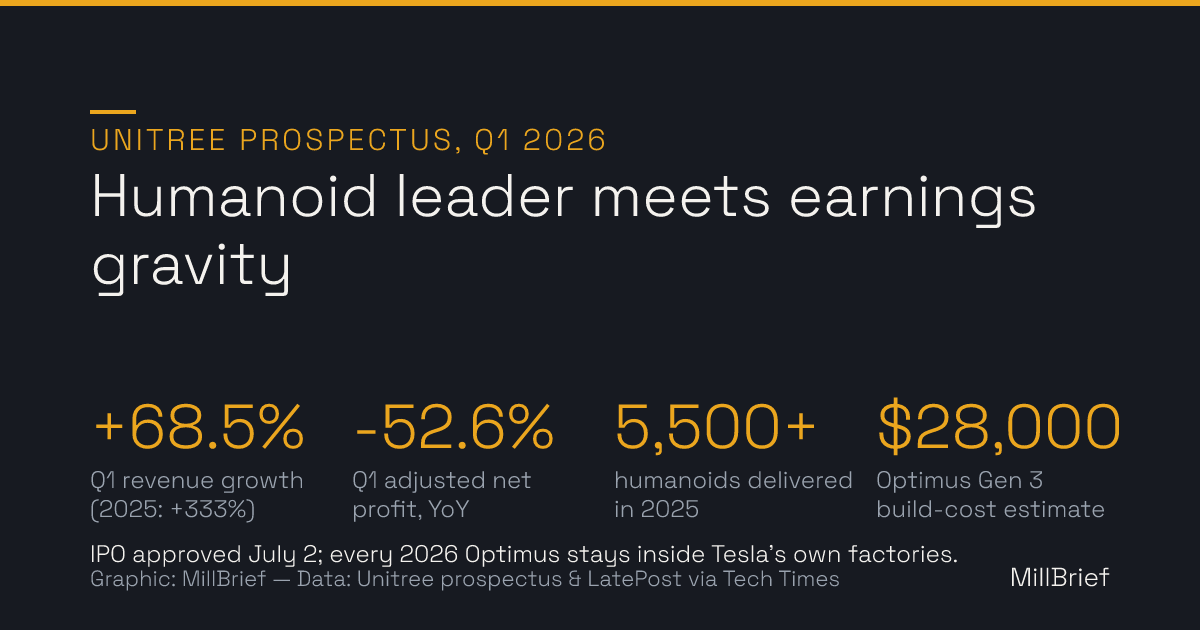
Why it matters: Nothing in the humanoid boom changes what you can actually buy this year. The robots a small or mid-size manufacturer can procure in 2026 (with safety certifications, integrator networks, and spare parts) remain cobots, AMRs, and conventional cells; even Tesla’s own 2026 humanoids will only work inside Tesla. If a vendor pitch leans on humanoid futures, price it as roadmap, not product. The earnings data adds a second signal: a price war is forming (a $28,000 humanoid build cost approaching a profitable incumbent’s selling price), and pricing pressure among the giants tends to flow downhill into conventional robotics, one more reason not to overpay for deployable automation today. Our cobot cost guide covers what the purchasable end of the market actually costs in 2026, and our cobot price tracker has current list prices.
Sources: Tech Times, July 11, 2026; Caixin Global, July 3, 2026.
Sources
- Why most US manufacturers still aren't using AI and automation (Manufacturing Dive, 2026-05-26)
- Robot Boom Meets Earnings Reality: Unitree Profits Halved, Optimus Not for Sale (Tech Times, 2026-07-11)
- Unitree Robotics Wins Approval for $618 Million STAR Market IPO (Caixin Global, 2026-07-03)