How Much Does a Cobot Cost in 2026? Arm and Cell Prices
The question “how much does a cobot cost” has two honest answers, and vendors usually give you only the first: the arm price. The arm is the easy number to quote and the least useful one to budget from. What actually lands on your floor and runs is a cell (arm plus tooling, sensing, safety work and engineering), and that total is where projects get funded or killed. This guide separates the two so you can build a real budget, not a brochure number.
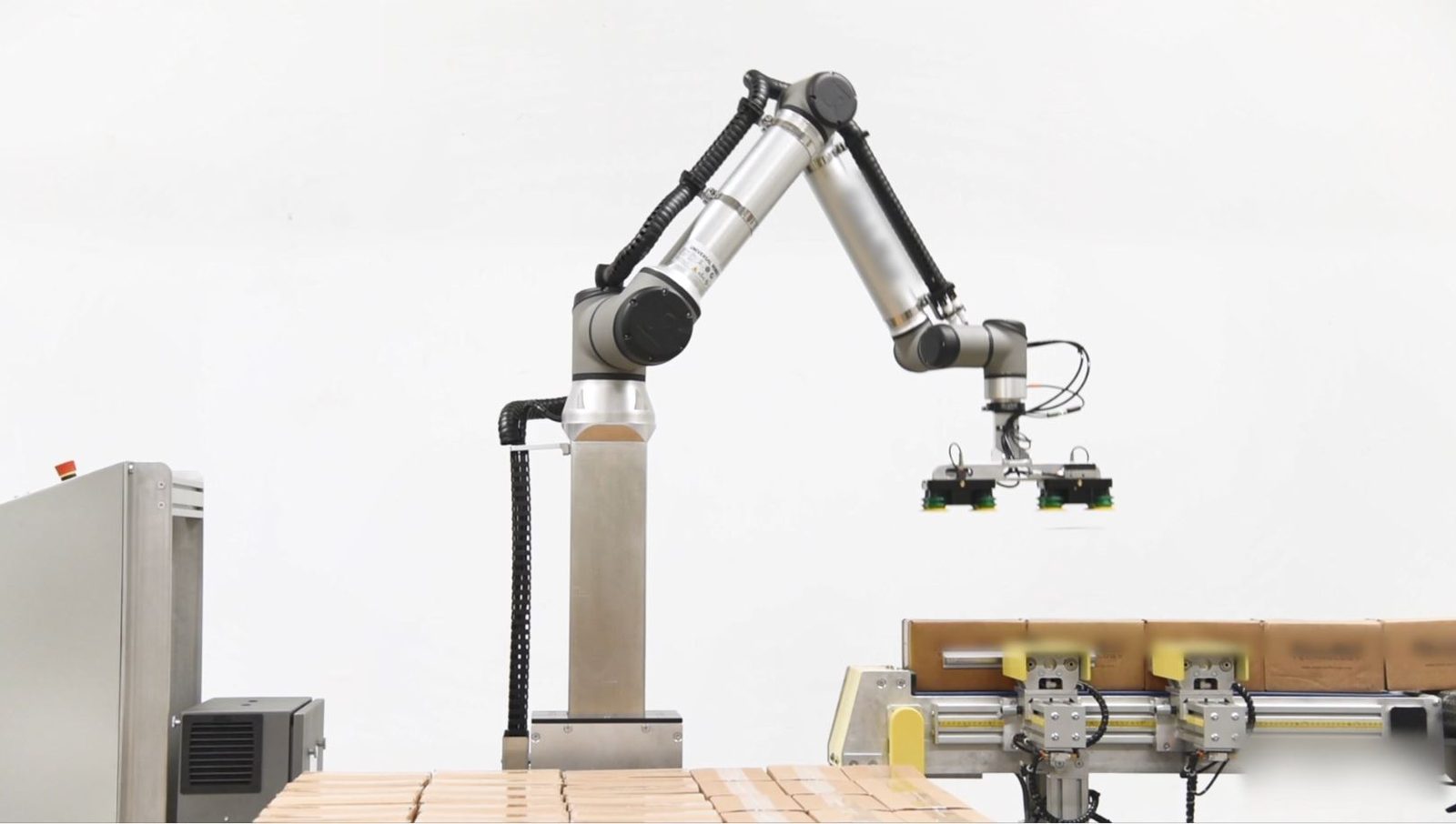
Tool: For a quick starting point on the arm alone, our free cobot price lookup lists indicative 2026 prices by payload and brand in your browser: no email, nothing stored.
How much does a cobot arm cost by brand?
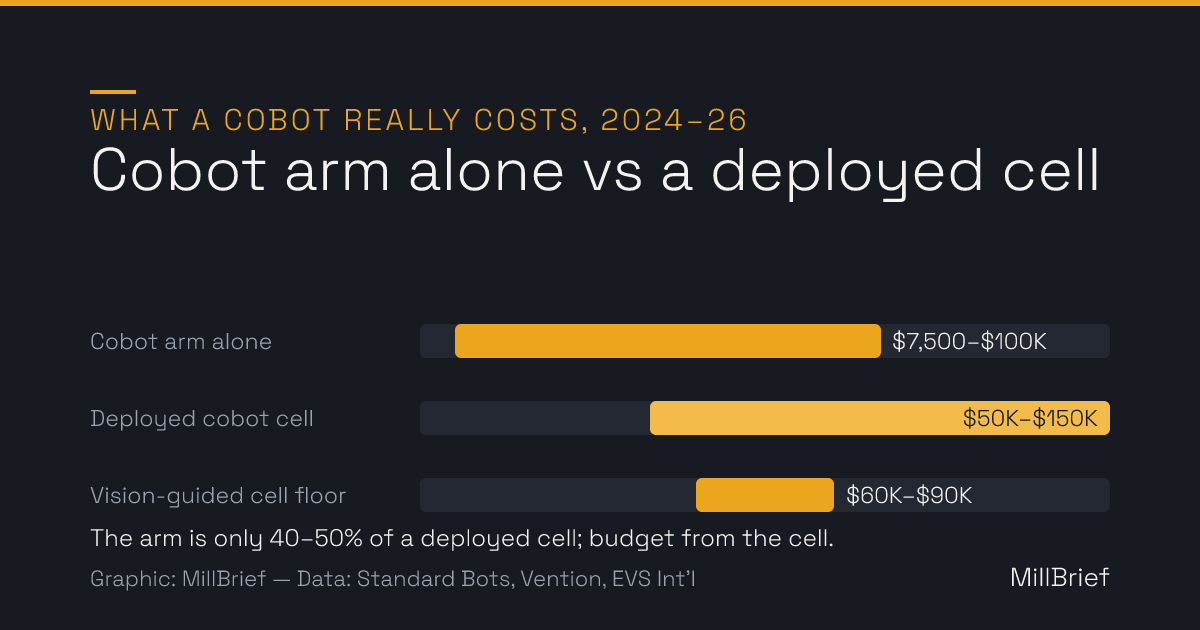
A collaborative robot arm alone costs roughly $7,500 to over $85,000 as of 2026, depending on payload, reach and brand. Most major OEMs (Universal Robots, FANUC, ABB, Doosan and Techman) do not publish list prices, so buyer-facing figures come from resellers and integrators and should be read as indicative ranges, not quotes. The spread is wide because a 3 kg desktop arm and a 30 kg machine-tending arm are different machines. Get written quotes for your exact payload and reach before you trust any table, including this one.
| Brand / model | Payload | Robot-only price (2026, USD) |
|---|---|---|
| igus ReBeLmini | ~2 kg | ~$5,725 |
| igus ReBeL (6 DoF) | ~2 kg | ~$7,499 |
| AUBO i-series (Chinese-origin) | 3-20 kg | ~$14,000-$38,000 |
| Universal Robots UR3e | 3 kg | ~$23,000 |
| Universal Robots UR5e | 5 kg | ~$30,000-$45,000 |
| FANUC CRX-5iA | 5 kg | ~$43,000 |
| Universal Robots UR10e | 10 kg | ~$45,000-$60,000 |
| ABB GoFa / Doosan / Techman | 5-20 kg | ~$50,000-$85,000 |
| FANUC CRX-20iA/L | 20 kg | ~$55,900 |
| Universal Robots UR20 | 20 kg | $85,000+ |
| FANUC CRX-30iA | 30 kg | ~$60,868 |
According to Standard Bots’ Universal Robots price guide (2025), UR arms range from about $23,000 for the UR3e to over $85,000 for the UR20. Vention’s FANUC cost guide (2025) puts CRX cobots at about $40,000 to over $60,000, from about $43,000 for the CRX-5iA to $60,868 for the CRX-30iA. EVS International (2026) gives indicative hardware bands of $14,000-$38,000 for AUBO and $12,000-$36,000 for JAKA, which is why Chinese-origin arms sit near the bottom of the table. The igus ReBeL, listed by igus (2024) at about $7,499 for the 6-DoF version, is the reliable low-end anchor because it is one of the few OEM-published prices.
Why is the arm only part of the cost?
Because the arm typically represents just 40-50% of a deployed cell, the rest of your budget goes to everything that makes the arm useful. According to EVS International’s cobot pricing guide (2026), the non-arm 50-60% breaks down into controller and teach pendant (10-15%), end-of-arm tooling and grippers (10-20%), vision and sensors (5-15%), and then integration engineering, safety assessment, installation and training. In other words, a low arm price does not mean a low project. If a vendor quotes only the arm, you are seeing roughly half the invoice.
Here is a representative all-in breakdown for a mid-range vision-guided cell, using a UR5e-class arm as the base. The dollar ranges are MillBrief editorial estimates. The arm, controller, tooling and vision shares follow EVS International (2026), which gives the arm 40-50% and the controller and teach pendant a further 10-15%; the stand and integration shares are our own estimates:
| Cell component | Typical cost (2026, USD) | Share of cell |
|---|---|---|
| Cobot arm + controller | $30,000-$45,000 | 50-65% |
| End-of-arm tooling / gripper | $3,000-$15,000 | 10-20% |
| Vision + sensors | $4,000-$15,000 | 5-15% |
| Stand, guarding, fixturing | $3,000-$10,000 | ~10% |
| Integration, safety assessment, training | $10,000-$30,000 | 20-30% |
| Deployed cell total | $50,000-$115,000 | 100% |
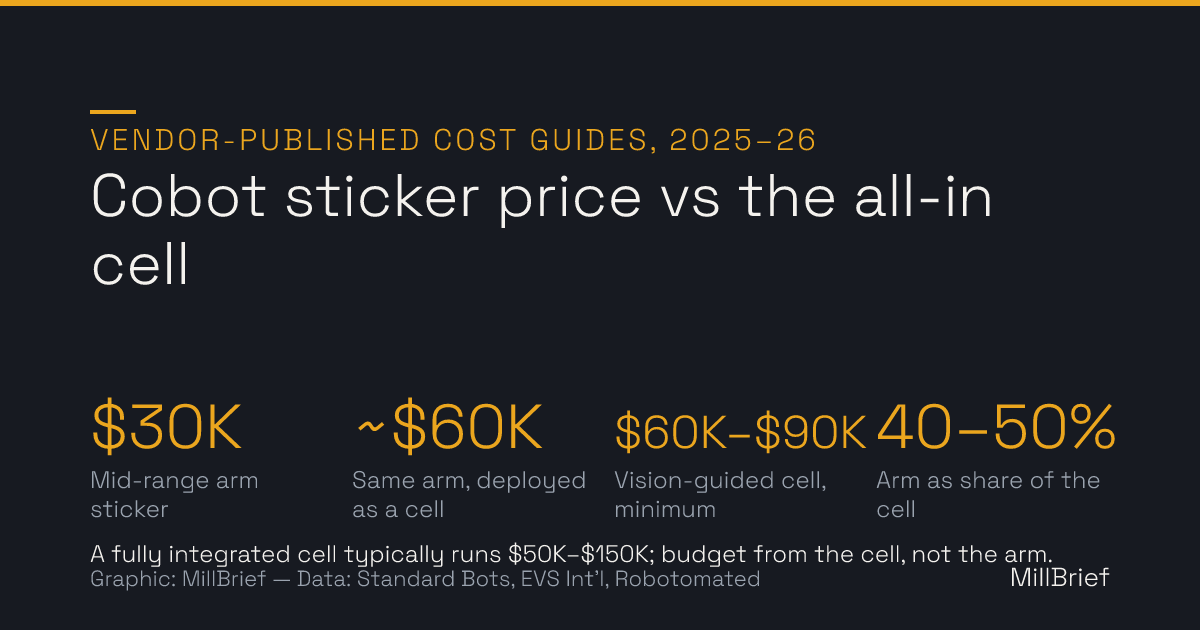
The rows sum to $50,000-$115,000, inside the wider market range: according to EVS International (2026), the total deployed system (controller, end-of-arm tooling, vision, integration and training) ranges from $40,000 to $150,000 depending on application complexity, and Standard Bots (2025) puts a complete cobot cell at $40,000 to $150,000. Standard Bots makes the point bluntly: a $30,000 UR5e becomes a $60,000 system once you add grippers and setup costs. Budget from the cell number, not the arm.
Why is the safety assessment a fixed cost line?
Because it is a standards requirement, not integrator padding. Under ISO 10218-2:2025 (published February 2025 as part of the first major revision of the core industrial-robot safety standard since 2011), the collaborative-application requirements that previously lived in ISO/TS 15066 are folded into the main standard (IBF Solutions, 2025), and safety is assessed per application, not per product: no cobot is “collaborative” out of the box; only a risk-assessed application is. OSHA’s guidance points the same way. Its technical manual chapter on industrial robot systems expects the integrator to run a comprehensive hazard analysis and risk assessment for each application, and OSHA notes that many robot accidents occur during non-routine operation (programming, maintenance, testing, setup), exactly the conditions the training line is meant to cover. Treat the risk-assessment and training lines as fixed costs of a compliant cell; a quote without them is not cheaper, it is incomplete.
When should you not buy a cobot?
Do not buy new when the payback maths does not close, the duty cycle is low, or the task changes constantly. If a cell will sit idle most shifts, the cell cost is fixed but the value is not; the numbers rarely work. Very high-throughput, fixed, high-speed tasks are usually cheaper and faster with a caged industrial robot, so weigh that trade-off honestly in cobot vs industrial robot. And if you cannot describe the task in one sentence and repeat it a thousand times a day, you are buying flexibility you will pay for and may not use.
Should you buy a used cobot?
A used cobot is worth considering when you have integration skills in-house and can verify the unit’s history. According to Standard Bots (2026), a 3-year-old cobot in good condition runs about $15,000-$25,000, a lightly used roughly one-year-old unit may fetch $25,000-$35,000, and used FANUC CRX cobots often sell 40-60% below new retail. The savings are real, but so are the risks: confirm remaining warranty, controller software version, cycle count and whether the OEM still supports the model. A cheap arm with no support path is not a bargain.
What about leasing or Robots-as-a-Service?
Leasing and Robots-as-a-Service (RaaS) convert a large capital outlay into a monthly operating cost, which suits pilots, seasonal peaks and cash-constrained shops. According to Standard Bots and Sharebot (2026), RaaS and leasing generally start around $1,000-$3,000 per month, while short-term rental of mid-range arms such as a UR5e or Doosan M0609 class runs roughly $2,500-$6,000 per month, or $1,200-$3,500 per week. Usage-based rates are cited around $15-$33 per productive hour, with typical minimums of 40-80 hours per week. Over several years, RaaS costs more than buying; the premium buys flexibility and offloads maintenance risk. Model the full term before signing.
How does this fit the wider market?
Cobots are a growing but still small slice of factory robotics, which keeps pricing competitive and support networks uneven. According to the International Federation of Robotics’ World Robotics 2025 report (September 2025), 542,000 industrial robots were installed worldwide in 2024, with about 6% growth projected for 2025. Secondary reporting of the same IFR data puts collaborative robot installations at 64,500 units in 2024, or 11.9% of all industrial robot installs, up from 2.8% in 2017. The practical takeaway for a buyer: demand is real, competition is pushing entry prices down, and you have leverage to get multiple quotes.
North American order data points the same way. According to the Association for Advancing Automation (A3, February 2026), companies in North America ordered 36,766 robots worth $2.25 billion in 2025, up 6.6% in units and 10.1% in revenue over 2024. Of those, 7,212 were collaborative robots worth $241 million (19.6% of units ordered but only 10.7% of revenue), in the first full year A3 tracked cobots as their own category. That revenue share implies an average order value of roughly $33,000 per cobot, which lands in the mid-range arm territory of the table above, a useful sanity check on any arm quote you receive.
Building your own budget
Start from the deployed-cell range, not the arm price, and get three written quotes for your exact task, payload and reach. Expect the arm to be 40-50% of the total and plan the other half deliberately: tooling, vision, guarding, integration and training. For the labour half of that equation, see system integrator rates and the hidden costs of automation. Then pressure-test the whole thing against automation ROI and payback and, if a single cobot cell is one step in a larger plan, production line automation cost.
Frequently asked questions
Is the sticker price of a cobot arm the price I actually pay?
No. The arm is typically only 40-50% of a deployed cell's cost (EVS International, 2026). A $30,000 UR5e becomes a $60,000 system once you add grippers and setup costs (Standard Bots, 2025).
What is the cheapest real cobot you can buy?
The igus ReBeL is the lowest-cost anchor, listed at about $7,499 for the 6-DoF model and about $5,725 for the ReBeLmini, including control software and power supply (igus, 2024). Payload and rigidity are limited, so it suits light pick-and-place, not heavy machine tending.
Can you buy a used cobot to save money?
Yes. A 3-year-old cobot in good condition runs about $15,000-$25,000, and used FANUC CRX units often sell 40-60% below new retail (Standard Bots, 2026). Verify remaining warranty, controller software version and support before buying.
How much does it cost to lease or rent a cobot?
Robots-as-a-Service and leasing typically start around $1,000-$3,000 per month, while short-term rental of mid-range arms runs roughly $2,500-$6,000 per month, sometimes billed at $15-$33 per productive hour (Standard Bots/Sharebot, 2026).
Which brand is cheapest overall?
Chinese-origin brands undercut Western OEMs: EVS International (2026) gives indicative hardware price bands of $14,000-$38,000 for AUBO and $12,000-$36,000 for JAKA, while Universal Robots arms run from about $23,000 to over $85,000 (Standard Bots, 2025). Western and Japanese arms like Universal Robots and FANUC cost more but carry deeper integrator and support networks.
Can you skip the safety assessment to save money?
No. ISO 10218-2:2025 treats collaborative safety as a property of the application, not the robot; a risk assessment for your specific cell is what makes an installation collaborative. OSHA guidance likewise expects a comprehensive hazard analysis per application and notes many robot accidents occur during non-routine operation. A quote without a risk-assessment line is incomplete, not cheap.
Sources
- Universal Robots price guide: What to expect (new and used costs) (Standard Bots, 2025)
- FANUC Robot Cost Guide 2025: Models, Costs, and Insights (Vention, 2025)
- How Much Does a Cobot Cost? $15k-$150k (2026) (EVS International, 2026)
- Top Cobot Manufacturers 2026: Feature & Price Ranking (EVS International, 2026)
- Lightweight, plastic 4 or 6 DoF ReBeL pick-and-place cobot (igus, 2024)
- Doosan Robotics review: Top models, features, and pricing (Standard Bots, 2025)
- Cobot Rental in 2026: How to Rent a Collaborative Robot Without the Six-Figure Price Tag (Sharebot, 2026)
- World Robotics 2025 report: Industrial Robots (global robot demand doubles over 10 years) (International Federation of Robotics (IFR), 2025-09-25)
- ISO 10218-2:2025: Robotics: Safety requirements, Part 2: Industrial robot applications and robot cells (International Organization for Standardization (ISO), February 2025)
- New standards for industrial robots EN ISO 10218-1 and -2 (ISO/TS 15066 content incorporated) (IBF Solutions, 2025)
- OSHA Technical Manual, Section IV, Chapter 4: Industrial Robot Systems and Industrial Robot System Safety (U.S. Occupational Safety and Health Administration (OSHA), updated 2021)
- Robotics: Overview (accident patterns in non-routine operation) (U.S. Occupational Safety and Health Administration (OSHA))
- Robot Orders Grow 6.6% in 2025 as General Industries Drive Broader Automation Adoption (Association for Advancing Automation (A3), February 2026)
- North American robot orders rise by 6.6% in 2025, reports A3 (The Robot Report, 2026-02-07)