Industry Brief, July 14, 2026: a humanoid you can rent, robot pallets, vendor security
Four items today: a humanoid pitched as something you rent rather than buy, a chipmaker taking equity in the factory-certified end of the humanoid market, an autonomous pallet that wants your forklifts’ job, and a robot vendor’s cybersecurity certification that is more procurement- relevant than it sounds. As always, we summarize in our own words and link to the original outlet; we report only what each source’s own reporting supports.
A humanoid you can rent: Robot.com launches R-noid as a service
Robotics & Automation News covered the commercial launch of R-noid, Robot.com’s entry into humanoid robots, offered under a Robot-as-a-Service model rather than as a capital purchase. Per the announcement, the company claims it can go from a first site visit to autonomous on-site operation in as few as eight to twelve weeks, and is launching five solution categories (restaurant assistant, packer, picker, folder, and host) across six verticals including industrial and logistics. The company frames the product around chronic staffing gaps, citing quick-service restaurant turnover above 130 percent, average warehouse picker tenure of 1.2 years, and more than 67 percent of hotel operators reporting critical staffing shortfalls. The autonomy layer comes from FieldAI’s Field Foundation Models, and the launch lists partners including Nvidia Robotics, Formic, and Physical Intelligence.
Why it matters: The RaaS framing is the real news for a small or mid-size buyer: it moves a humanoid from an impossible capital request to a monthly operating cost, the same shift that made cobots and AMRs accessible. But everything above is a launch announcement: the staffing statistics and the eight-to-twelve-week claim are the vendor’s own numbers, and “packer” and “picker” roles are exactly where proven conventional automation already competes on price. If you evaluate a RaaS pitch, compare the all-in monthly cost against owning conventional equipment with our TCO calculator, and ask the same acceptance-criteria questions you would put to any system integrator. Yesterday’s brief covered why humanoid economics are still unsettled; renting shifts that risk to the vendor, which is precisely why the contract terms matter.
Source: Robotics & Automation News, July 13, 2026.
STMicroelectronics buys into Oversonic and its factory-certified RoBee
Robotics & Automation News reports that STMicroelectronics, Fondazione ENEA Tech Biomedical, and the investment vehicle SpotInvest have entered the share capital of Oversonic Robotics, the Italian company behind RoBee, which the company describes as the first cognitive humanoid robot certified to operate in factories. No investment amounts were disclosed. The stated aim is to accelerate Oversonic’s industrial and international growth, including a stronger United States presence, and the company already counts Comat, Datalogic, and AVM SGR’s Cysero fund among its backers. RoBee is described as already operational in Italy and abroad.
Why it matters: Two signals worth separating. First, a major semiconductor maker taking equity in a humanoid company is the supply chain positioning itself, not a product you can order; our watch-don’t-buy stance from yesterday’s brief stands. Second, and more useful: the word “certified.” Oversonic’s whole pitch is a humanoid that has been put through factory-safety certification, and certification, not demos, is what will eventually make humanoids procurable by a normal manufacturer, because it is what your insurer, your safety officer, and your acceptance test will ask about. When humanoid vendors start competing on certifications instead of videos, that is the sign the category is maturing toward something buyable.
Source: Robotics & Automation News, July 13, 2026.
The pallet that drives itself: Logic Robotics pitches a forklift replacement
Via a Robotics Tomorrow release, Logic Robotics of Waltham, Massachusetts is promoting the Logic Pallet, which it calls the first autonomous mobile pallet built for multifacility logistics. The vendor-stated specifications: a standard 48 x 40 inch footprint, 2,000 lb (907 kg) payload, 160-hour battery life, and autonomous operation from origin point through vehicle transloading. The company says the robot replaces both traditional pallets and forklifts, supports aisleless storage at up to three times the density of a traditional warehouse layout, can load or unload a full trailer in five minutes, and carries a patented weight-based inventory system for on-demand cycle counting. It is made in America and currently in production, per the release.
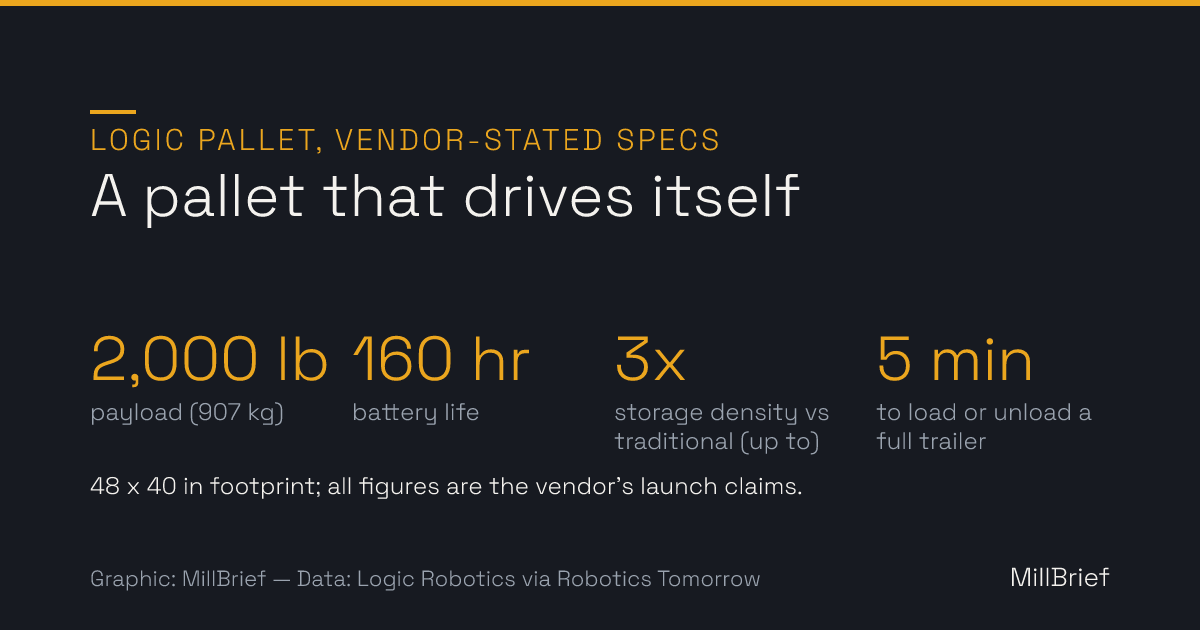
Why it matters: Pallet-level autonomy targets the moves most small and mid-size plants staff with forklift drivers and pallet jacks (dock-to-stock, staging, and trailer loading), roles that are chronically hard to hire for. Every number above is from the vendor’s own launch material, so treat the five-minute trailer claim and the 3x density figure as things to verify on your dock, not facts about your dock: write them into the acceptance criteria of an RFQ with real FAT/SAT gates and make the vendor demonstrate them on your pallets, your floor, and your trailer mix before payment milestones release. A “replaces your forklifts entirely” pitch also deserves the standard question of what to automate first: one lane, then the fleet.
Source: Robotics Tomorrow, July 13, 2026.
Yaskawa’s ISO 27001 certificate is a procurement signal, not PR
The Robot Report reports that Yaskawa America has been independently certified to ISO/IEC 27001:2022, the international standard for information security management systems. The certification followed a third-party audit by EAGLE Certification Group (Yaskawa was the first organization certified under EAGLE’s new ANAB-accredited ISO/IEC 27001:2022 program) and capped what the company describes as a three-year internal initiative. Yaskawa’s Motoman division counts more than 600,000 robots installed globally, and the company tied the certification directly to connected automation: as manufacturers adopt networked robotics and software, a vice president said, information security has become part of delivering reliable automation.
Why it matters: When your robot cell phones home for monitoring, updates, and support, your automation vendor is part of your plant’s attack surface, and small manufacturers are the least equipped to audit a supplier’s security themselves. That is what a third-party ISO 27001 certificate is for: it is a vendor-neutral checkbox you can require instead of an audit you cannot perform. The practical move is to put it in writing: add the vendor’s information-security posture (ISO 27001 or equivalent, patch policy for PLCs/HMIs, remote-access terms) to the commercial-terms section of your automation RFQ, alongside the safety and acceptance requirements. A major vendor spending three years on certification tells you where buyer due-diligence questions are heading; expect it to show up in competitors’ bids and in your insurer’s questionnaires.
Source: The Robot Report, July 13, 2026.
Sources
- Robot.com launches humanoid 'built for the work that burns people out' (Robotics & Automation News, 2026-07-13)
- STMicroelectronics acquires stake in humanoid robot developer Oversonic Robotics (Robotics & Automation News, 2026-07-13)
- Logic Highlights the Logic Pallet: The First Autonomous Mobile Pallet Engineered for Multifacility Logistics Automation (Robotics Tomorrow, 2026-07-13)
- Yaskawa America gets information security certification (The Robot Report, 2026-07-13)