Industry Brief, July 22, 2026: 50% tariffs, a humanoid unicorn, the labor wall
Four items today: a 50% tariff on a range of Canadian goods and what it does to cross-border equipment quotes, a London humanoid maker becoming a unicorn with two German component giants as strategic investors, a vendor-compiled reshoring report whose most important number is a labor gap, and the end of a surgical-robot company that raised roughly $300 million (a vendor-viability lesson that travels well beyond the operating room). As always, we summarize in our own words and link to the original outlet; we report only what each source’s own reporting supports.
Trump imposes 50% tariffs on a range of Canadian goods
Forbes reports that the US imposed 50% tariffs on Canadian goods including wine, dairy, cement, furniture, and ice hockey gear, invoked under Section 338 of the Tariff Act of 1930, taking effect in 30 days. US Trade Representative Greer’s stated reasons: Canada “has taken U.S. alcohol products off Canadian shelves, given better market access to dairy products from the European Union, and has put a cap on U.S. vehicle exports to Canada.” Prime Minister Mark Carney called the tariffs a violation of the USMCA, said Canada had “merely matched” earlier US auto-sector tariffs, and stopped short of announcing retaliation, saying Canada stands “ready to intensify those discussions in the coming weeks”, while noting the dispute “has raised costs for families, particularly in the U.S.” Ontario Premier Ford called for “tariff for tariff, dollar for dollar” retaliation. Forbes also notes Trump declined to renew the USMCA “in its current form” earlier this month; the agreement lapses in 2036 unless renegotiated.
Why it matters: Cement and furniture are the listed items closest to a plant project’s bill of materials, but the durable lesson is volatility, not any single rate: North American supply chains are now repricing on 30-day notice, in both directions. If you have automation equipment, fabrications, or spare parts crossing the US-Canada border, reread your open quotes for who owns the duty: a quote that is silent on Incoterms leaves the tariff surprise with you. Ask integrators to break out imported content and duty assumptions as line items, and put a tariff-change clause in anything with a lead time longer than the 30-day fuse on this round. Duties, brokerage, and freight are exactly the kind of quote-to-invoice gap we catalog in hidden costs of automation.
Source: Forbes, July 21, 2026.
Humanoid raises $152M with Schaeffler and Bosch as strategic investors
The Robot Report covers a $152 million Series A for Humanoid, the London-based company (founded as SKL Robotics Ltd. in 2024) building the HMND 01 industrial humanoid, at a $1.35 billion post-money valuation, bringing total funding to $270 million. The Robot Report calls it the largest Series A for a Europe-based humanoid robotics company. The notable names are the strategic investors: bearing and components giant Schaeffler AG, which is also a commercial partner, and Robert Bosch GmbH through its Robert Bosch Robotics subsidiary. The current platform is the Alpha wheeled bimanual mobile manipulator, with a bipedal variant in development and a fleet-orchestration AI framework called KinetIQ. Deployment status, per the company: early-access deployments with select customers now, “long-term commercial deployments at customer facilities across logistics, manufacturing, retail, and other sectors, beginning with the roll-out of Beta version robots in Q4 2026.” Founder Artem Sokolov’s claim of “one of the strongest pipelines in the industry” is the company’s own.
Why it matters: When Schaeffler and Bosch put money and commercial partnerships into a humanoid startup, that is component suppliers positioning for a market they expect to supply, a stronger signal about the category than another financial-investor round, and worth noting alongside the capital European industrial policy is now attracting. But read the deployment sentence like a buyer, not an investor: the product shipping to customers in Q4 is a Beta, wheeled, and in early access. Nothing here changes what you can put on a purchase order today; for the work a mid-size plant automates first, the proven options remain conventional cells and cobots, and any humanoid conversation should be run as a pilot with the same first-project discipline you would apply to any unproven cell.
Source: The Robot Report, July 21, 2026.
MISUMI’s reshoring report: record buildout, and the labor wall behind it
The Robot Report summarizes The Rise of U.S. Manufacturing, a report from components distributor MISUMI Americas that compiles reshoring and investment statistics from sources including the Manufacturing Institute/Deloitte, the Census Bureau, the BEA, and the Reshoring Initiative (vendor-compiled, but from public datasets). The boom side: US manufacturing value added hit a record $2.91 trillion in 2024, factory construction spending peaked at $235.6 billion in 2024 (nearly triple 2021’s $81.9 billion, moderating to about $196 billion by January 2026), and reshoring plus foreign direct investment have announced more than 2 million jobs since 2010. The wall: the industry will need 3.8 million more workers by 2033 and 1.9 million of those positions could go unfilled, with more than 65% of manufacturers calling talent their single biggest business challenge. MISUMI is backing H.R. 9097, a bill that would send American workers to Japan, Germany, or South Korea for 6-12 months of hands-on advanced- manufacturing training, though as written it caps participation at no more than 10 people a year and sunsets after two years unless renewed. MISUMI CEO Dave Evans’s framing: “the next constraint isn’t capital. It’s having enough people with the right advanced skills.”
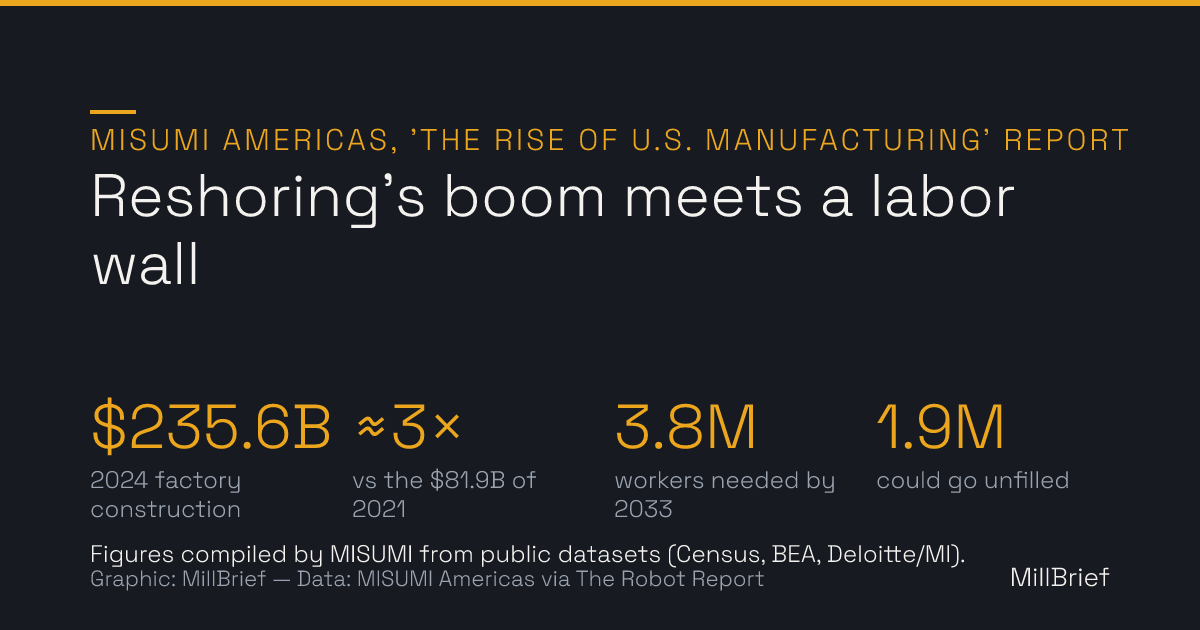
Why it matters: A components vendor has an interest in a rosy reshoring story, which is why the number to keep is the one that cuts against salesmanship: a 1.9-million-worker shortfall projection, and 40%+ annual turnover in some settings per MISUMI’s own SVP. That gap, not equipment prices, is what drives most small-shop automation math now, and it is why we treat scarce skilled labor as an input to the payback calculation, not a footnote: when you cannot hire a millwright, the value of a cell is the production you otherwise would not run. Meanwhile the flagship training bill’s 10-person annual cap is a useful calibration for reading policy headlines: the near-term fix for your plant remains whether automation pencils for you, trained on your own people.
Source: The Robot Report, July 21, 2026.
Vicarious Surgical shuts down after raising roughly $300 million
The Robot Report reports that Vicarious Surgical, a soft-tissue surgical robotics developer, is shutting down immediately following a July 21 investor vote, after failing to secure additional funding while on the NYSE delisting watch list. The company had raised approximately $300 million, primarily through a 2021 SPAC merger. The arithmetic of the endgame, from the company’s own disclosures: burn cut from $50 million a year in August 2025 to under $20 million by early 2026, a $7.3 million loss in Q1 2026, and $3.7 million in cash against $9 million in liabilities as of March 31, with CEO Stephen From saying another $10 million “would get us to the end of the year.” The design freeze it needed by end-2026 was not reached. All remaining staff (26 people as of March) lose their jobs.
Why it matters: Off-domain for a factory, directly on-domain for anyone who buys robots: $300 million of funding was not proof this vendor would exist next year. An industrial robot is a 10-plus-year asset whose spare parts, controller software, and service contract live or die with its maker, and the SPAC class of 2021 is still being sorted. So do balance-sheet diligence on any automation vendor whose hardware you will depend on (public filings if listed, or direct questions about runway and installed base if not), and write survival into the contract: source-code and design-file escrow, spare-parts commitments, and documented third-party serviceability. Our integrator questions and RFQ guide both carry sections for exactly this; the cheapest time to ask is before the purchase order.
Source: The Robot Report, July 21, 2026.
Sources
- Carney Says Canada Is Open To Talks After Trump Imposes New 50% Tariffs (Forbes, 2026-07-21)
- U.K.-based Humanoid secures $152M in Series A funding (The Robot Report, 2026-07-21)
- MISUMI Americas releases reshoring report, supports manufacturing training bill (The Robot Report, 2026-07-21)
- Vicarious Surgical officially shutting down (The Robot Report, 2026-07-21)