Industry Brief, July 29, 2026: US robot import ban, OTA updates, BAUHAUS unloading
Four items today: the US moves to ban imports of foreign-made mobile robots and power inverters (with a definition broad enough to reach most AMRs), the Scythe Robotics founders launch a company for the unglamorous problem of shipping software to robots in the field, a European retail giant puts container-unloading robots to work in Krefeld, and NORD stretches one VFD family across a 0.33-to-200 hp range. As always, we summarize in our own words and link to the original outlet; we report only what each source’s own reporting supports, and vendor performance numbers are labelled as exactly that.
The FCC bans imports of foreign “advanced robotic devices” and power inverters
The Verge reports (following earlier reporting by Reuters) that the FCC announced an import ban on “advanced robotic devices” and power inverters made in foreign countries. The agency says the ban covers “mobile” robots such as humanoid and quadruped models but is not limited to robots that walk; its FAQ defines an advanced robotic device as a machine capable of “locomotion, obstacle avoidance, navigation, or movement on the ground,” carrying a sensor that perceives its surroundings and a chip for network connectivity, and weighing more than 4.4 pounds including any docking station. The FCC says the move isn’t aimed at one country, but The Verge notes the practical weight falls on China, both in robots and in inverters, where it names Sungrow and the already-blacklisted Huawei. The mechanics matter for buyers: existing products already in the US are exempt and can keep operating; new imports need a waiver, whose application requires a detailed plan to begin manufacturing in the US but, as The Verge points out, no security improvements to the device itself; sources tell Reuters the FCC “is expected to exempt many non-Chinese suppliers.” A separate waiver allows security and compatibility updates for existing devices through January 1, 2029.
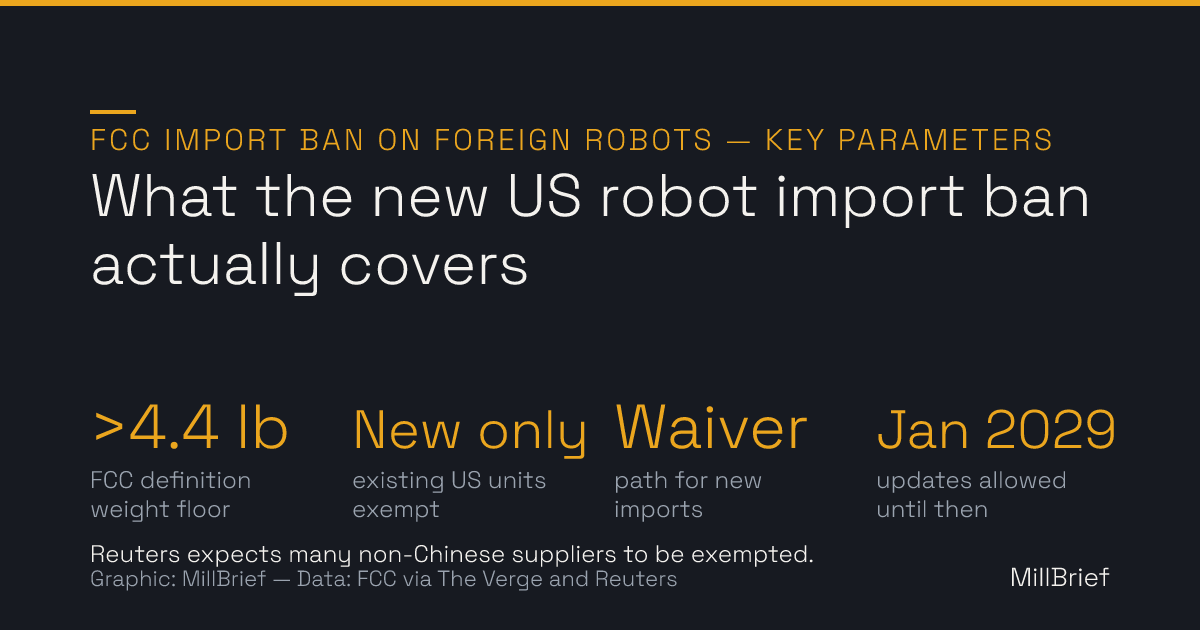
Why it matters: Read the definition like a procurement engineer: ground mobility plus environment sensors plus network connectivity over 4.4 pounds describes essentially every AMR, AGV, and mobile cobot base on the market; that reading is ours, but it follows directly from the FCC’s own criteria. If you run or are quoting mobile robots with foreign-made hardware, three questions belong in the next vendor conversation: where is the unit actually manufactured, does the vendor have (or need) a waiver for continued US imports, and what is the committed update and spare-parts path after January 2029? Your installed fleet is safe; your expansion and your spares pipeline may not be, and a fleet you cannot expand or patch is a stranded asset, the same vendor-continuity exposure we tell readers to write into contracts via our integrator questions and to price via the hidden-costs checklist. Country-of-origin and waiver status just became legitimate RFQ line items. The inverter half touches any plant with solar or energy-storage projects, too.
Source: The Verge, July 28, 2026.
Scythe’s founders launch Agency Tool Co. to fix robot software updates
The Robot Report covers the launch of Agency Tool Co. by Jack Morrison and Davis Foster, co-founders of Scythe Robotics. Their first product, ATC Deploy, ships software updates to deployed robots while working with whatever the customer already uses: their own OS image, Docker/OCI containers, or plain file trees. The pitch is that what looks like a solved problem (“everyone installs software”) is not, at fleet scale: today teams manage script piles to copy software, switch versions, restart services, and validate against corruption, and field robots sit on “straw-like” LTE or 3G links (or, for undersea and satellite robots, connections measured in bits) and power off at unpredictable times. Launch partners span the maturity curve: Burro (750+ agricultural robots in the field), Gather AI (drones), and Tempo (grinding machines, early deployments). Next on the roadmap is ATC Build, hosted embedded compute for continuous-integration testing; full rollout of Deploy is expected “in the next few months.”
Why it matters: When you buy a robot you are also buying its software pipeline, and this launch is a reminder that even robotics vendors find updates hard enough to pay a specialist. Turn that into diligence: ask any AMR or cell vendor how updates reach your machines, what happens when one fails mid-install on your network, whether updates require a maintenance window or a technician visit, and who validates that a patch doesn’t change cycle times. Those answers are recurring cost and downtime (hidden-costs territory), and after this week’s FCC news (above), the update pathway is also a compliance question, not just a convenience. A maturing third-party tooling layer is good news for buyers overall: it is what turning robots from projects into products looks like.
Source: The Robot Report, July 28, 2026.
BAUHAUS automates container unloading at its Krefeld warehouse
Robotics Tomorrow carries XYZ Robotics’ announcement (a vendor press release, and we read it as one) that its RockyOne and RockyOne SE mobile manipulation robots now run goods receiving at the BAUHAUS central warehouse in Krefeld, Germany. Per the release: RockyOne drives into shipping containers to unload loose, mixed-size cartons, a barcode station sorts them in real time, and RockyOne SE builds pallets to customer-defined patterns. The site context is real enough (BAUHAUS operates 290+ home-improvement centers across 19 countries, and Krefeld handles thousands of inbound shipments a day across more than 10,000 SKUs), and the task is one of warehousing’s genuinely nasty ones: repetitive lifting in confined, hot containers, with the turnover and injury rates to match. The customer quote supplied in the release (“the system has run reliably around the clock without manual intervention”, Torsten Winter, VP Operations, BAHAG/BAUHAUS AG) is an endorsement, but note what the release does not contain: no throughput figures, no exception rates, no cost or payback numbers.
Why it matters: Container devanning keeps showing up in deployments because it scores exactly the way a good first automation target should: ergonomically brutal, chronically hard to staff, and repetitive enough to automate; the labor case can carry the project even before throughput gains. If you receive containers of mixed cartons, this category is now worth a serious look. But procure it on the numbers the press release leaves out: cartons per hour against your manual baseline, exception and damage rates on your carton mix (odd shapes, damaged boxes, polybags), floor-space and dock changes, and what happens at the barcode station when a label won’t read. Those belong in a structured pilot with acceptance criteria, the same integrator discipline as any cell, applied to a newer category.
Source: Robotics Tomorrow (XYZ Robotics press release), July 27, 2026.
NORD stretches one compact VFD family from 0.33 to 200 hp
The Robot Report covers NORD Drivesystems’ expansion of its NORDAC PRO SK 500P variable-frequency-drive series: four new frame sizes (ten total) take the family to 200 hp, from 0.33 hp at the bottom. Per the company: a book-style form factor installs side-by-side without gaps to save cabinet space; drives run both three-phase asynchronous motors and IE5+ permanent-magnet synchronous motors; advanced versions add a multi-protocol Ethernet interface, USB parameterization that works without mains power, and a microSD slot for moving parameter sets between drives; SK 510P and up offer integrated functional safety (STO, SS1); and a Bluetooth stick plus the free NORDCON software provide wireless commissioning and diagnostics. All characterizations are the vendor’s.
Why it matters: VFDs are the least glamorous line on an automation quote and one of the most numerous: conveyors, pumps, fans, mixers, the production line’s supporting cast. One family covering 0.33-200 hp is mostly a maintenance story: common spares, one software tool, and parameter sets that copy between drives via SD card cut the engineering hours and the spares shelf that multi-vendor drive estates quietly accumulate. Integrated STO/SS1 can also displace external safety relays and their wiring (worth asking your panel builder to quote both ways). None of this changes whether a project pencils, but drive standardization is a cheap lever on the hidden costs side of the ledger when you are speccing a new line anyway.
Source: The Robot Report, July 27, 2026.
Sources
- The US is banning foreign robots (The Verge, 2026-07-28)
- Agency Tool Company wants to make OTA software updates easier (The Robot Report, 2026-07-28)
- BAUHAUS Partners with XYZ Robotics to Automate Its Entire Goods Receiving Process (Robotics Tomorrow (XYZ Robotics press release), 2026-07-27)
- NORD expands compact NORDAC VFD family to 200 hp (The Robot Report, 2026-07-27)