Industry Brief, July 30, 2026: Robot-ban reactions, ABB buys Rotork, Renault's Skypods
Four items today: the industry’s first considered reactions to the US robot import ban we covered yesterday (and they split sharply along commercial-interest lines), ABB writes a $5.5 billion check for flow control while its robotics arm heads to SoftBank, Renault publishes the kind of before-and-after warehouse numbers vendors usually keep vague, and KUKA’s new AI orchestration platform goes “live” in a plant KUKA itself owns. As always, we summarize in our own words and link to the original outlet; we report only what each source’s own reporting supports, and vendor numbers are labelled as exactly that.
Robot-ban reactions: read each expert’s interest before their quote
The Robot Report gathered reactions to the FCC’s import restrictions on foreign “advanced robotic devices,” and added mechanics that matter beyond what we covered yesterday: conditional approval can come via the Department of War or Homeland Security, models that already hold FCC equipment authorization are unaffected (along with devices already acquired), federal purchases are exempt, and software updates for foreign-supplied systems can be approved by waiver. The Commerce Department is separately considering tariffs on imported robotics and industrial machinery. The reactions sort by position on the board: Standard Bots CEO Evan Beard (whose company sells US-made robots and says it lobbied for “exactly this kind of action”) calls it “one of the strongest technology-security actions in modern U.S. history.” Robert Little (ex-Novanta robotics strategy chief) grounds the security case in specifics: researchers found a backdoor in Unitree robots and models transmitting data to servers in China without owners’ knowledge. The skeptics are equally concrete: STM’s Georg Stieler notes China holds more than 90% of rare-earth magnet refining (a countermeasure lever), and that years of DJI restrictions still produced no competitive US consumer-drone maker. UC San Diego’s Henrik Christensen warns the ban is “potentially much wider than China” and that “Canadian [and] European robots could be impacted… very bad news for the industry in general.” Interact Analysis’ Rueben Scriven expects limited short-term impact (most Chinese humanoid makers haven’t entered the US) but says the policy could slow US commercialization by removing the low-cost platforms that were educating the market. Context figures cited in the piece: China has more than half of world industrial robot installations and 80-90% of humanoid shipments to date.
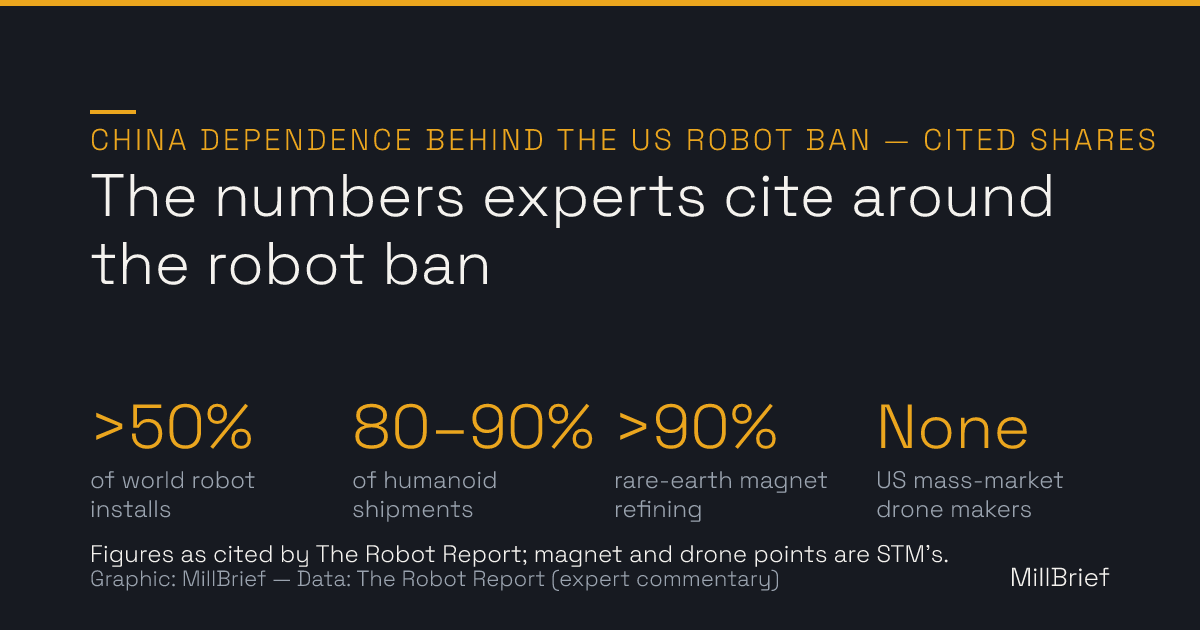
Why it matters: Two practical refinements to yesterday’s guidance. First, the exemptions are broader than the headline: gear that already holds FCC equipment authorization stays importable, so the right vendor question is not “are you foreign?” but “does the specific model on my quote hold FCC authorization, and does your roadmap model have it?” Put it in the RFQ alongside country of manufacture. Second, note that every reaction above tracks the speaker’s commercial position: the domestic vendor applauds, the Asia-focused advisor warns, the analyst hedges. Do the same discount when your integrator or vendor explains what the ban means for your project; the questions-to-ask discipline exists precisely because every party you’ll ask has a book to talk. The upstream point is the sleeper: if magnets, reducers, and actuators still come from China, a “US-made” robot’s lead time is not immune to the next round of countermeasures.
Source: The Robot Report, July 29, 2026.
ABB pays $5.5B for Rotork, and swaps robots for flow control
Engineering.com carries ABB’s announcement (effectively the company’s own release, and we read it as one) of a recommended cash offer for Rotork, the UK maker of electric actuators and intelligent flow-control systems: 503 pence per share, roughly a 60% premium to the three-month average, an enterprise value around $5.5 billion (about 5.3× Rotork’s 2025 sales and 19.5× EBITDA by ABB’s own math), closing expected in the first half of 2027 subject to shareholder and regulatory approval. Rotork (roughly $1 billion in 2025 revenue at a 24.6% adjusted operating margin, 8% average organic growth 2022-2025) would run as a separate division inside ABB’s Automation business. The other half of the portfolio story is in the financing note: ABB’s already-signed divestment of its Robotics business to SoftBank is expected to bring about $4.8 billion in the second half of 2026: ABB is, in effect, selling robot arms and buying valves and actuators.
Why it matters: If you buy Rotork actuators or ABB field devices, the near-term risk is low (the deal doesn’t close until 2027 and ABB says Rotork stays a separate division with its UK manufacturing base), but pricing leverage shifts when an independent supplier becomes part of a portfolio, so lock multi-year pricing and support terms while Rotork still negotiates as Rotork. The bigger signal for robot owners is the SoftBank half: ABB, one of the big four robot makers, is exiting robot manufacturing. Nothing about installed ABB robots changes tomorrow, but ownership transitions are exactly when service organizations, spare-parts pricing, and controller roadmaps get re-examined; the vendor-continuity diligence we keep in the integrator questions (escrow, spares commitments, third-party serviceability) applies to $100K robots from $50B companies too.
Source: Engineering.com (ABB announcement), July 29, 2026.
Renault’s spare-parts warehouses: order processing from 120 to 15 minutes
Robotics & Automation News details Renault Group’s goods-to-person rollout with Exotec (company-supplied numbers, but unusually specific ones). At the modernized Villeroy warehouse in France, the Skypod system runs 167 robots, 14 picking stations, and 67,000 storage bins on 10.8-meter racks, processing 4,130 bins an hour across more than 1.6 million stored items. The headline results, per Renault: order processing time down from 120 minutes to 15, a 4× productivity improvement in the covered perimeter targeting 20,000 order lines a day, and reduced reliance on temporary staff. Two details worth more than the headline: the robots came after a full network redesign (Renault closed its aging Cergy site, opened a new international facility at Puiseux, and specialized Flins for heavy parts), and the Villeroy install list includes the unglamorous supporting cast: carton formers, closers, label and RFID printers, a wrapping machine, thirty ergonomic grippers. The partnership is now expanding to Germany with 89 Skypods at a new Brühl warehouse.
Why it matters: This is what a credible automation case study looks like (a named site, system counts, a before/after on one metric), and the two buried lessons transfer to any operation holding parts inventory. First, sequence: Renault fixed its network and slotting before automating; robots amplify a good process and concretize a bad one, which is the what-to-automate-first discipline at warehouse scale. Second, budget shape: count the ancillary equipment in that install list: the goods-to-person core is maybe half the project; carton handling, printing, and ergonomics are the hidden-costs line items that turn a robot quote into a project price. Still, treat 120→15 minutes and 4× as the vendor-and-customer’s own numbers on their chosen metrics: your part mix, order profile, and building will not be Villeroy’s.
Source: Robotics & Automation News, July 29, 2026.
KUKA’s AMP platform goes “live”, in KUKA’s own plant
Robotics Tomorrow carries KUKA’s announcement (a vendor press release) that KUKA AMP (Automation Management Platform), its orchestration layer for connecting existing automation with AI-powered systems, is now live at KUKA Toledo Production Operations in Ohio. The venue is genuinely impressive and genuinely KUKA’s own: KTPO, a wholly owned KUKA subsidiary, builds the body-in-white for every Jeep Wrangler sold worldwide (since 2006) and the Gladiator (since 2019): over 300 vehicle bodies a day, roughly one every two minutes, with 285 robots and more than 60,000 connected devices in a 335,000-square-foot facility. The stated goal is the right one: squeeze more from existing assets rather than replace them, by pooling dormant production data and coordinating across workflows. But read the company’s own language closely: KUKA’s software chief describes “testing the alpha version of KUKA AMP at KTPO” in “a familiar environment for us” to “accelerate improvements.”
Why it matters: “Live in a major automotive plant” and “alpha version deployed at our own subsidiary” are both accurate, and the second is the one to price. Orchestration platforms that promise AI value on top of your existing line without ripping out assets are the most buyer-friendly framing of Physical AI yet, and a vendor proving its platform in its own high-volume plant before selling it to you is the honest sequence. But an alpha at the vendor’s own facility is a reference visit, not a reference customer. If this category reaches your roadmap, the questions are the classic platform ones: what does it cost to connect your mix of legacy controllers, who owns the production data it aggregates, what happens to the connected plant if you stop paying, and can it show measured payback at a customer that doesn’t share the vendor’s logo.
Source: Robotics Tomorrow (KUKA press release), July 29, 2026.
Sources
- Experts react to FCC limits on U.S. imports of new humanoid and mobile robots (The Robot Report, 2026-07-29)
- ABB agrees to acquire Rotork for automation portfolio (Engineering.com (ABB announcement), 2026-07-29)
- Renault Group expands Exotec warehouse automation across France and Germany (Robotics & Automation News, 2026-07-29)
- KUKA AMP Goes Live in North America Automotive Production (Robotics Tomorrow (KUKA press release), 2026-07-29)