Industry Brief, August 29, 2026: Grip, grit, and the robot in the server room
A quietly useful day. The biggest warehouse-robot fleet operator explains what actually limits robotic picking, a farm-equipment giant’s earnings show what the autonomy line is really for, and Wired gets inside the least glamorous robot deployment imaginable: pressing power buttons in server halls. Our own words, links to the original outlet, vendor numbers labelled as vendor numbers.
Locus on picking: reliability first, speed later
The Robot Report interviews Locus Robotics’ SVP of robotic grasping (the former CEO of Nexera, the gripper company Locus acquired) on what it takes to make its Array mobile manipulator pick like its AMR fleet drives (6 billion-plus picks assisted, by Locus’s count). The candor is the story. On grippers: suction handles “60 to 70 percent” of warehouse picking on its own; the hard remainder (porous polybags, cloth, odd shapes) is why Nexera’s combined suction-plus- pinch soft gripper matters. On priorities: reliability and pick quality come before speed, because product damage, double picks, and mispicks “eat into a customer’s costs quickly” while rarely appearing in vendor marketing. And on what’s still missing industry-wide: robust tactile sensing that doesn’t degrade with use, a gap he argues simulated training data won’t close. Array currently ships with its original suction gripper; the integrated Nexera hardware has no announced customer date yet.
Why it matters: When a vendor quotes you picks-per-hour, this interview is the counter-script: ask for the mispick rate, the damage rate, and the double-pick rate at a comparable SKU mix, because those failure modes land in your hidden-cost column, not the vendor’s brochure. The 60-70 percent suction figure is also a useful sanity check: if your SKUs sit mostly in the easy bucket, you may not need the exotic gripper at all.
Source: The Robot Report, August 28, 2026.
China’s carmakers are all-in on humanoids now
TechCrunch surveys the stampede: after XPeng’s robotics unit raised over $900 million at a $6.3 billion valuation (the round we covered in Tuesday’s brief), Chery’s robotics arm AiMOGA is reportedly preparing an IPO, BYD unveiled a humanoid called Xiao Di, and Changan, GAC, Li Auto, SAIC, and Seres all have humanoid programs. Per the Wall Street Journal, XPeng’s founder and co-president put roughly $100 million of their own money into the round. The analyst quote frames the logic: razor-thin margins in cars, so “robots look much more promising.” The Western counterpoint is further along in factories: Hyundai plans Atlas humanoids in its Georgia plant this year, targeting parts-sequencing work by 2028, and Mobileye bought Mentee Robotics for $900 million earlier this year.
Why it matters: Carmakers bring genuine manufacturing muscle to humanoids (“they have all the hardware,” as the analyst puts it), which means unit costs will fall faster than the last hype cycle assumed. But last week’s market repricing showed what the sector does to overpromising. For buyers the near-term signal is Hyundai’s: a named factory, a named task, a dated deployment; that’s the template worth tracking, not valuation records.
Source: TechCrunch, August 28, 2026.
Deere’s quarter: equipment down, tech thesis intact
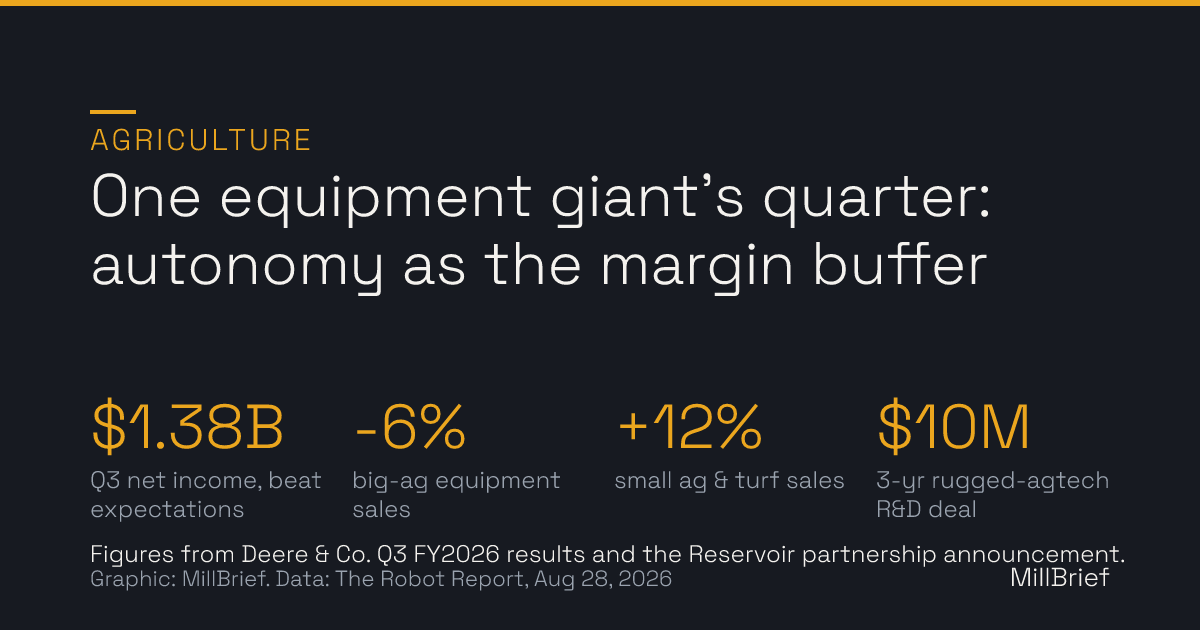
Deere & Co. posted Q3 net income of $1.379 billion ($5.10 a share), beating expectations even though its Production and Precision Agriculture division (home of the autonomy and smart-spraying portfolio) saw sales fall 6 percent and profit fall 9 percent on lower shipment volumes. Small Ag and Turf went the other way: sales up 12 percent, profit up 28 percent. Deere raised full-year guidance to $4.75-5 billion, which The Robot Report reads as a bet that fiscal 2026 is the trough of the farm-equipment cycle, with high-margin autonomous capabilities and connected-fleet software cushioning margins until replacement buying resumes. Alongside the update: a $10 million, three-year R&D partnership with Reservoir, the Salinas-based agtech network Deere backs, aimed at field-hardening AI systems for high-value crops.
Why it matters: This is what “software-defined equipment” looks like on an income statement: when machine sales sag, the vendor leans on subscription and autonomy margins, which is exactly why per-acre and per-hour tech fees keep creeping into quotes. If you’re buying connected equipment in any sector, model the recurring fees over the machine’s life, not the sticker, the same payback discipline we apply to factory gear.
Source: The Robot Report, August 28, 2026.
Meta is quietly testing robots in its server halls, and hitting familiar walls
Wired reports, from current and former data-center workers, that Meta is piloting robots to plug in cables, reset servers, and power-cycle equipment across its facilities (using arms and platforms from Kinova, ABB, and startup Watney Robotics), with Microsoft, Google, and Amazon running parallel efforts. One worker estimates a successful cable-swap bot could absorb up to 80 percent of some workloads (a worker estimate, not a company figure; Meta declined to comment on the testing). The failure details are the valuable part: an inventory robot that can’t tell a red fault light from a green one because its camera sees only grayscale, wheels that snag on floor cables, battery downtime workers complain about, and an internal admission that racks “designed for human hands” (five-minute repairs) will take years to redesign around machines. Meanwhile the simplest deployed robot is essentially a remote-controlled finger that presses power buttons.
Why it matters: If the world’s richest automation buyer, on its own premises, is blocked by grayscale cameras and cable clutter, that’s the brownfield lesson in miniature: environment, not robot capability, is usually the binding constraint, the pattern behind most failed automation projects. The transferable move is Meta’s sequencing: start with the dumbest reliable machine (the button-presser), instrument everything, and redesign the environment before scaling the ambitious robots.
Source: Wired, August 28, 2026.
Sources
- How Locus is getting a grasp on one of robotics biggest challenges: manipulation (The Robot Report, 2026-08-28)
- Chinese automakers are following Tesla's bet that robots are the next big profit machine (TechCrunch, 2026-08-28)
- Deere faces headwinds in Q3 update and announces Reservoir R&D partnership (The Robot Report, 2026-08-28)
- Inside Meta's Push to Put Robots to Work in Data Centers (Wired, 2026-08-28)