Industry Brief, August 26, 2026: Humanoid reality week: records, flames, and $900M
Today’s items all circle one question: how far are humanoid robots from doing paid work? A market crash, a sports spectacle, a mega-raise, and a quiet job-site deployment each give a different answer, and the last one is the only story where robots are earning their keep this year. Our own words, links to the original outlet, vendor numbers labelled as vendor numbers.
Physical AI’s “GPT-2 era”: the market just repriced the gap
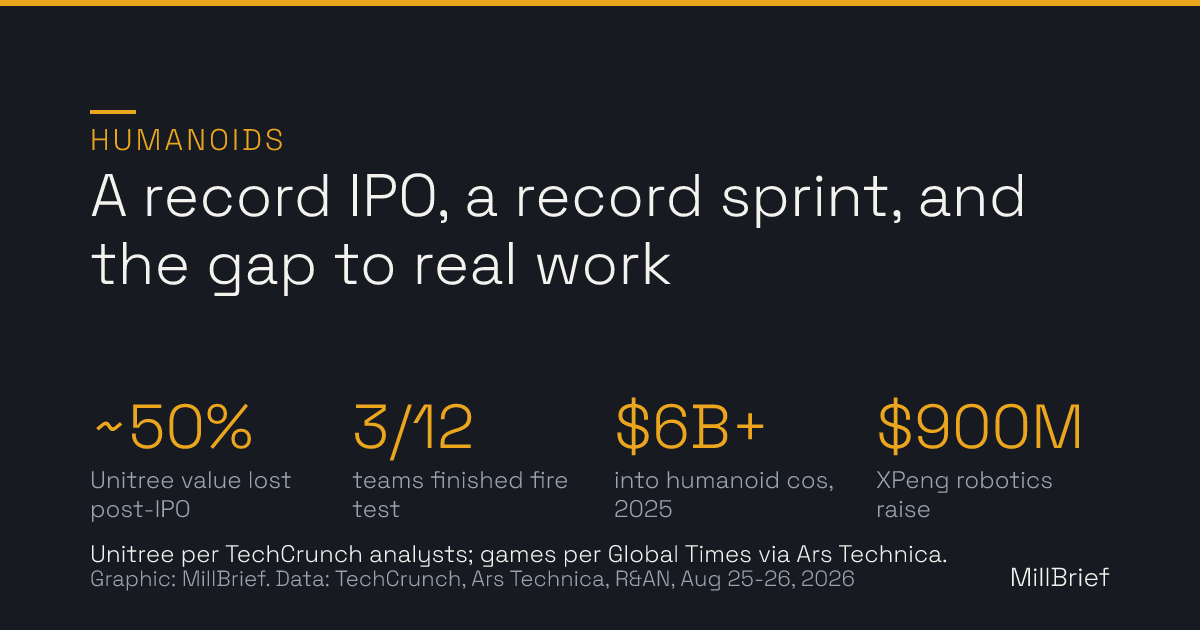
TechCrunch reports from Actuate, the physical-AI developer conference (1,500 attendees this year, tripled since 2023; the organizer Foxglove’s own count), and pins the week’s defining event: Unitree, China’s leading robot maker, was valued at $66 billion after listing on China’s NASDAQ equivalent, then lost nearly half that value this week. The analyst diagnosis TechCrunch quotes is blunt: the robots’ bodies keep improving, but they still lack the know-how to do value-creating work. One founder’s framing: physical AI is in its “GPT-2 era,” pre-ChatGPT, short on training data above all. The sharper split is strategic. Genesis AI’s CEO argues nobody pays for a general-purpose robot at an 80 percent success rate, and points at the companies shipping today: task-specific robots building solar farms, working industrial sites, and running excavators, while general-purpose humanoids stay in the lab. The counter-argument, from Wayve’s CEO: build the general brain anyway, because a narrow vertical built on GPT-2-class models “will get crushed by the company building on GPT-4.”
Why it matters: If you’re evaluating robotics vendors, this is the frame to bring to every “general-purpose” pitch: ask what task, at what success rate, measured over how many trials, the same evidence standard we apply in our RFQ guide. The robots producing value in 2026 are boring, single-task, and measurable, which is also what the payback math rewards.
Source: TechCrunch, August 26, 2026.
At the robot games, the sprints impress and the chores tell the truth
Ars Technica’s wrap-up of the second World Humanoid Robot Games (Beijing, August 22-26) is the best reality-gap document of the week. The headline feats are real: robots beat the human 100-meter record and the standing high jump, genuine progress in whole-body control, a Purdue robotics researcher tells Ars. So are the failure modes: sprinters that cannot stop after the finish line, crash into barriers, break at the waist in showers of sparks, or catch fire. Each robot was engineered for exactly one event. The events that matter for buyers were the boring ones, and there the results invert: in laundry-washing and room-cleaning scenarios robots lagged well behind human working speeds, only 3 of 12 teams completed an outdoor firefighting challenge (per Chinese state outlet Global Times, which Ars cites), and many competitors were openly teleoperated by humans (allowed under the rules, at a scoring penalty). Investors have put more than $6 billion into humanoid robot companies in 2025 alone, Ars notes.
Why it matters: A robot that runs faster than Usain Bolt but can’t stop, run twice, or fold a shirt at human speed is a precise picture of where autonomy stands: impressive single-task control, weak reliability and generality. For a plant buyer the transferable test is the researcher’s suggestion: make it do the same task ten times. That’s a repeatability question, and it’s the one demo condition vendors don’t volunteer.
Source: Ars Technica, August 25, 2026.
XPeng raises $900M for humanoids anyway
The capital keeps arriving regardless. Robotics & Automation News reports XPeng, the Chinese EV maker, raised more than $900 million for its robotics business at a post-money valuation above $6.3 billion, led by IDG Capital with strategic money from Tencent and Alibaba. The company calls it the largest single-round private raise in China’s embodied-AI industry (its own claim). The vendor spec sheet: the IRON humanoid has 76 degrees of freedom (21 per hand) and runs its physical-AI model on board via three in-house Turing chips totalling 2,250 TOPS, which XPeng says enables autonomy without remote control (worth reading against the teleoperation caveat in the games item above). The stated plan: mass production by the end of 2026, first deployments in XPeng’s own stores and campuses, and commercial deliveries in China and overseas in 2027. All of it is company-stated and pre-revenue for the robotics unit; the EV-manufacturing carry-over argument is plausible but unproven at humanoid scale.
Why it matters: The same week the public market cut Unitree in half, private investors wrote the biggest embodied-AI check China has seen (per the company). Both can be rational: the bet is that manufacturing muscle plus onboard compute closes the work-capability gap before the money runs out. For buyers the practical note is the deployment sequence: even the vendor’s own plan starts with its own stores, not your factory, consistent with the staged-rollout pattern in yesterday’s shipyard humanoid item.
Source: Robotics & Automation News, August 26, 2026.
Meanwhile, on actual job sites: robots placing solar arrays
The counterpoint to all of the above is the week’s least flashy story. Burns & McDonnell (a tier-one engineering, procurement and construction firm) signed a strategic partnership with Gritt to deploy AI-powered robotics on utility-scale solar construction, after a year of testing at multiple live sites. Gritt’s approach is the anti-humanoid: intelligent systems that attach to standard construction equipment crews already know, handling repetitive tasks like placing and assembling solar arrays, pouring concrete, and laying rebar. The task profile is textbook automation economics (“lifting 80-pound modules day after day,” as Burns & McDonnell’s renewables director puts it) in exactly the outdoor, variable conditions factory robots avoid. Gritt is also the company TechCrunch’s conference piece names as one of the task-specific players actually out of the lab. Capability claims are the partners’ own; no deployment counts or productivity figures were disclosed.
Why it matters: This is what “robots at work in 2026” actually looks like: a bounded, repetitive, physically punishing task; retrofit intelligence on familiar equipment instead of a new form factor; and a labor-shortage driver, the same shortage math we keep seeing in welding and warehousing. If you’re weighing automation, note which pattern keeps winning: automate the task, not the worker’s shape.
Source: Robotics & Automation News, August 26, 2026.
Sources
- Robot brain builders are pushing out of their GPT-2 era (TechCrunch, 2026-08-26)
- World humanoid robot games show runners breaking records, bursting into flames (Ars Technica, 2026-08-25)
- XPeng's new robotics business raises $900 million at $6.3 billion valuation (Robotics & Automation News, 2026-08-26)
- Burns & McDonnell and Gritt partner to deploy AI-powered robots on solar construction sites (Robotics & Automation News, 2026-08-26)