Industry Brief, September 25, 2026: 5 million robots, AI bin picking, robots and doors
Today’s lead is the annual count. The International Federation of Robotics has published its World Robotics 2026 figures, and the United States is now the second largest market for industrial robots. After that: an integrator adding an AI vision system for bin picking, a quadruped inspection robot that can now badge its way through locked doors, and a motion-control vendor arguing that engineering hours, not component prices, decide what a machine really costs. As always, the writing is ours, each item links to the original outlet, and vendor numbers are labelled as vendor numbers.
The IFR counts 5 million factory robots, and the U.S. is now the second largest market
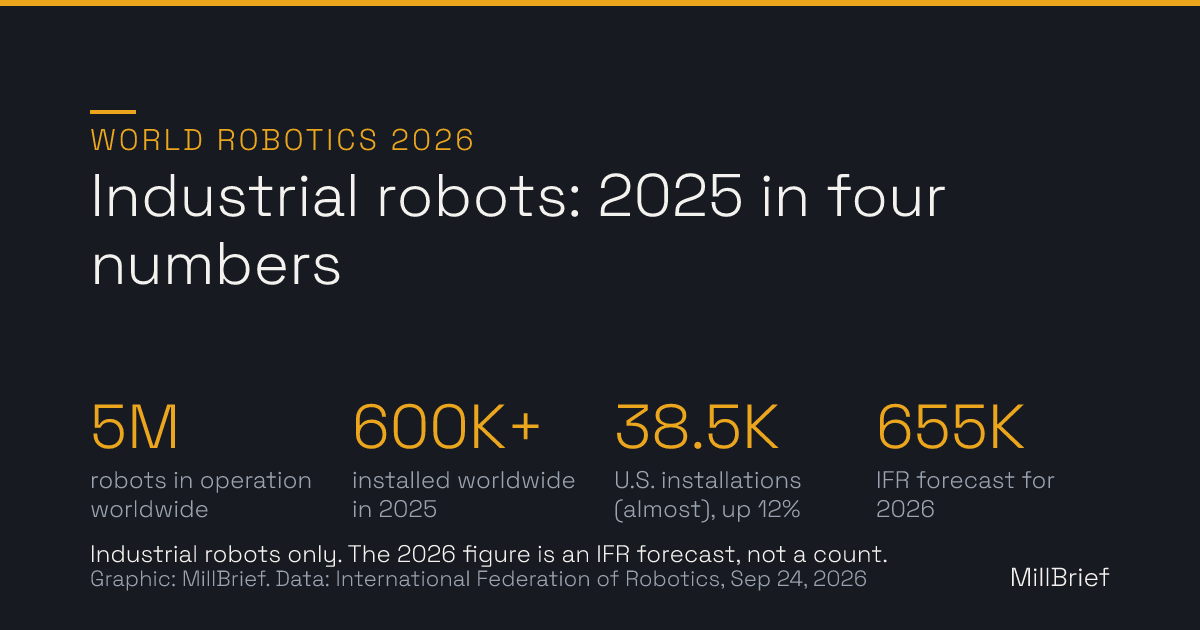
The International Federation of Robotics (IFR) says the number of industrial robots in operation worldwide rose 9% to a record 5 million in 2025, on the back of an 11% rise in installations: factories installed more than 600,000 new robots during the year. China installed 354,000, up 20%, for 59% of the world total, and Chinese robot makers took 55% of their home market (57% in 2024). The United States passed Japan to become the second largest market, with installations up 12% to almost 38,500, the third highest U.S. figure the IFR has recorded. Japan fell 19% to 36,219. Our arithmetic: China installed roughly nine times as many robots as the U.S. (354,000 divided by 38,500 is about 9.2).
The final U.S. figure is slightly above the IFR’s preliminary estimate in June of 38,000 units, up 11%. Elsewhere in the Americas, Mexico fell 7% to fewer than 5,200 (its third year of decline), Canada rose 5% to almost 4,000, and Brazil jumped 38% to almost 4,300, which the IFR says was most likely driven by Chinese carmakers investing there.
Europe is the slow region. In a separate IFR release carried by Robotics Tomorrow, installations in the EU fell 11% to 60,500, while Asia rose 14% to 457,315 and the Americas rose 14% to 57,044. Germany installed 24,800, down 8% but still 41% of the EU total. The EU’s operating stock reached 712,000 robots, up from 390,000 in 2015. The IFR forecasts global installations of 655,000 in 2026 (up 9%) and 806,000 in 2029. The Robot Report has the same figures, with comment from Jon Quick, CEO of Launchpad Build AI.
Why it matters: These are counts of robots installed, not evidence that any particular project pays back. Their use to a small or mid-size plant is context: the U.S. market is growing, and the IFR itself credits easier programming and system integration with bringing down deployment costs. A busier market can also mean more buyers competing for integrator time, so get delivery and start dates written into the quote. Your own case still rests on your own parts and hours; start with automation ROI and payback.
Sources: International Federation of Robotics, September 24, 2026; Robotics Tomorrow (IFR release), September 24, 2026; The Robot Report, September 24, 2026; International Federation of Robotics, June 18, 2026.
Shelley Automation adds Eureka’s AI vision system for bin picking
Shelley Automation and Eureka Robotics have announced a partnership to build Eureka’s AI Vision System into Shelley’s automation systems, aimed at bin picking, according to a release on Robotics Tomorrow. The Eureka system combines a 3D camera, a controller and software. According to the release, it rests on a model trained on millions of parts, its software is accessible to entry-level users, and it cuts deployment time by months compared with conventional vision projects. The release also says the system works with any robot arm, models can run locally, engineers can train new parts in-house, and there are no subscription fees.
The release says the system is in production at Toyota, Pratt & Whitney and Subaru and has completed more than 30 million picks. Those are Eureka’s figures. Shelley’s Selman Qadri, vice president of sales and marketing, said customers get bin picking “without the complexity that often held back vision projects”. No prices were given. The two companies will show the system on Eureka’s booth (S23055) at FABTECH, October 21 to 23.
Why it matters: Picking jumbled parts out of a bin is one of the jobs most likely to look easy in a demo and struggle on the floor. “No subscription fees” and “models run locally” are commercial terms worth having in writing, because vision software licences can be an ongoing cost. Before buying, ask for a test on your own parts, in your own bins, and ask for the pick success rate, the cycle time and what happens when a pick fails. If you go to FABTECH, bring your awkward parts. Our RFQ guide shows how to write those tests into a quote.
Source: Robotics Tomorrow, September 24, 2026 (company press release).
ANYbotics teaches its inspection robot to get through locked doors
ANYbotics, the Zurich company whose four-legged ANYmal robots do routine inspection in process industries such as energy, metals, mining and chemicals, has partnered with door and access company dormakaba and credential maker LEGIC Identsystems so the robot can pass through closed doors, The Robot Report reports. For unlocked doors, a radar sensor detects the robot and triggers a dormakaba ED 100 or ED 250 swing door operator retrofitted to the existing door. For secured doors, the robot carries a LEGIC credential and requests access from dormakaba’s exos system, which grants or refuses it based on predefined permissions; the robot logs each credential scan and passage. The company says the setup works on existing doors, meets indoor, outdoor and fire-rated specifications, and needs no structural changes.
GE Vernova tested the system for several weeks at its Whitegate power plant in County Cork, Ireland, where the companies say the robot completed its routes through controlled doors without manual intervention. The add-on is due for current deployments and future ANYmal hardware later this year; no price was given. Asked about people following the robot through a door, ANYbotics’ Jacob Euler-Rolle said the robot does not override a site’s anti-tailgating measures, so tailgating a robot triggers the same response as tailgating a person. He also claimed that fire doors place 30% to 50% of critical equipment in process plants behind restricted barriers.
Why it matters: Doors, lifts and fire barriers are where many mobile robot projects quietly grow, whether the robot has legs or wheels. If a mobile robot on your list needs to cross zones, ask who surveys and retrofits the doors, who pays for it, whether your fire and security teams must sign off, and what happens when a door fails. Those items belong in the hidden costs of automation.
Source: The Robot Report, September 24, 2026.
A motion-control vendor’s case for pricing engineering hours, not parts
In a column for The Robot Report, Allen Tubbs, a product manager at Kollmorgen (part of Regal Rexnord) who previously spent 19 years at Bosch Rexroth, argues that machine builders compare drives and controllers on torque, speed, power density and price, but that integration, commissioning and troubleshooting decide whether a machine is delivered on time. A cheaper drive, he writes, can cost more overall if it adds hours of configuring communications, writing custom code or chasing faults.
Mixing controllers, drives, motors, I/O and operator interfaces from different vendors adds work, he says, even with standards such as OPC UA. He points to three software areas that matter: quick configuration, support for the IEC 61131 programming languages, and good diagnostic tools. Such tools matter more now, he adds, because many facilities no longer have large teams of experienced engineers on hand. This is a vendor-authored piece, and near the end it names Kollmorgen as a supplier of the integrated motion products it recommends.
Why it matters: The argument holds even if you never choose a drive yourself. When you buy a machine or a cell, the commissioning hours and the tools your maintenance staff will use to find a fault are part of the price. Ask the builder for an estimate of commissioning hours, which diagnostic software comes with the machine, and whether the controls come from one vendor or several. Our guide to system integrator rates and the TCO calculator help put a number on those hours.
Source: The Robot Report, September 24, 2026 (contributed column by a Kollmorgen employee).
Sources
- Five Million Robots now Operate in Factories Globally (International Federation of Robotics, 2026-09-24)
- 5 million robots are now at work in factories worldwide, reports the IFR (The Robot Report, 2026-09-24)
- European Union's Industrial Robot Stock Hits Record 700,000 Units (Robotics Tomorrow (IFR release), 2026-09-24)
- US Robot Industry Returns to Double Digit Growth (International Federation of Robotics, 2026-06-18)
- Eureka Robotics and Shelley Automation partner to bring physical AI to North American manufacturing (Robotics Tomorrow, 2026-09-24)
- ANYbotics opens the door for inspections with ANYmal robots (The Robot Report, 2026-09-24)
- Why you should look beyond the spec sheet when choosing motion architecture (The Robot Report, 2026-09-24)