Industry Brief, September 27, 2026: Welders in demand, composites automation, tyre robots
Three stories today, all about the gap between the work that needs doing and the people available to do it. Data centre construction is hiring the welders, pipefitters and electricians that small plants also need, and one family-owned hose maker in Georgia is growing because of it. A Los Angeles startup says the way to automate carbon fibre parts is to choose materials and processes a robot can handle from the start. And a tyre-changing robot has left the lab for a working shop in Calgary, where it met dust, weather and dandelion seeds. As always, the writing is ours, each item links to the original outlet, and vendor numbers are labelled as vendor numbers.
Data centre builds are hiring the same welders and pipefitters that factories need
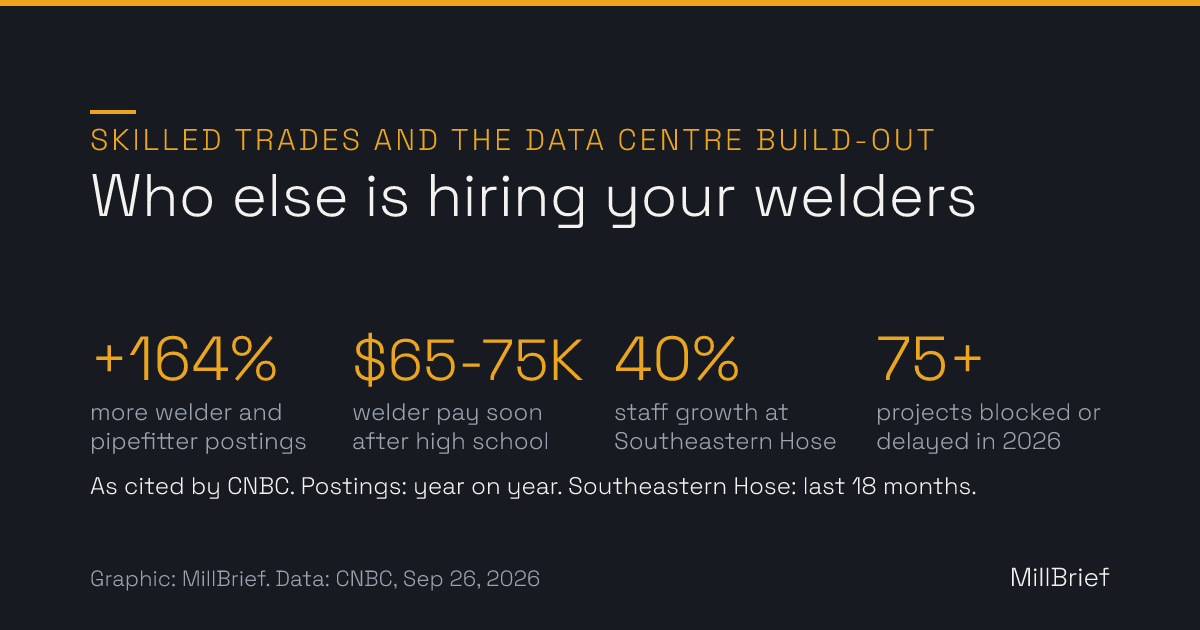
A CNBC report looks at how building data centres, and the grid and cooling infrastructure around them, is lifting demand for skilled trades. According to ZipRecruiter labour economist Nicole Bachaud, welders and pipefitters are the biggest blue-collar beneficiaries, with postings for those jobs up 164% year over year, though she said a small sample may be part of the reason. Maria Flynn of the nonprofit Jobs for the Future put apprentice-level technician pay at $40,000 to $60,000, and experienced electricians at more than $100,000. Rachel Lipson, founder of Harvard’s Project on Workforce, said welders can earn $65,000 to $75,000 a year soon after high school, with almost unlimited overtime.
The story includes a small manufacturer. Southeastern Hose, a family-owned maker of industrial hose and expansion joints in Bremen, Georgia (population 7,000), supplies parts used in data centre piping. Its vice president of operations, Trey Travis, told CNBC the company has grown significantly over the last 18 months, and CNBC describes a 150-person workforce that has grown by 40% in that time. The company hires through local trade schools and high schools, but Travis said even a top welder from the local trade school needs on-site training, because they have not seen that type of welding on that type of product before.
There is a counterweight. CNBC cites Data Center Watch as saying at least 75 data centre projects worth roughly $130 billion have been blocked or delayed this year, and notes a grid approval moratorium in Texas and a statewide ban on new data centres in New York. Lipson said many projects are already under way or approved, and Bachaud said planning, permits and construction can take months or years, so both expect any effect on trade jobs to arrive slowly.
Why it matters: If you employ welders, pipefitters or maintenance electricians, data centre contractors are now recruiting the same people, and in some regions they pay well. Two practical points. First, when you work out the payback on a welding cell or any other automation, use the wage you would have to pay to hire today, not last year’s figure; our automation ROI and payback guide shows where that number goes. Second, Travis’s point about training applies to robots too: someone has to program and maintain the cell, and that person is also in demand. Plan who that will be before you buy.
Source: CNBC, September 26, 2026.
A carbon fibre startup is designing its process around robots from the start
Helicon Industries, a Los Angeles startup, has come out of stealth with $16 million in seed funding led by AlleyCorp, The Robot Report reports. It is building automated systems to make composite parts, starting with carbon fibre, and aims to cut lead times from six months or more to two weeks. It is moving into a 36,000 square foot space in Torrance, California (about 3,345 square metres), and is hiring across engineering, robotics, manufacturing and operations.
Co-founder and CTO Edmundo Sanz-Gadea described the problem. Composite manufacturing is still largely manual, and handling flexible carbon fibre textiles is hard to automate. Companies can typically make 10 to 100 units by hand, he said, but when they win a contract for thousands, they cannot hire enough people. Many companies, in his account, buy flat carbon fibre sheets from overseas, cut them to shape and join them with fasteners, which creates a lot of assembly work.
Helicon’s answer is to pick materials and processes that are easier to automate, so a robot can reliably pick and place material, remove the finished part, and handle trimming and quality control. The company is aiming for cycle times under 15 minutes, compared with hours for traditional layup and autoclave processes. Sanz-Gadea also said Helicon’s materials offer higher stiffness than aluminium at 40% lower weight. These are the company’s goals and claims; it is still preparing for production and working toward aerospace and defence certifications.
Why it matters: The useful idea here is not carbon fibre. It is that Helicon changed the process so it would suit a robot, rather than trying to make a robot copy hand layup. The same thinking helps in any shop: if a task is hard to automate as it is done today, ask whether the part, fixture or material could change first. Our field note on the case against automating your worst process makes the same argument. And if you make composite parts by hand, note that a funded competitor is aiming at the high-volume end.
Source: The Robot Report, September 23, 2026.
A tyre-changing robot leaves the lab and meets dust, weather and dandelions
San Francisco startup PitPro Automation has installed its first automatic tyre-changing system at a Kal Tire location in Calgary, Alberta, TechCrunch reports. The company says the system can swap a full set of four tyres in under 15 minutes (our arithmetic: under about 3.75 minutes a wheel). It uses two robots, each roughly the size of an oven, that use sensors and a robotic arm to find and loosen the lug nuts, store them, pull each wheel and fit a new or rotated tyre.
Founder and CEO Jeremy Conrad told TechCrunch that tyre shops face a major labour shortage and that workers who are hired often leave within a few months to a year. One shop manager, he said, had to get permission to pay more after a Panda Express opened across the street and took about half their staff. PitPro is targeting chains rather than small shops because their bays have standard layouts, and mechanics can still use the bay for other work, which Conrad thinks makes shops more willing to try it.
The move to a real site brought problems the lab did not. Tyre shops usually work with the bay doors open, exposing the robots to dust, debris and weather, and PitPro had to make sure both the system and its sensors kept working. At one point the Calgary robots were almost covered in dandelion seeds; Conrad said that will not be a problem for them.
Why it matters: Two lessons carry over to a factory. First, the environment is part of the specification: open loading doors, dust, coolant mist and temperature swings all affect sensors and reliability, so tell your vendor about them in writing and ask how the system was tested. Our questions to ask a system integrator cover this. Second, PitPro chose sites with standard layouts and let the bay stay usable for other work. If your floor space is tight, ask whether a cell can share space with manual work rather than taking it over.
Source: TechCrunch, September 23, 2026.
Sources
- The blue-collar AI job market is booming. Will data center backlash make it go bust? (CNBC, 2026-09-26)
- Helicon brings automation to high-volume composites manufacturing (The Robot Report, 2026-09-23)
- PitPro's first tire-changing robot goes live in Canada (TechCrunch, 2026-09-23)