Industry Brief, September 29, 2026: ABB on tablets, pallet shuttles, harness robots
Four stories today about the practical side of owning automation. ABB has released a safety interface that lets you run its robots from your own tablet or PC. A Shanghai maker of four-way pallet shuttles has launched in the Americas. A German startup describes how its robots insert tiny crimps into wire harness connectors, a job that has stayed manual for a long time. And a field-service founder asks who repairs robots far from the maker. As always, the writing is ours, each item links to the original outlet, and vendor numbers are labelled as vendor numbers.
ABB lets you operate and program its robots from your own tablet or PC
ABB Robotics has launched E-Device, a compact safety interface that lets users operate, program and monitor its OmniCore-powered robots and cobots from their own tablet or PC, Design World reports. It is based on the OmniCore user interface, so the same robot controls appear on a tablet, a PC or a conventional teach pendant, which the report says can help reduce training during deployment.
From the device, users can reach RobotStudio, ABB’s offline programming and simulation software, and AppStudio, a no-code tool for building application-specific screens. Programs can be developed and simulated away from the line. The tablet or PC can move between robots: the report describes the robots as “E-Device-equipped” and the tablet or PC as the part that switches between them, which it suggests suits multi-robot sites and training rooms. The device’s camera can save troubleshooting images to the robot’s backup folder.
The physical safety controls needed for manual operation, an emergency-stop button and a three-position enabling switch, are built into E-Device. ABB says it complies with ISO 10218:2025 and carries CE and UL certifications. The report gives no price or availability date.
Why it matters: For a shop with several ABB robots, one familiar screen across all of them, and programming on a laptop at a desk, could cut training and commissioning time. But a consumer tablet on the shop floor becomes part of how the robot is run, so ask which devices ABB supports, who handles operating-system updates, and whether each robot needs its own E-Device fitted. Training and support are recurring costs, which is why they appear in our list of the hidden costs of automation.
Source: Design World, September 23, 2026 (ABB announcement).
A Shanghai pallet shuttle maker launches in the Americas
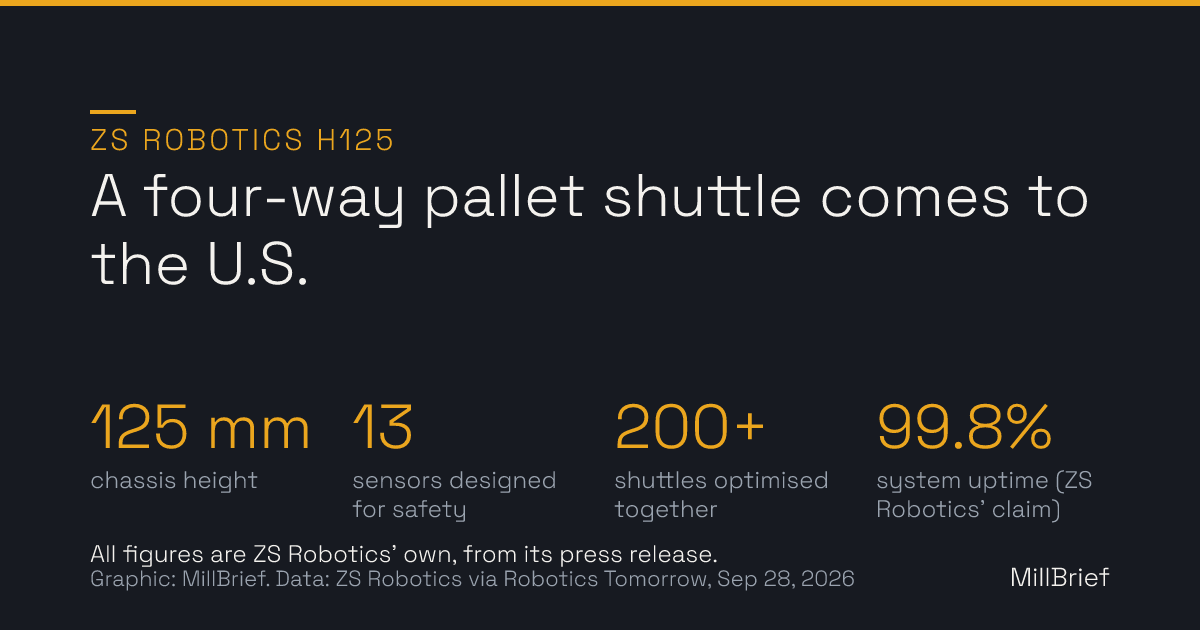
ZS Robotics, a Shanghai-based maker of four-way pallet shuttle storage systems (pallet AS/RS), has launched its H125 shuttle in the Americas, according to a company press release published by Robotics Tomorrow. The H125’s chassis is 125 mm high (our conversion: about 4.9 inches). ZS says it has carried out more than 250 warehouse automation projects and deployed over 1,000 four-way shuttles across Asia, South America, North America and Oceania, and claims a 100% project delivery record. It sells through system integrators and lists manufacturing among its target sectors. A demonstration space run by its partner Kingmore, with a training centre, showroom and spare parts store, is “opening soon” in Houston, Texas.
The company’s claims for the system: compliance with CE, UL and CSA safety standards; 13 sensors designed for safety, covering obstacle avoidance, pallet presence and load imbalance; and a charging cabinet with a mechanically self-sealing structure and a fire safety system that works independently of electronics and software. ZS says more than 90% of components are modular and can be swapped in as little as five minutes, that the shuttles charge from standard 120 V single-phase power, work with conventional shuttle racking and integrate with existing warehouse management software. Its scheduling software supports optimisation across more than 200 shuttles, a single failed shuttle does not stop the system, and ZS quotes system uptime of 99.8%.
Why it matters: Dense pallet storage is one way a mid-size plant can find space without building, and a low-profile shuttle that runs on 120 V charging and existing racking is aimed at retrofits. For scale, 99.8% uptime on a round-the-clock year still allows about 17.5 hours of downtime (our arithmetic: 8,760 hours times 0.2%), so ask how ZS measures it. The bigger question for a new U.S. entrant is support: the Houston spare parts store is not open yet, so ask your integrator where parts are stocked and how quickly a technician can reach you. Our integrator question list covers the spares and response-time terms to get in writing.
Source: Robotics Tomorrow, September 28, 2026 (ZS Robotics press release).
Robots take on wire harness assembly, one tenth of a millimetre at a time
Cellios, a company founded in 2024 that emerged from the Fraunhofer Institute for Manufacturing Engineering and Automation (IPA) in Stuttgart, is building modular robot cells to automate wire harness assembly, according to a case study from machine-vision software maker MVTec published by Robotics Tomorrow. Its project partner is TE Connectivity, and the goal, CTO Dr. Frank Nägele says, was to automate the whole process up to electrical testing, not just parts of it. The modules cover connector singulation, cable preparation, crimping, routing, ultrasonic splice welding, taping and end-of-line testing.
The hardest step so far is routing followed by contact insertion. Cables have no fixed shape, so a crimp’s position in the gripper changes with every move, and inserting it into a connector needs an accuracy of at least 0.1 mm. The robot shows the gripped crimp to a 2D camera, which measures its position and orientation and sends a correction; a second camera measures the target; and a force-torque sensor controls the insertion force. The vision side runs on MVTec’s MERLIC software alongside Cellios’s own.
The prototype was shown in November 2025 and market launch is planned for early 2027. Cellios plans to extend the system to more harness variants and to control cabinet wiring. Nägele notes that connectors and cable-processing machines were designed for people, not robots.
Why it matters: This is a vendor case study about a system not yet on sale, so there are no cycle times or prices to judge. The useful lesson for any shop is in the method: flexible parts that move in the gripper need measurement and correction (vision plus force sensing) rather than fixed positions, and parts designed for human hands may need to change before a robot can handle them. If you build cable assemblies or wire panels, it is one to watch, but not a reason to delay fixing a process that is still unstable; see our note on the case against automating your worst process.
Source: Robotics Tomorrow, September 28, 2026 (MVTec case study).
Who fixes the robot when it breaks far from the maker?
A contributed column in Robotics Tomorrow argues that field service is becoming the limit on robot growth. The author, Steve Urban, is founder and COO of Robo Reliance, a Colorado-based company that sells nationwide robot field service, so read it as an interested party’s view. His example: a robot maker with 60 robots spread over 30 cities has three poor options when one breaks. It can fly an engineer out, talk the customer through the fix by phone, or hire technicians in every market, who would sit idle most of the week in a city with only two robots.
His answer is third-party service partners, as happened with elevators, HVAC and medical equipment. His checklist: technicians trained and certified on the specific robot before they are sent, local people near the actual sites, preventive maintenance rather than only break-fix, remote diagnostics first, clear reports back to the manufacturer, support for several robot brands, and realistic promises on out-of-hours cover. Urban expects humanoids, with more joints, sensors and moving parts, to make the problem bigger.
Why it matters: The column is mostly about robots outside factories, in places like kitchens and hospitals, but a manufacturer far from a vendor’s engineers faces the same question. Before you buy, ask who will come when the robot stops, how far away they are, whether they are trained on your model, and whether using a third party affects your warranty. Put response times and a priced spares list in the contract, and include service in lifetime cost with our TCO calculator.
Source: Robotics Tomorrow, September 28, 2026 (contributed column).
Sources
- ABB launches E-Device safety interface for OmniCore robots (Design World, 2026-09-23)
- ZS Robotics brings safe, compact, easy-to-use four-way pallet shuttles to the US (Robotics Tomorrow, 2026-09-28)
- With precision and clear vision: robots work autonomously in wire harness manufacturing (Robotics Tomorrow, 2026-09-28)
- Who fixes the robots? Field service is the next bottleneck in robotics (Robotics Tomorrow, 2026-09-28)