Industry Brief, October 1, 2026: Mobile robot rules, service robot sales, robot vision
Four stories today, and two of them are about the part of automation that happens after the robot arrives. A US safety standard now spells out what a plant has to do once its mobile robots are running. The robot federation’s new service robot figures show logistics robots leading the market, with rental models growing. A French robot vision company has raised money to help existing robots cope with parts that are not quite where they should be. And a logistics startup won a cross-dock deal by coordinating the people as well as the robots. As always, the writing is ours, each item links to the original outlet, and vendor numbers are labelled as vendor numbers.
The mobile robot safety standard now covers the user’s side
The Association for Advancing Automation (A3) says ANSI/A3 R15.08-3-2026, Part 3 of the American National Standard for industrial mobile robot (IMR) safety, is now available to buy, according to its September 29 announcement published by Robotics Tomorrow. It completes the three-part R15.08 series. Part 1 sets safety requirements for the mobile robots themselves and Part 2 for IMR systems and applications. Part 3 is about continued use in day-to-day operations.
A3 says Part 3 is aimed at the responsibilities of users. It gives requirements and guidance for keeping risk acceptable through daily operation and the life of the equipment, covering risk assessment, management of change, employee training, and periodic reviews and inspections. It was developed alongside Part 3 of the ANSI/A3 R15.06 industrial robot safety standard, so that plants get consistent guidance whether they run fixed robots or mobile ones. The standard is sold as a PDF download from A3’s online store, alone or as a bundle with Parts 1 and 2.
Why it matters: Most of a mobile robot’s safety case is built before go-live by the vendor and integrator. What happens after that (a new rack in the aisle, a changed route, a new shift that was never trained) is the plant’s job, and Part 3 now names it. If you run or are buying AMRs or autonomous tuggers, ask your supplier which parts of R15.08 their system and your application were assessed against, and put a management-of-change step in your own procedures for any layout change. Our RFQ guide shows how to write standards compliance and training into the request for quote.
Source: Robotics Tomorrow, September 30, 2026 (A3 announcement).
Service robot sales rose 24%, led by logistics
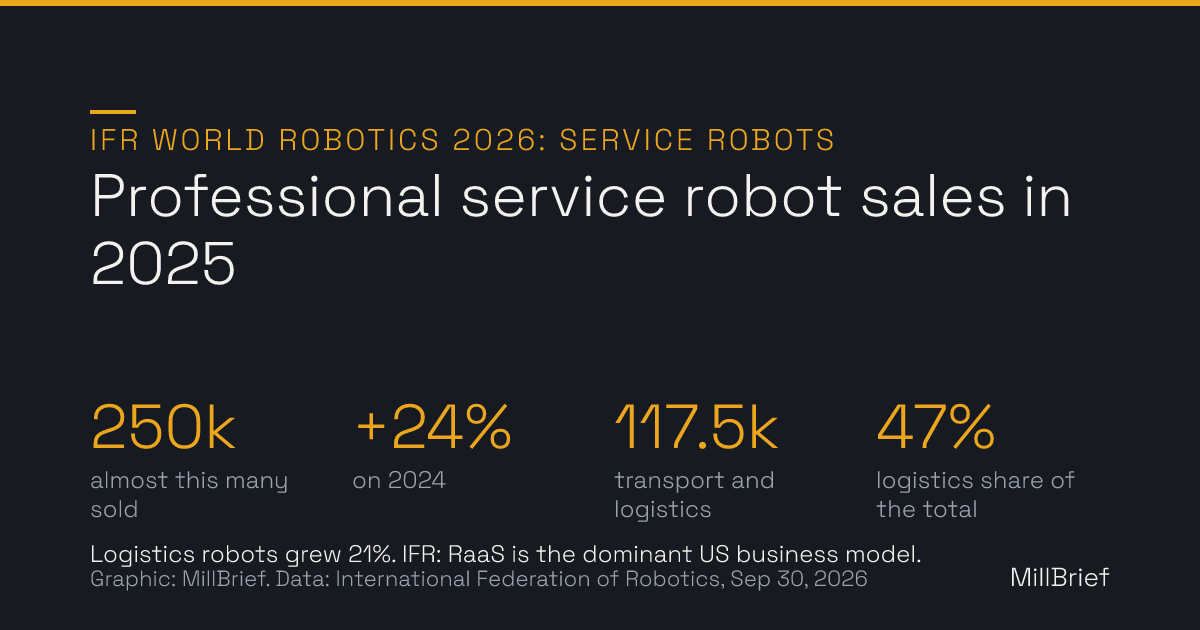
Global shipments of professional service robots rose 24% to almost 250,000 units in 2025, the International Federation of Robotics (IFR) said on September 30, presenting its World Robotics 2026 Service Robots report. Transportation and logistics robots stayed the largest application, with 117,500 units sold, up 21% and 47% of the market (our check: 117,500 divided by 250,000 is 47%). These are mainly robots that move material and make deliveries. Hospitality robots came second and professional cleaning robots third.
The IFR says traditional sales remained the main way these robots are sold, but robots-as-a-service (RaaS) kept growing and is already the dominant business model in the US. On humanoids, it counts about 7,000 full-size units (above 140 cm) sold in 2025 for commercial and professional use, and lists safety standards, high training and maintenance costs and the lack of a strong business case, particularly in industrial settings, as limits on adoption. Medical robots grew 19% and consumer service robots 37%.
Why it matters: The mobile robots that move parts and totes around a plant fall in this logistics category, and they are the fastest route for many smaller manufacturers into automation because they do not need a guarded cell. With RaaS now the main model in the US, expect monthly quotes alongside purchase quotes. Compare them on the same basis: total cost over the years you expect to use the robots, including support, software and what happens at the end of the term. Our TCO calculator helps with that sum. For humanoids, the IFR’s own list of barriers points the same way as before: ask for paying production references first.
Source: International Federation of Robotics, September 30, 2026.
Inbolt raises $12.5M for vision that lets robots adjust to real parts
Inbolt, a Paris company that sells 3D vision and AI software to guide industrial robots, has raised $12.5 million, according to a company release on Robotics Tomorrow. Shift4Good led the round, joined by Bridges Climate Transition Partners, with existing investors BNP Paribas Développement and Ora Global. Inbolt says total funding is now $34 million (our arithmetic: about $21.5 million raised before this round). The money is for expansion in the US, where it opened a Detroit office this year, and in Asia-Pacific, and for entry into data centres and electronics manufacturing.
The pitch is that most robots cannot see when a part is slightly out of position, so they stall, throw an error or make a bad part. Inbolt says its system finds the part and adjusts the robot’s path in real time, can be added to existing lines as well as new ones, is trained on a CAD model in minutes, and works with FANUC, ABB, KUKA, Yaskawa, Comau and Universal Robots arms. The company says it is deployed on more than 200 robots in more than 100 factories across three continents, naming Bosch, Beko, Flex, Ford, Stellantis and Toyota as clients. CEO Rudy Cohen says the round will help it reach manufacturers beyond those with the deepest integration budgets. The release gives no prices.
Why it matters: Part presentation is one of the quiet costs of a robot cell. Fixtures, locating pins and feeders that hold a part precisely enough for a blind robot often take a large share of a cell’s design effort, and they have to change when the part does. Vision guidance can cut that, but it adds its own risks: lighting, reflective surfaces, cycle time and a software subscription. If a vendor offers it, test with your real parts, including worn and out-of-tolerance ones, and count what fixtures you avoid. Our hidden costs of automation page lists the fixturing and changeover costs to weigh it against.
Source: Robotics Tomorrow, September 30, 2026 (Inbolt press release).
A cross-dock robot deal won by directing the people too
Destro, a startup that has come out of stealth with an $8 million seed round, does not build robots. It sells software that runs other makers’ robots and also tells human workers what to do, TechCrunch reports. The customer in the story is Yusen Logistics. At a Yusen site in the Pacific Northwest, workers unload goods from inbound trucks into carts, and three cart-moving robots built by Miva Robotics find the full carts and take them to the right outbound truck. Destro’s software directs the people, the carts and the trucks, which Yusen’s director of automation for its American logistics group, Richard Brunelle, says replaced paper with a systematic process.
According to TechCrunch, Yusen also talked to two other robot startups. One could move carts point to point but could not handle loading and unloading; the other had fleet management tools but left the coordination to a person. Destro is now expanding the pilot to a full deployment of 26 robots and starting a 17-robot pilot at a Yusen site in Southern California. Base10 Partners and Bonfire Ventures led the round, with CoFound Partners also investing. Brunelle says he has yet to find a good use case for a bipedal humanoid.
Why it matters: A robot that drives from A to B is the easy part. The saving shows up only when the workflow around it (who loads what, when, and where it goes next) is redesigned, and that is where many material-handling projects stall. Before buying mobile robots for a shipping dock or line-side delivery, map the whole flow and ask the vendor which steps its software actually directs and which it leaves to your supervisors. Our guide to why automation projects fail covers the cost of automating one step and not the process.
Source: TechCrunch, September 30, 2026.
Sources
- New R15.08 Part 3 Safety Standard for Industrial Mobile Robot Users Now Available (Robotics Tomorrow, 2026-09-30)
- Global Sales of Professional Service Robots Surge 24% (International Federation of Robotics, 2026-09-30)
- Inbolt Raises $12.5M to Bring Sight and Intelligence to Industrial Robots, From Stellantis and Toyota to Data Centers (Robotics Tomorrow, 2026-09-30)
- Destro AI's secret sauce is getting robots and humans on the same page (TechCrunch, 2026-09-30)