Industry Brief, October 2, 2026: Input prices jump, inspection robots, lean first
Four stories today. The monthly survey of US purchasing managers shows factory demand holding up while input prices jumped. Two makers of inspection robots now pitch their machines less as robots and more as a feed into the maintenance software a plant already runs. A Toyota materials handling executive makes the case for fixing a process before automating it. And a humanoid maker has signed a safety deal that shows how much of a robot’s safety sits outside the robot. As always, the writing is ours, each item links to the original outlet, and vendor numbers are labelled as vendor numbers.
September PMI: orders and backlogs up, input prices jump
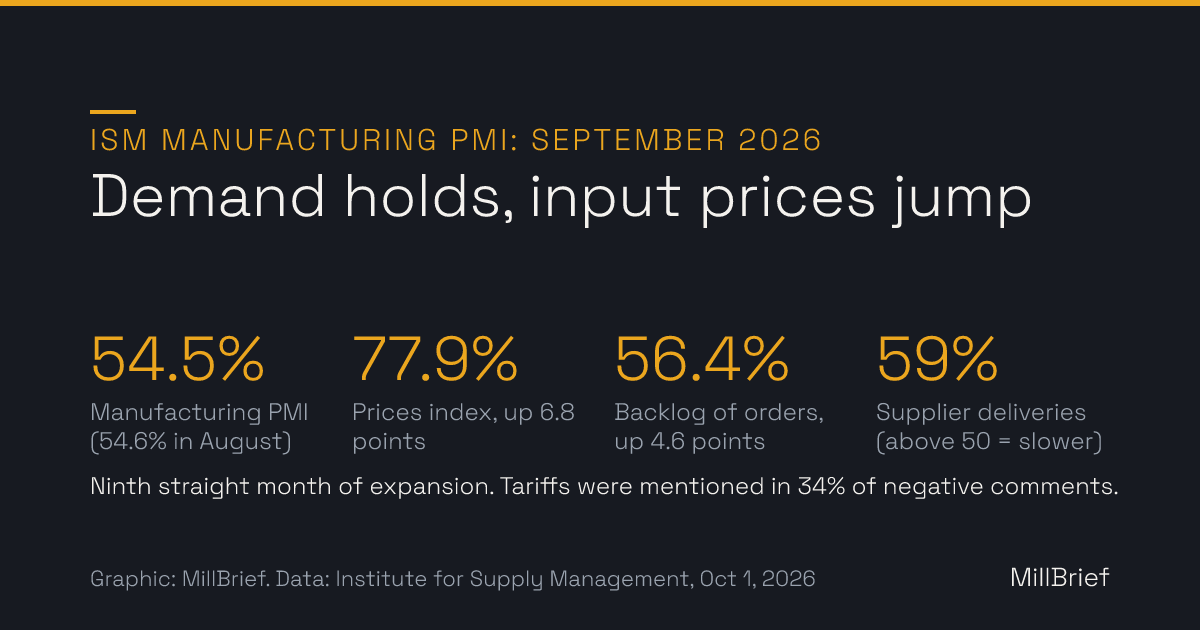
The Institute for Supply Management’s manufacturing PMI was 54.5% in September, 0.1 point below August and the ninth straight month of expansion (above 50%), according to ISM’s report published on October 1. Demand firmed: new orders rose 1.6 points to 55.3%, the order backlog rose 4.6 points to 56.4%, and employment rose 1.5 points to 52.7%. Production slowed but still grew, at 56.7%. Supplier deliveries were slower for a tenth month, at 59% (in this index, above 50% means slower).
The jump was in prices. The prices index rose 6.8 points to 77.9% (our check: 77.9 minus 71.1), close to the 78.3% of March, when the Iran war began, and the 24th straight month of rising raw material prices. Susan Spence, who chairs ISM’s survey committee, put it down to steel and aluminium prices, tariffs on imported goods and petroleum-based products. The share of respondents reporting higher prices rose from 46.2% to 58.6%. Of the negative comments, 46% mentioned pricing volatility, 34% tariffs, 30% the Iran war and 21% longer lead times. Steel has been on the list of commodities up in price for 11 months running.
Respondents’ own words are blunt. A fabricated metal products firm said its biggest problem was a severe shortage of workers limiting output, with steel availability second. An electrical equipment firm said new tariffs against Canada had drastically increased the cost of capital expenses and assemblies. A transportation equipment firm said customers were pushing out capital spending until costs and demand are more certain.
Why it matters: Robot cells, guarding, conveyors and machine bases are built from steel, aluminium and electronic components, all on ISM’s list of items up in price this month. If you have a quote in hand, check how long the price is valid and whether it carries a surcharge clause, and ask for delivery dates in writing. The fabricator’s comment is the other side of the coin: a labour shortage that caps output is the case for automation, so rerun your payback math with today’s wage and lost-output figures as well as today’s equipment price.
Source: Institute for Supply Management via PR Newswire, October 1, 2026.
Inspection robots now report straight into maintenance software
Two makers of legged inspection robots were reported on October 1 with new software aimed at the same gap: getting what the robot finds into the systems that schedule repairs. Boston Dynamics released Spot 5.2, Robotics & Automation News reports. Its Orbit fleet software is now organised around a plant’s assets rather than individual inspections, and can import asset hierarchies of the kind kept in maintenance management (CMMS), MES and asset management systems. Data from PLCs, fixed sensors and security cameras can now flow into Orbit, which the company says lays the groundwork for AI agents to send Spot out when set conditions are met, for example to check a machine after a fixed sensor raises an alert. New inspection options include video-based checks using Google Gemini models (dripping pumps, slipping conveyors, warning lights), gas detection, visual vibration analysis and partial discharge detection on high-voltage equipment.
ANYbotics launched Shift, a cloud platform for its ANYmal robots, The Robot Report reports. It schedules robot fleets, judges readings against operating conditions such as motor speed and load, and turns confirmed anomalies into work orders in systems such as SAP and IBM Maximo. ANYbotics says a first deployment needs no enterprise integration, that training takes a few days, and that Shift already runs across more than 200 robot deployments. It cites a cement plant where it ran more than 33,000 inspections in 16 months and a utility that it says saved more than $3.5 million in its first months. Those are company figures. Neither report gives a price.
Why it matters: ANYbotics’ customers are in energy, power, metals, mining and chemicals, and robots like these mostly serve large sites, so few small plants will buy one soon. The lesson travels, though: an inspection or monitoring system pays only when its findings turn into repairs. If you are pricing condition monitoring of any kind, ask how alerts reach your maintenance team, whether your asset list must be cleaned up first, and who owns that work. Both belong in the hidden costs column.
Sources: Robotics & Automation News and The Robot Report, October 1, 2026.
Toyota’s materials handling chief: fix the process, then automate
In an interview with Forkliftaction News, Ralph Cox, senior vice president market operations at Toyota Material Handling Europe, argues that every automation project should start with an analysis of current processes, standardising them and removing steps that are not efficient, then reviewing flow and layout. He also says the data a project relies on must be available and correct. He recommends a site survey and a lean assessment to find tasks worth automating, naming structured, repetitive work such as order picking, horizontal transport, picking and dropping at conveyors, replenishment and storage.
Cox says up to 80% of operations can in most cases be automated with automated guided vehicles, while the last 10% to 20%, with variable or custom products and unpredictable conditions, is often hard or impossible to automate. He says smaller businesses can also get a return, because investment can now be lower and more modular, scalable systems exist, and advises starting with less than the full scope and building momentum. Toyota Material Handling sells automation, so read this as a vendor’s view.
Why it matters: The advice cuts against a common first mistake: automating the messiest process because it hurts most. A robot repeats a bad process faster and at higher cost. Standardise the work by hand first, then automate the stable, repetitive part and leave exceptions to people. Our note on the case against automating your worst process and our guide to what to automate first cover the same ground.
Source: Forkliftaction News, October 1, 2026 (interview).
Agility and FORT sign a safety deal for the next Digit humanoid
Agility Robotics and FORT Robotics have signed a memorandum of understanding to work together on the safety systems of Digit 5, Agility’s next humanoid, according to a FORT release on Robotics Tomorrow. The release describes a three-part architecture: a safety pendant, on-robot communications, and an off-robot interface, the Offboard Safety Bridge, that connects Digit to external safety systems. The pendant is a holder for Digit’s tablet with emergency stop and enabling-device functions, used for monitoring and as a manual override during setup, maintenance or an unexpected situation.
Agility calls Digit 5 its first humanoid engineered for “cooperatively safe” work, with planned onboard safe human detection. It says earlier Digits have logged more than 65,000 hours and been deployed at Schaeffler, GXO and Toyota Motor Manufacturing Canada. The agreement also covers joint hardware development, regulatory compliance and deployment support. FORT is pursuing a Nasdaq listing by merging with a special purpose acquisition company. No timing or prices are given.
Why it matters: An MOU is a statement of intent, not a product. But it is a reminder that a mobile robot’s safety depends on how it connects to the rest of your safety system, not just on the robot. Before any humanoid or mobile robot works near people, ask which safety functions are certified and to which standard, how the robot ties into your existing stops and guarding, and who does the application risk assessment. Our cobot vs industrial robot page explains why the application, not the machine, decides whether people can share the space.
Source: Robotics Tomorrow, October 1, 2026 (FORT Robotics press release).
Sources
- Manufacturing PMI® at 54.5%; September 2026 ISM® Manufacturing PMI® Report (Institute for Supply Management (via PR Newswire), 2026-10-01)
- Boston Dynamics updates Spot to connect autonomous robot inspections with enterprise AI systems (Robotics & Automation News, 2026-10-01)
- ANYbotics launches Shift to streamline robot fleet operations, scale inspections (The Robot Report, 2026-10-01)
- SVP market operations Toyota MH Europe Ralph Cox on lean manufacturing & automation (Forkliftaction News, 2026-10-01)
- Agility and FORT Robotics Announce Strategic Partnership to Advance Humanoid Robot Safety (Robotics Tomorrow, 2026-10-01)