Cobot vs Industrial Robot in 2026: Cost, Speed and Safety
The label matters less than the job. A cobot (collaborative robot) is built to share space with people at reduced speed; a conventional industrial robot is built for speed, force, and endurance behind a guard. Both are articulated arms, and the same integrator often installs either one. This page compares them on the specs that actually change your quote and your throughput, then gives blunt decision rules and kills the most expensive myth in the category: that a cobot is safe just because it says “collaborative” on the box.
How do cobots and industrial robots compare on specs?
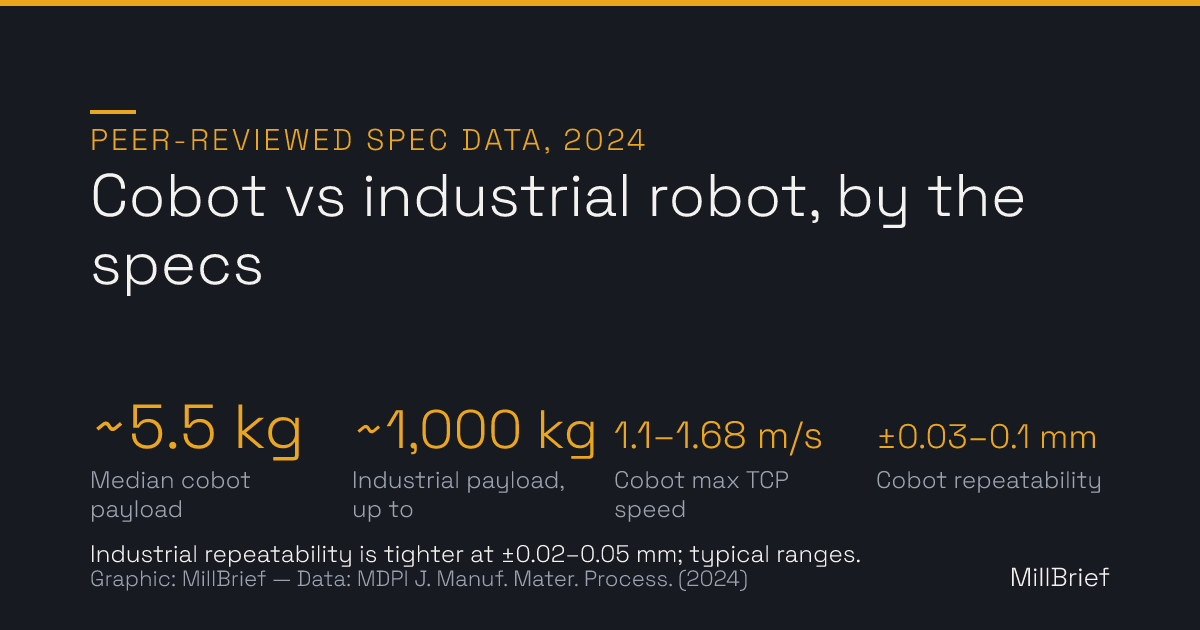
On raw performance, industrial robots win on speed, payload, and precision; cobots win on flexibility and floor space. According to MDPI’s Journal of Manufacturing and Materials Processing (2024), industrial robots hold repeatability of ±0.02-0.05 mm and handle payloads up to ~1,000 kg, while cobots range ±0.03-0.1 mm and top out near 20-25 kg, with a median cobot payload of about 5.5 kg and max tool-center-point velocity of 1.1-1.68 m/s. Universal Robots’ published datasheets (2023) show the UR10e at 10 kg and ±0.05 mm; industrial arms run several times faster.
| Factor | Cobot | Industrial robot |
|---|---|---|
| Max TCP speed | ~1.1-1.68 m/s | Several times faster |
| Payload | ~3-25 kg (median ~5.5 kg) | Up to ~1,000 kg |
| Repeatability | ±0.03-0.1 mm | ±0.02-0.05 mm |
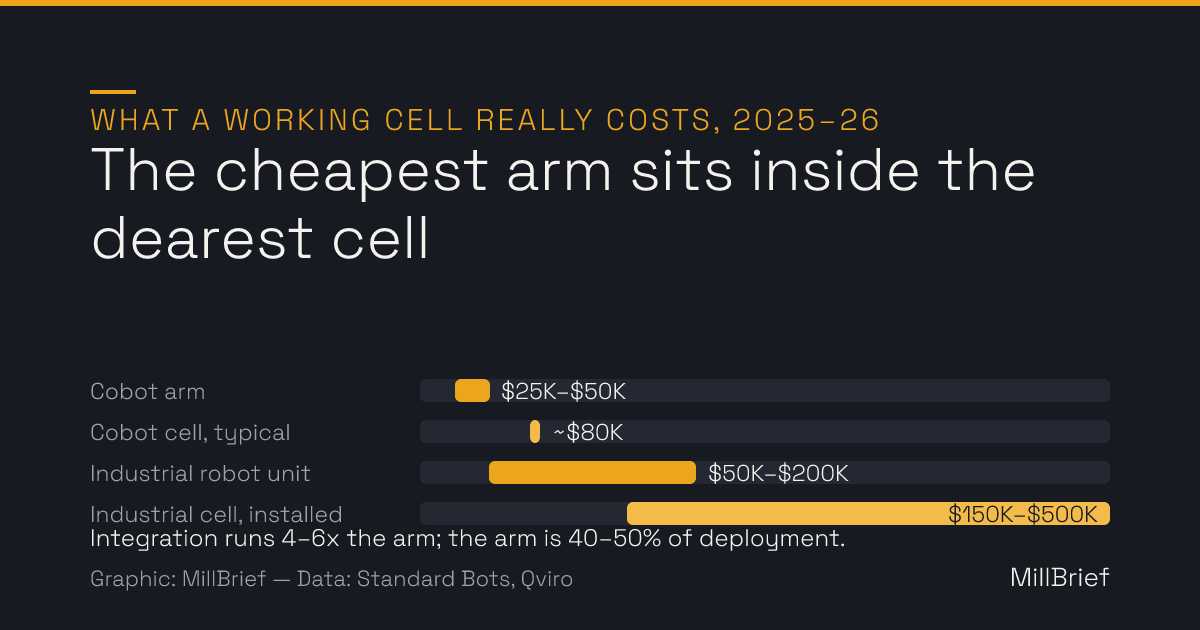
| Robot price (2026) | ~$25,000-$50,000 (to ~$90,000+) | ~$50,000-$200,000 |
| Total cell (2026) | ~$80,000 typical | ~$150,000-$500,000 |
| Integration cost | ~4-6x the arm | ~4-6x the arm |
| Safety approach | Fenceless if risk assessment allows | Fixed guarding / caged cell |
| Flexibility | Redeploy in minutes | Fixed, single-purpose |
| Footprint | Small, no cage | Larger, caged |
What do cobots and industrial robots actually cost?
Expect a cobot cell around $80,000 and an industrial cell of $150,000-$500,000, because the arm is never the whole bill. Standard Bots (2026) puts standard cobot models at $25,000 to $60,000, with high-end welding or spray-painting configurations above $90,000. EVS International (2026) notes the arm is only about 40-50% of total deployment cost, so a $35,000 arm becomes an $80,000 deployed system once controller, tooling, sensors, integration, safety assessment, and training are included. For industrial robots, Standard Bots (2026) gives $50,000 to $200,000 base price and $150,000 to $500,000 total system cost, and Qviro (2024) puts industrial robots at $50,000 to $150,000 each, with turnkey systems from $150,000 to over $500,000.
Integration is the line item buyers underestimate. According to Qviro (2024), professional system integrators usually charge $100 to $200 per hour for installation and integration in North America, and the total depends on project size and complexity. For a full breakdown see our cobot cost and industrial robot cost guides, and the production line automation cost page for multi-station projects.
Is a cobot automatically safe? (The myth that costs money)
No. A cobot is not inherently safe, and treating it as safe is a documented pitfall that gets people hurt and projects rejected. Airline Hydraulics (2024) is blunt: depending on the task, a cobot fitted with a sharp tool, a hot part, or run at speed can still cause harm. Safety is a property of the whole application, the robot, end-effector, workpiece, speed, and layout together, not of the arm in isolation. Over-simplifying the risk assessment is the most common mistake integrators see.
The governing standard is explicit. According to A3 and Robotiq (2025), ISO/TS 15066 supplements ISO 10218-1/-2 and defines four collaborative operation methods: safety-rated monitored stop, hand guiding, speed and separation monitoring, and power and force limiting. Power-and-force limiting relies on biomechanical limits, a maximum force and pressure per body part that contact must not exceed. A documented cell risk assessment is mandatory before any cobot runs near people, and ISO/TS 15066 content is now folded into ISO 10218-2:2025.
The primary documents say the same thing. ISO’s own abstract describes ISO/TS 15066:2016 as specifying safety requirements for collaborative industrial robot systems and the work environment, supplementing ISO 10218-1 and ISO 10218-2, and ISO now lists it as due for revision (ISO, 2016). In the US there is no robot-specific federal rule: OSHA states there are currently no specific OSHA standards for the robotics industry, and lists related general-industry rules such as machine guarding (29 CFR 1910.212) and lockout/tagout (29 CFR 1910.147) alongside the consensus standards, ANSI/RIA R15.06-2012 as the US adoption of ISO 10218-1 and -2, and RIA TR R15.606 as the US adoption of ISO/TS 15066:2016 (OSHA, Robotics: Standards). The OSHA Technical Manual adds that these standards require integrators to conduct hazard analyses and risk assessments for each application, ideally with the employer and workers taking part, and it sorts industrial robot applications into collaborative and non-collaborative by how much they interface with workers (OSHA Technical Manual, Section IV, Chapter 4). In other words, “collaborative” describes the application, not the arm.
Where people actually get hurt matters too. OSHA notes that many robot accidents occur during non-routine operating conditions such as programming, maintenance, testing, setup, or adjustment, when a worker may be inside the robot’s working envelope (OSHA, Robotics: Overview). That is true of both robot types, so the fenceless-cobot saving does not remove the need for lockout and safe teach procedures.
The practical takeaway: budget for the risk assessment on both robot types. A cobot may let you skip the fence, but only after the assessment confirms it for that exact application. Skipping or rubber-stamping this step is a top reason automation projects stall.
When should you choose a cobot instead of an industrial robot?
Choose a cobot when volume is low-to-mid, the job changes often, and a human works nearby. Cobots earn their keep on flexibility: because they often run fenceless (subject to risk assessment), they save floor space versus caged cells and, per Standard Bots (2026), can be redeployed to a new station in minutes, extending asset life beyond one product cycle and reducing stranded capital. As an editorial estimate, cobot payback commonly falls in the 12-24 month range, and can be faster for machine tending, pick-and-place, and palletizing where the cell runs multiple shifts.
Pick a cobot if: your parts are under ~20 kg, cycle time is not the bottleneck, you run multiple short jobs or frequent changeovers, floor space is tight, and workers must be in the cell. Do not pick a cobot to chase raw throughput, its speed limit is real, and forcing a cobot into a high-volume line usually costs more than a caged industrial robot doing the same work faster.
When should you choose an industrial robot instead?
Choose an industrial robot when the job is high-volume, fixed, and driven by cycle time or heavy payload. If you are running one part around the clock at high speed, or lifting parts a cobot cannot, the industrial arm’s speed and payload advantage compounds every shift and pays back the larger cell cost. The International Federation of Robotics (2025) reports 542,000 industrial robots installed worldwide in 2024, versus a cobot share of 10.5% of 2023 installs (IFR, 2024), collaborative robots remain the minority precisely because most factory work still favours speed and force over flexibility.
Pick an industrial robot if: the process is stable and long-running, cycle time drives your cost per part, payloads exceed ~25 kg, and you can dedicate floor space to a guarded cell. The trade-off is rigidity, a caged industrial cell is expensive to reconfigure, so it is the wrong bet when your product mix shifts often. Note that IFR (2025) reports 6-axis robot average selling prices have fallen roughly 3-5% annually, gradually lowering the entry barrier on both sides.
How to decide and where to go next
Match the robot to the application, then price the whole cell, not the arm. Start with three questions: how heavy is the part, how fast must it run, and how often will the job change? Heavy or fast and stable points to industrial; light, variable, and human-adjacent points to collaborative. Either way, the arm is 40-50% of the bill and the risk assessment is non-negotiable.
Before you request quotes, read our questions to ask a system integrator so you can compare bids on equal terms. For definitions, our glossary explains what is a cobot.
Frequently asked questions
Is a cobot always safer than an industrial robot?
No. Safety is a property of the whole application, not the arm. Per ISO/TS 15066, a cobot with a sharp tool, hot workpiece, or high speed can still injure someone, so a documented cell risk assessment is mandatory before it runs near people.
How much faster is an industrial robot than a cobot?
Cobots typically top out around 1.1-1.68 m/s TCP velocity, while conventional industrial robots run several times faster. For high-throughput lines where cycle time drives cost, that speed gap usually decides the choice in favour of an industrial robot.
Can a cobot run without a safety fence?
Sometimes, but only after a risk assessment permits it for that specific task. Fenceless operation depends on the end-effector, workpiece, speed, and layout together. The cobot's power-and-force-limiting feature alone does not guarantee it can run fenceless.
Which is cheaper to buy and install?
A standard cobot arm typically runs $25,000-$60,000 and an industrial robot unit $50,000-$200,000 (Standard Bots, 2026), but the arm is only 40-50% of total deployment cost (EVS International, 2026). A $35,000 cobot arm becomes an $80,000 deployed system (EVS International, 2026); industrial systems reach $150,000-$500,000 (Standard Bots, 2026).
Is there an OSHA standard for cobots?
No robot-specific one. OSHA states there are currently no specific OSHA standards for the robotics industry. It points instead to general-industry rules such as machine guarding and lockout/tagout, and to the consensus standards: ANSI/RIA R15.06-2012, the US adoption of ISO 10218-1 and -2, and RIA TR R15.606, the US adoption of ISO/TS 15066:2016. Those standards expect a risk assessment for each application, cobot or not.
What payload can each handle?
Cobots typically top out around 20-25 kg, with a median payload near 5.5 kg. Industrial robots handle payloads up to roughly 1,000 kg. If your part is heavy, an industrial robot is usually the only option.
Sources
- How robots work alongside humans (collaborative robots position paper) (International Federation of Robotics (IFR), 2024)
- World Robotics 2025: Global robot demand in factories doubles over 10 years (International Federation of Robotics (IFR), 2025)
- ISO/TS 15066 Explained (technical paper) (Association for Advancing Automation (A3) / Robotiq, 2025)
- A Statistical Analysis of Commercial Articulated Industrial Robots and Cobots (MDPI, Journal of Manufacturing and Materials Processing, 2024)
- UR10e / e-Series technical datasheets (Universal Robots, 2023)
- Cobot price explained: guide to collaborative robot costs (Standard Bots, 2026)
- How much do robots cost? 2026 price breakdown (Standard Bots, 2026)
- How Much Does a Cobot Cost? $15k-$150k (2026) (EVS International, 2026)
- Implementation Costs of Industrial Automation (Qviro, 2024)
- Cobot Safety: Myth-Busting and a Guide to ISO & ANSI Standards (Airline Hydraulics, 2024)
- ISO/TS 15066:2016 Robots and robotic devices: Collaborative robots (International Organization for Standardization (ISO), February 2016)
- ISO 10218-2:2025: Robotics: Safety requirements, Part 2: Industrial robot applications and robot cells (International Organization for Standardization (ISO), February 2025)
- Robotics: Standards (U.S. Occupational Safety and Health Administration (OSHA))
- Robotics: Overview (accident patterns in non-routine operation) (U.S. Occupational Safety and Health Administration (OSHA))
- OSHA Technical Manual, Section IV, Chapter 4: Industrial Robot Systems and Industrial Robot System Safety (U.S. Occupational Safety and Health Administration (OSHA), updated 2021)