Industry Brief, October 3, 2026: Hitachi and FANUC, OB7-AI, rent or buy, robot security
Four stories today. Two Japanese industrial groups are teaming up to teach robots the jobs that still need people, such as changeovers. A US cobot maker says its new arm can find parts on a machine table by itself. One integrator now offers the same robots to rent or to buy, while a startup rents only. And a mobile robot maker’s security certificate is a reminder of what your IT team will ask before a connected robot goes on the network. As always, the writing is ours, each item links to the original source, and vendor numbers are labelled as vendor numbers.
Hitachi and FANUC aim physical AI at changeovers and mixed-part picking
Hitachi and FANUC have entered a strategic partnership to jointly commercialise what they call physical AI, according to a news release dated September 30. The plan combines Hitachi’s AI technologies, including its HMAX Industry platform, with FANUC industrial robots that already carry AI functions. Hitachi factories in the Ibaraki region will act as “Customer Zero”: the AI is meant to keep learning each site’s own production rules there, which the companies say goes beyond what imitation learning or digital twin simulation can do on their own.
The first applications named are picking parts of various shapes and changeovers when the product being made changes. The partners will measure recognition accuracy, robot motion, takt time and quality, and will also test Hitachi’s edge AI chip with FANUC robots. They plan to start deploying to customers in fiscal 2027, across industries including semiconductors, pharmaceuticals, automotive, logistics, food, shipbuilding and agriculture. Hitachi’s fiscal 2025 ended on March 31, 2026, so fiscal 2027 runs from April 2027 to March 2028 (our arithmetic). No prices or product names are given.
Why it matters: The target is the right one. The release itself says many operations, including parts handling, machine loading and product changeovers, still depend on human judgment, and for a high-mix shop the changeover, not the cycle, is often what kills the case for a robot. But this is a validation programme inside Hitachi’s own plants, and customer deployments are due to begin in fiscal 2027, which starts in April 2027, six months from now. Do not hold a sound project today waiting for it. If your volumes are too mixed for a fixed cell now, write down your changeover counts and times; that is the data you will need to judge any “AI changeover” offer, and it feeds straight into what to automate first.
Source: FANUC news release, September 30, 2026 (joint Hitachi and FANUC announcement).
Productive Robotics says its OB7-AI cobot finds its own blanks
Productive Robotics has introduced OB7-AI, an AI-equipped addition to its 7-axis OB7 cobot line aimed at CNC machine tending, according to a company release on Robotics Tomorrow dated October 1. The company says the arm scans a machine’s work area to learn where things are, so operators no longer have to place blanks precisely; it needs only “finger room” between parts. It then opens the machine door, loads the vise, closes the door and presses start. To know when a cycle has finished, it reads the CNC screen, then unloads and repeats until the job is done.
President Zac Bogart says teaching an OB7 only has to be done once per job but takes time, and that OB7-AI lets operators recoup that time, with no AI training cycles needed for new parts or tasks. The release says the product was introduced at IMTS 2026. Those are the company’s claims; the release gives no price, no availability date and no figure for how much setup time is saved.
Why it matters: For a job shop running short batches, setup time per job decides whether a cobot pays, so a tool that cuts it is worth a demo. Two things to test with your own parts: how the arm copes with blanks that are close together, odd shapes or reflective surfaces, and what happens if reading the CNC screen fails (a wrong “cycle done” signal at an open door is a crash or a safety problem). Ask whether the screen reading can be backed up by a hard-wired machine signal. Our anatomy of a first machine tending cell lists the other parts of the cell that the arm does not solve.
Source: Robotics Tomorrow, October 2, 2026 (Productive Robotics press release dated October 1).
Rent or buy: an AutoStore integrator now offers both
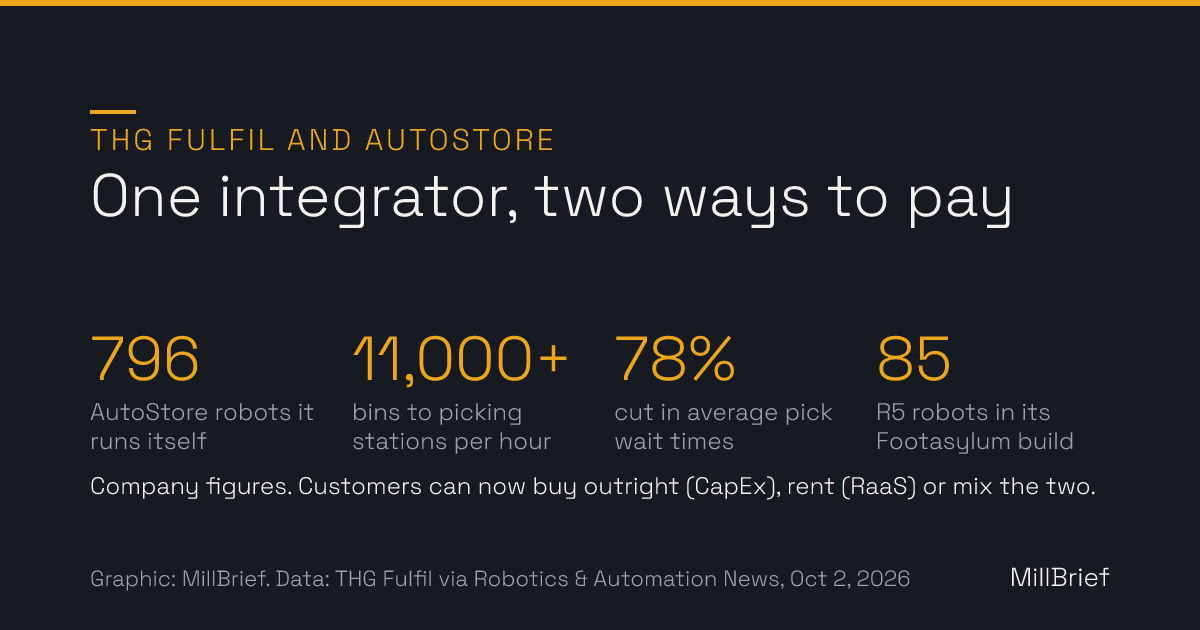
THG Ingenuity’s THG Fulfil has expanded its distribution deal with AutoStore so customers can buy AutoStore systems outright as well as rent them, Robotics & Automation News reports. Until now it offered AutoStore only as robots as a service (RaaS). It now has global distribution rights for the whole AutoStore range under the capital purchase model, while RaaS covers a selected range, including R5 Pro and R5 Pro+ robots and several port types. Customers can choose either model or a hybrid without changing integrator. THG Fulfil says it runs 796 AutoStore robots in its own network, delivers more than 11,000 bins per hour to picking stations and cut average pick wait times by 78%. Those are company figures.
Separately, The Robot Report profiled Maven Robotics, which sells its two-arm mobile manipulator as a service, starting with mixed-case palletizing and tote handling. CEO Hamza Derbas says its robots run 16 hours a day, five days a week, with up to 99% uptime, and that it plans to run fleets around the clock before the end of the year. That is 80 of the 168 hours in a week today, about 48% (our arithmetic: 16 x 5 = 80; 80 / 168 = 0.476). He expects a couple of hundred robots on production contracts over the next year.
Why it matters: When the same integrator offers both models, you can compare them on one quote. Ask for both: total RaaS payments over the expected life, against purchase price plus service, software and spares. Check what RaaS includes (maintenance, upgrades, uptime guarantees), the minimum term, and what happens at the end. And note Maven’s numbers: if a rented robot is charged per month, how many hours it actually works changes the cost per hour a lot. Run both options through our TCO calculator.
Sources: Robotics & Automation News, October 2, 2026, and The Robot Report, October 1, 2026.
Cyngn’s ISO 27001 certificate and the security questions buyers now ask
Autonomous warehouse robot maker Cyngn has achieved ISO/IEC 27001:2022 certification for the information security management system behind Cyngn Insight, its cloud fleet management platform, Robotics & Automation News reports. The standard requires a company to set up, maintain and keep improving a security management system, with controls covering access management, risk assessment, incident response, business continuity, vendor management and data protection. Cyngn says it expects to complete a SOC 2 Type II examination in October 2026.
CEO Lior Tal says enterprise customers expect partners to show security is built into how they operate, and that the certificate removes another potential barrier with larger customers. The report notes that manufacturers and logistics operators are applying stricter security reviews to connected equipment in their plants.
Why it matters: A robot that talks to a vendor’s cloud is a network device. ISO 27001 certifies a management system, and Cyngn’s covers the one behind its cloud platform; it is not a security rating of the vehicle on your floor. Before you sign, ask any vendor of connected equipment what data leaves the site, where it is stored, how remote access works and who can switch it off, and whether the scope of any certificate covers the service you are buying. Put those questions in your RFQ; our RFQ guide shows where they fit.
Source: Robotics & Automation News, October 2, 2026.
Sources
- Hitachi and FANUC enter strategic partnership toward joint commercialization of physical AI implementation (FANUC Corporation (news release), 2026-09-30)
- PRODUCTIVE ROBOTICS INTRODUCES 7-AXIS COBOT WITH PHYSICAL AI (Robotics Tomorrow, 2026-10-02)
- THG Fulfil expands distribution partnership with AutoStore (Robotics & Automation News, 2026-10-02)
- How Maven Robotics plans to automate industrial work, one task at a time (The Robot Report, 2026-10-01)
- Autonomous warehouse robot maker Cyngn achieves ISO 27001 Certification (Robotics & Automation News, 2026-10-02)