Industry Brief, October 11, 2026: Cobot IT checks, workflow reliability, humanoid scale-up
A quiet weekend for announcements, so today’s brief is about questions rather than launches. An IT consultant sets out what a small shop should agree with its integrator before a first cobot is connected. A venture investor shows, with simple arithmetic, why a robot’s success rate on one action says little about whether it can run a whole job alone. And two suppliers to humanoid robot makers describe where production at volume is likely to pinch. These are opinion and interview pieces, so we say whose view each one is, and each item links to the original.
Seven IT questions to settle before your first cobot ships
A contributed article on Robotics Tomorrow, published October 9, starts from a familiar picture: a first cobot quote that covers the arm, gripper, fixturing, risk assessment and operator training, but rarely a single line about the network. The author, Tony Ciovacco, is founder and CEO of TeknaByte Consulting, an Indianapolis-based managed IT and security provider whose work for manufacturers includes network segmentation, backup and NIST SP 800-171 readiness, so this is advice from a firm that sells those services. His point is that a modern cobot is also a networked computer, and in a shop with no IT staff the answers “get decided by default on commissioning day”.
His seven questions, which he says take about an hour with the integrator before the cell ships: does the cell need to be on the network at all (ask for a list of every connection it makes, in both directions, and why); if it connects, where does it sit (he suggests a separate VLAN for production equipment, with firewall rules allowing only the traffic the cell needs); who changes the default controller and pendant passwords at handover, where they are stored, and what access level operators get; how the integrator will support the cell remotely; how programs and configuration are backed up, and whether anyone has ever restored one; how you will hear about firmware updates, who may apply them, and whether an update means re-validating the cell; and whether any of it touches defense work.
Two points stand out. On remote support, he says a cellular router in the cabinet deserves the most attention because it can create a path into the shop that never touches the firewall; he advises getting the method in writing, including who can use it, whether your plant must approve each session, and how it is switched off if the relationship ends. On defense work, if a cell runs parts under a contract covered by DFARS 252.204-7012, drawings and part programs may be Controlled Unclassified Information, and the controller, programming laptop and backup storage can fall inside the boundary protected under NIST SP 800-171. He writes that this obligation “has not moved” with recent changes to the CMMC timeline.
Why it matters: None of this needs a security team, and all of it is cheaper to settle before the purchase order turns into a running cell. Add the seven questions to your request for quotation so the answers are priced in, and keep the written answers with the cell documentation. An operator login that can edit the safety configuration, as the author notes, is a safety problem as well as a security one. Our questions to ask a system integrator and RFQ generator are a place to start, and our machine-tending cell report walks through a typical first cell.
Source: Robotics Tomorrow, October 9, 2026.
Why a robot that succeeds 99% of the time is not 99% automated
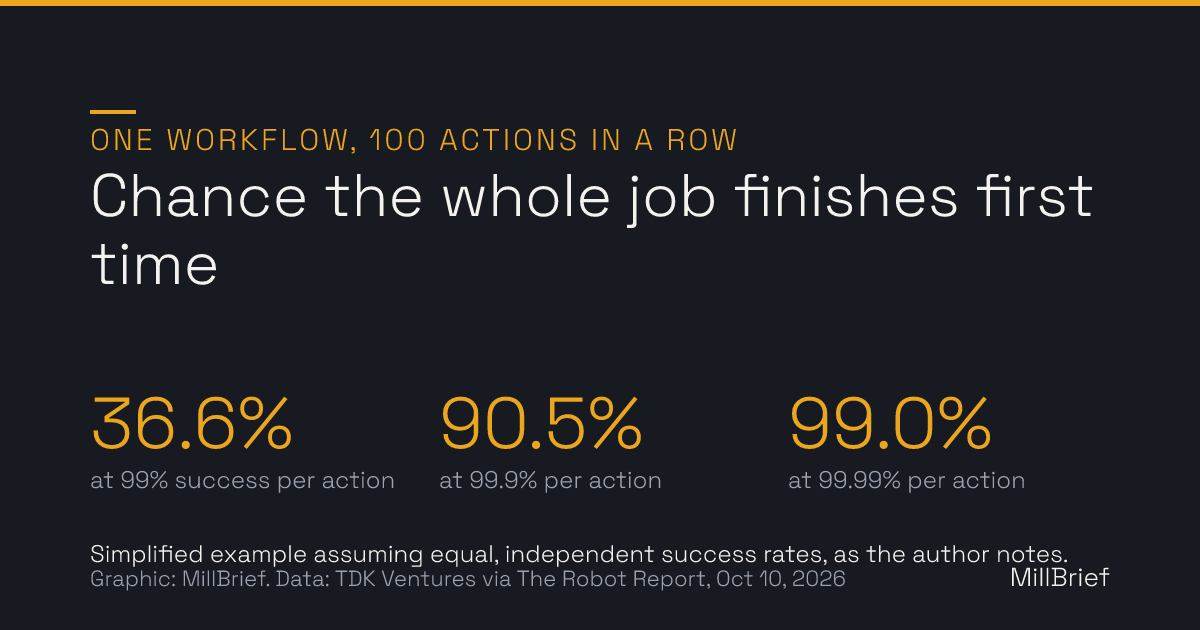
In a contributed article in The Robot Report on October 10, Nicolas Sauvage, founder and president of TDK Ventures, the corporate venture arm of TDK Corp., puts numbers on a problem buyers meet in every demo. Take a job that needs 100 physical actions in sequence. If each action succeeds 99% of the time, the chance that all 100 succeed first time is 36.6%. At 99.9% per action it is 90.5%, and at 99.99% it is 99.0%. He calls it a simplified example that assumes equal and independent success rates. We checked the arithmetic: 0.99 to the power 100 is 0.366, 0.999 to the power 100 is 0.905, and 0.9999 to the power 100 is 0.990.
Sauvage argues that recovery is a large part of dexterity: what counts is whether a robot detects a slipping grip early enough to correct it. He says the right physical form is the one that fits the job, citing three TDK Ventures portfolio companies: Agility’s Digit, which can connect to specialised tools; ANYbotics’ four-legged inspection robots, which he says have reportedly carried out more than 33,000 inspections across 450 inspection points in one deployment; and Starship’s wheeled delivery robots, for which he says Starship reports more than 10 million autonomous deliveries. Those are reported figures, relayed by an investor in the companies. The questions he now asks are what share of complete workflows finish without human help, how often the robot recovers on its own, what breaks first under repeated use, how quickly it can be repaired, and what each successfully completed job costs.
Why it matters: When a vendor quotes a pick or grasp success rate, count the actions in your own cycle and do the multiplication; a figure that sounds near perfect can still mean frequent stops. Then ask the investor’s questions: share of full cycles with no intervention, measured at a running site, plus mean time to recover and to repair. Each assisted cycle is operator time that belongs in your payback sum. Our automation ROI and payback guide and OEE calculator show where those stops land.
Source: The Robot Report, October 10, 2026.
Humanoid makers’ next problem is production, and their suppliers say where it will pinch
Steve Ricketts, senior vice president of business development at Misumi Americas, a supplier of mechanical components and automation parts, told Robotics & Automation News in an interview published October 10 that actuators are “the most likely pressure point” as humanoid volumes grow. Each humanoid needs dozens of them, he said, and each combines motors, precision gears, bearings, encoders and housings. He called high-precision gearing, such as harmonic drives and planetary reducers, and the machining behind it capacity-constrained today, named rare-earth magnets for motors and specialised bearings and sensors as supply concerns, and said five-axis machining, precision grinding and tight-tolerance inspection will strain existing capacity. He expects a shift towards more automated production and in-line metrology. His advice to developers, flexible processes such as CNC machining and 3D printing until a design settles and a supplier ecosystem rather than full vertical integration, also suits a company that sells parts.
A Jabil view, published by The Robot Report on October 8, points the same way. Thomas Brown, Jabil’s senior director for engineering and technology, said the industry is “entering a phase of tens of thousands” of units, past hand assembly on site, and that more edge computing is needed but “prices are an ongoing pain point for scale”. Jabil has worked with Apptronik on its Apollo humanoid. Brown also said that safety certification, failure modes and how to certify humanoids in new environments will take “a tremendous amount of work”, and that traditional high-speed automation “will still have a big play for the foreseeable future”.
Why it matters: For most small and mid-size plants, humanoids are not this year’s purchase, and the supplier view supports that: the parts, the production capacity and the safety rules are all still being worked out. Two practical angles remain. If you already run five-axis machining, precision grinding or tight-tolerance inspection, Ricketts is describing demand for work you do. And if your next cell depends on precision reducers or servo motors, ask your supplier about lead times before you commit to a start date. Our cobot vs industrial robot comparison covers the options available today.
Sources: Robotics & Automation News, October 10, 2026; The Robot Report, October 8, 2026.
Sources
- Before the First Cobot Arrives: Seven IT Questions for the Small Shop Buying One (Robotics Tomorrow, 2026-10-09)
- Why dexterity is physical AI's real bottleneck (The Robot Report, 2026-10-10)
- Interview: Humanoid robots are advancing fast. Manufacturing them at scale is the next challenge (Robotics & Automation News, 2026-10-10)
- Jabil discusses the pace of humanoid robot development and production (The Robot Report, 2026-10-08)