Industry Brief, October 17, 2026: Schneider prices, Hyundai's 204 robots, cobot sorting
Three items today. A major supplier of electrical and automation equipment says its price increases are still rolling through. A carmaker’s plant in India shows what selective automation looks like: robots for the welding, people for most of the assembly. And a university team in Serbia has built a cobot cell for the kind of small, changing waste stream most small plants produce. Where a figure comes from a company or a study’s authors, we say so.
Schneider Electric’s record quarter comes with more price increases
Schneider Electric reported third-quarter revenue of €11,460 million, up 16.9% on an organic basis and 17.9% as reported, in its Q3 2026 release dated October 16. The company calls it a record for any quarter. Most of it came from Energy Management, €9,615 million and up 18.8% organic, helped by data centre demand that the company says rose by triple digits. Industrial Automation brought in €1,845 million, up 8.1% organic, which is about 16% of the group total (our arithmetic: 1,845 divided by 11,460).
The automation side was strongest in North America, up 16.3% organic, where the company says discrete automation grew by double digits and the U.S. grew double digits with discrete automation sold into industrial manufacturing. Process and hybrid automation sales declined slightly in the region. Schneider upgraded its 2026 target and now expects organic revenue growth of 12% to 14% and organic adjusted EBITA growth of 18% to 21%.
The part buyers should read is about price. Schneider says product revenue grew 17% organic, mostly from volume, with price “increasing sequentially as expected”: the pricing actions taken at the start of the year are now at full run-rate and “supplementary actions” are ramping up. For the fourth quarter it expects continued pricing momentum to offset raw material inflation and net tariffs, and warns that disruption in the Middle East could put pressure on global supply chains and raise inflation.
Why it matters: If your panels, power distribution or automation hardware come from Schneider or its distributors, its own release says more price increases are on the way, and its fastest growth is coming from data centres rather than from factory orders. Ask for a price validity date on every quote, place orders for long projects early enough to lock the price, and keep a contingency line for components in the budget. Our automation RFQ guide covers the commercial terms to put in writing before you sign.
Source: Schneider Electric, October 16, 2026 (company results release).
Hyundai fully automated welding in its Indian plant, but only about a tenth of parts placement
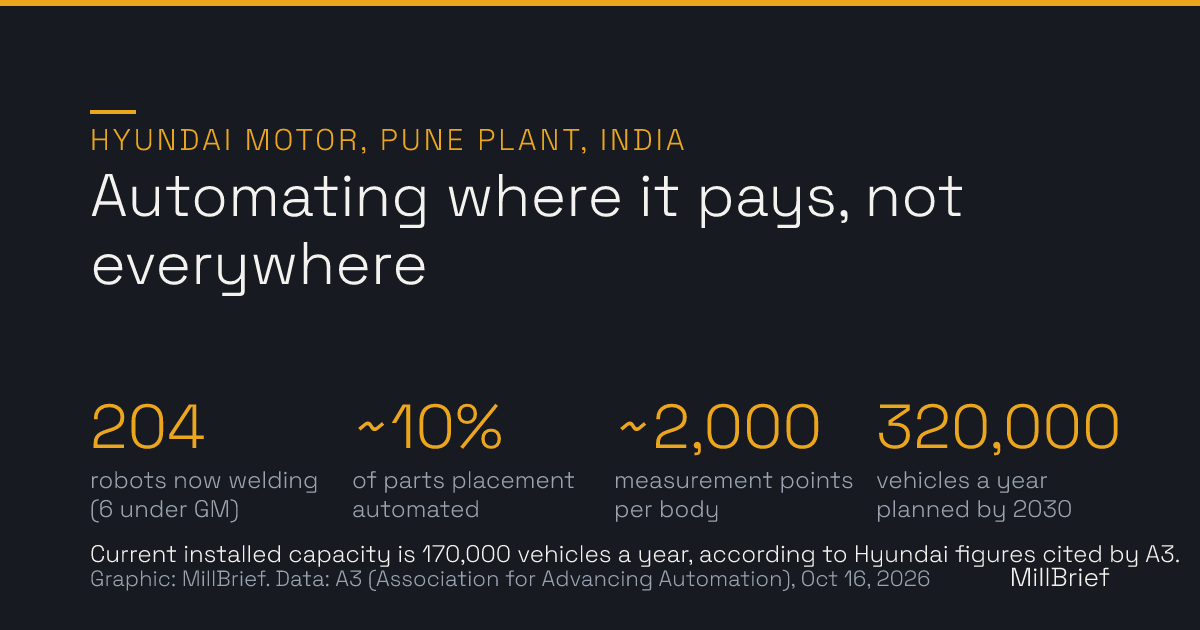
At Hyundai Motor’s modernized plant in Pune, Maharashtra, 204 industrial robots now do welding work that was once largely done by hand, according to an analysis by Aaron Prather, director of market intelligence at A3, published on October 16. When General Motors ran the plant, it had six robots. Hyundai bought the plant in 2023, after GM ended production there in 2020, and A3 says it spent about 1 trillion Korean won modernizing it. The body shop’s welding is now fully automated, but only about 10% of parts placement tasks are done by automation, and workers still carry out much of the assembly. A3’s reading is that Hyundai put robots where precision, consistency, safety and production needs justify the cost, in a country where labour is still relatively cheap.
Two details stand out for anyone automating an old building. The structural pillars are about 15 metres apart, which complicated installing robotic equipment, and Hyundai redesigned its production systems around the existing structure instead of replacing it. Car bodies are checked at about 2,000 measurement points, with additional 3D scanning, and an identification system links each vehicle to the assembly equipment to reduce the risk of fitting the wrong part. Hyundai’s figures, as cited by A3, put installed capacity at 170,000 vehicles a year, with plans for 320,000 by 2030.
The wider numbers come from the International Federation of Robotics: India installed almost 10,500 industrial robots in 2025, up 15%, and stayed the world’s sixth-largest market. In 2022 the figure was about 5,350, so installations have nearly doubled in three years (our arithmetic: 10,500 divided by 5,350 is about 1.96). The car industry accounted for about 45% of India’s installations in 2024. A3 adds a point any small plant will recognise: tooling, integration, programming, safety systems, maintenance, training and disruption during installation can make automation hard to justify for smaller manufacturers when manual labour is easy to find.
Why it matters: A carmaker that spent about 1 trillion won on one plant still chose not to automate most of its assembly. The lesson for a small shop is to automate the step where repeatability is the whole job (welding, inspection, dispensing) and leave variable, low-volume handling to people until the numbers say otherwise. Partial automation is a normal end state, not a failed project. If you are tempted to start with the station that causes the most trouble, read our field note on the case against automating your worst process first.
Source: A3, October 16, 2026 (analysis citing Hyundai and IFR figures).
A cobot cell built for small, changing batches of packaging waste
Most robotic waste sorters are built for large recycling plants with steady, high volumes. Researchers at the University of Belgrade’s School of Electrical Engineering and the University of Kragujevac in Serbia have built a workstation for the opposite case: modest volumes of industrial packaging waste whose mix changes often. Their paper was published in Frontiers in Robotics and AI on October 9 and written up by Bioengineer.org on October 16.
The cell uses a NEURA Robotics MAiRA Pro M seven-axis cobot with a torque sensor in every joint, an Intel RealSense D455 depth camera, a four-finger soft gripper from the SoftGripping kit, and ROS2 software that reads the conveyor’s encoder over OPC UA so the robot can pick items without stopping the belt. The authors say the design is not tied to that cobot model. The vision side pairs a general-purpose segmentation model (the Segment Anything Model) with a small classifier, so adding a new packaging type mainly means sorting cropped images into folders by class rather than drawing outlines around objects. Items the system cannot classify with confidence are marked unknown and left for a human operator.
In lab tests with aluminium cans, plastic bottles and Tetra Pak cartons, placed on the belt by hand with gaps between them, 184 of 200 grasps succeeded (92.0%) and 178 items were sorted all the way to the right bin (89.0%). The mean cycle time was 10.47 seconds per item, which the authors convert to about 5.73 picks a minute (our check: 60 divided by 10.47 is 5.73). That leaves 22 of 200 items, about one in nine, that the robot did not finish (our arithmetic: 200 minus 178). The authors list the limits themselves: three materials, one robot, one gripper and one camera, items with little overlap, and controlled lab conditions. Cost, operator workload and return on investment have not been measured yet.
Why it matters: Plenty of small plants have a stream like this, whether cardboard and film at receiving, mixed scrap, or returns, that never justified a dedicated sorting line. This study is a design pattern rather than a product: the robot takes the picks it is sure of and hands the rest to a person, and a new item type needs far less labelling than a conventional detector would. At 89% end to end and with items pre-spaced by hand, a person still has to stay at the belt. If you are pricing a cell like this, put a realistic success rate into our OEE calculator rather than assuming the robot clears everything.
Sources: Frontiers in Robotics and AI, October 9, 2026 (peer-reviewed paper); Bioengineer.org, October 16, 2026.
Sources
- Q3 2026 Revenues: Record revenues, strong execution and full year target upgraded (Schneider Electric (regulatory release via Webdisclosure), 2026-10-16)
- India's Robot Boom: Why Low Labor Costs Are No Longer Enough to Keep Factories Manual (A3 (Association for Advancing Automation), 2026-10-16)
- Development of a small batch flexible station for packaging waste sorting in circular economy applications (Frontiers in Robotics and AI, 2026-10-09)
- Collaborative Robot Workstation Brings Flexible AI Sorting to Small-Batch Packaging Waste (Bioengineer.org, 2026-10-16)