Industry Brief, October 18, 2026: Robot hours, Digit 5's battery supplier, cost of waiting
Three items today, and they share one theme: hours. A commentary in Fortune argues that what a robot costs per hour depends far more on how many hours it works than on its price. Agility Robotics has named the battery supplier behind its claim that Digit 5 can work more than 20 hours a day. And an automation builder sets out how to add up what an ageing machine is already costing you before you defer its replacement again. Two of the three are opinion or vendor writing, and we label them that way.
A robot’s hourly cost depends mostly on how many hours it works
In a commentary for Fortune published October 16, Navin Chaddha, managing partner of the venture firm Mayfield, and Mark Minevich, founder and president of Going Global Ventures, take on the very different hourly costs quoted for robots: $2 an hour from a Roland Berger study earlier this year, $10 to $12 from JPMorgan, and more than $35 in reports on early industrial deployments. Their argument is that the figures measure different things. Roland Berger’s $2 covers energy, software, network and scheduled maintenance but leaves out buying or leasing the machine, and the authors say it only beats average US warehouse wages if the robot is running 60% to 70% of the time.
Their worked example is a $90,000 industrial robot amortized over five years. At 2,000 working hours a year, the hardware adds about $9 to each operating hour (our check: $90,000 divided by 10,000 hours is $9), and maintenance and other costs could take the total towards $12. At 1,000 hours a year, the hardware cost per hour doubles. They also cite a JPMorgan estimate that it currently takes about two humanoids to match the output of one worker, which doubles the effective hourly cost again.
The authors call Agility Robotics’ S-4 filing the clearest public evidence. As they report it, the filing puts the cost of Agility’s next robot at roughly $400,000 over a five-year life: about $40 an hour on one 2,000-hour shift, and close to $20 an hour on two. Against Agility’s fully loaded worker benchmark of $30 an hour, they say the robot only becomes cheaper above about 2,700 hours a year (our arithmetic: $400,000 over five years is $80,000 a year, and $80,000 divided by $30 is about 2,667 hours). They also argue for paying for completed work rather than equipment, which they call Labor-as-a-Service, so that the provider carries the utilization risk. The piece discloses that Mayfield is an investor in Rhoda AI, a robot foundation model company.
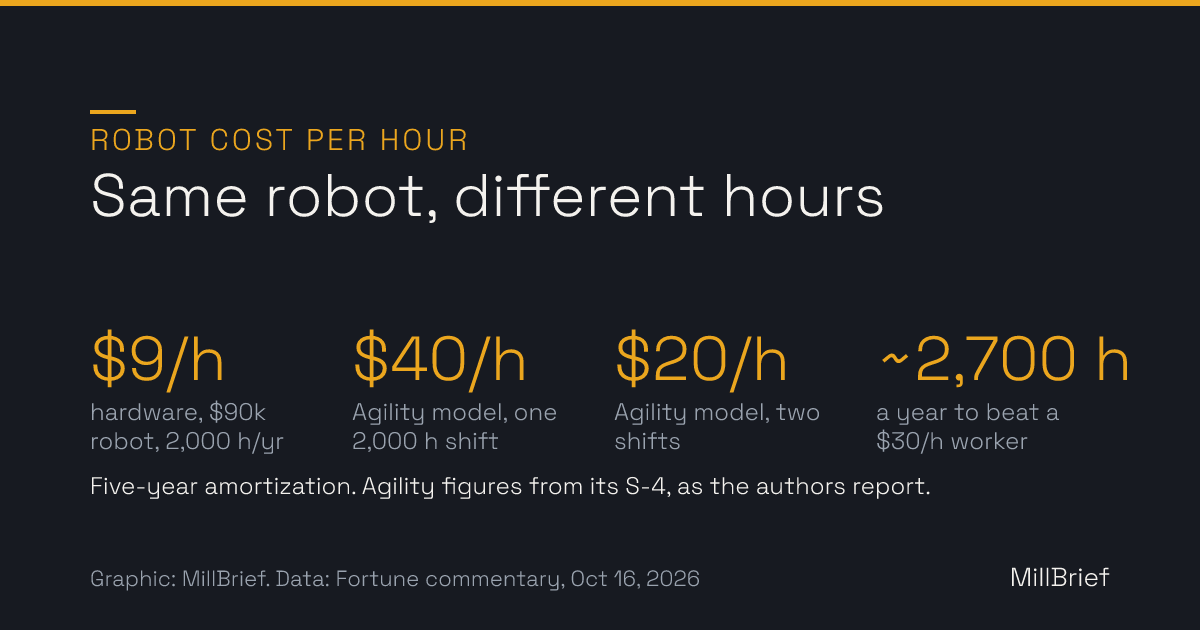
Why it matters: The most useful number in any robot quote is one the vendor cannot give you: how many hours a year the cell will really run on your floor. In the authors’ own example, halving the hours doubles the hardware cost per hour, so a robot that waits for parts, changeovers or an operator on a single shift can cost far more per hour than the brochure suggests. Before comparing a robot with a wage, write down realistic run hours per year (not shift hours), then put them into our TCO calculator along with integration, maintenance and supervision. If a vendor offers per-pick or per-hour pricing, ask what your bill looks like in a slow month.
Source: Fortune, October 16, 2026 (commentary by investors, with disclosure).
Agility names Nyobolt as the sole battery supplier for Digit 5
Agility Robotics announced on October 15 that Nyobolt, a battery company based in Cambridge, UK, and founded in 2019, is the technology provider for the fast-recharge battery system in its Digit 5 humanoid. The release was reported by The Robot Report the same day and by Interesting Engineering on October 17. We covered Digit 5’s specifications when it launched in September; what is new is the supplier and what the release says about that relationship.
The performance figures are Agility’s: 90 minutes of runtime from a nine-minute charge, a 10:1 run-to-charge ratio against 2:1 for Digit 4, and more than 20 hours of productive work in a 24-hour day. “For our customers, Digit’s uptime is the business case,” said Daniel Diez, Agility’s chief business officer. As Interesting Engineering points out, the announcement gives neither the battery’s capacity nor a cycle-life figure. Early access to Digit 5 with the new battery is expected in the first half of 2027, with availability increasing over the following six to nine months. The Robot Report adds that Nyobolt reached a $1 billion valuation in May 2026 when it raised $60 million, with support that included Symbotic.
The fine print is worth reading. Among the risks listed in the release’s forward-looking statements is “the Company’s reliance on Nyobolt as the exclusive provider of battery technology for Digit 5,” and the risk that Nyobolt may be unable to supply battery systems in the quantities, at the quality or on the timeline required. Agility is also still completing its merger with the blank-check company Churchill Capital Corp XI, which the release says is expected to close in the fourth quarter of 2026.
Why it matters: Fast charging is how Agility says it will get Digit 5 to more than two shifts a day, and the Fortune arithmetic above shows why those hours decide the cost. Digit 5 with this battery is not due at customer sites until early access in the first half of 2027, so for now the 20-hour figure is a company target. For any mobile robot or humanoid you evaluate, ask how long a charge lasts on your duty cycle, how many charge cycles the pack is rated for and what a replacement costs, and who supplies it. Where there is one battery source, put spare packs, lead times and supply interruptions into the service agreement, and see our questions to ask a system integrator for the rest of the list.
Sources: Nyobolt, October 15, 2026 (press release); The Robot Report, October 15, 2026; Interesting Engineering, October 17, 2026.
Before you defer that machine again, add up what it already costs
Eclipse Automation, which designs and builds factory automation systems, published an article on October 16 by its marketing manager, Katie Windley, on the cost of putting off an equipment upgrade. It is vendor writing and it ends with a pitch for Eclipse’s assessment and simulation services, but the method in it is one any plant can use on its own.
The article’s starting point is that the cost of keeping a failing machine is spread across budgets. Maintenance pays for the parts and call-outs, operations pays the overtime to recover lost hours, quality carries the scrap and rework, and customer service pays for expedited freight, so no single line shows the total. Its suggested exercise is to add up twelve months of running as-is: maintenance spent on the asset, unplanned downtime converted to lost units at the demonstrated run rate and valued at contribution margin, scrap and rework from that station, overtime for recovery, and expedited freight tied to late shipments. Costs that are harder to pin down, such as a quote priced conservatively because nobody trusted the line or a product variant the plant could not take on, go in as clearly labelled estimates.
The article is also candid about when new equipment is the wrong answer. It says to test first whether a rebuild, a controls retrofit or a return to disciplined preventive maintenance would close the gap, and warns that replacing a reliable machine only because it is old ties up capital: “Age is a poor proxy for cost.” Where the data does not exist yet, it suggests basic machine monitoring on one or two critical assets, which it says will give a defensible baseline within a quarter.
Why it matters: Small plants often defer a capital request because the purchase price is the only number on the page. A year of the status quo, totalled from the maintenance, quality and overtime records you already keep, changes that conversation, and it can also show that better maintenance is the cheaper fix. Once you have the baseline, our guide to calculating automation payback honestly shows how to set it against the all-in project cost, and our field note on the case against automating your worst process explains why an unstable station needs fixing before a robot goes in.
Source: Eclipse Automation, October 16, 2026 (company article).
Sources
- Does a robot cost $2 or $35 an hour? A multitrillion-dollar market depends on how the answer (Fortune (commentary), 2026-10-16)
- Agility Robotics Selects Nyobolt as its Ultra-Fast Charging Battery Technology Partner for Digit 5 (Nyobolt (press release), 2026-10-15)
- Agility chooses Nyobolt for ultra-fast charging for Digit 5 humanoid (The Robot Report, 2026-10-15)
- US humanoid robot Digit 5 targets 20-hour workdays with 9-minute charging (Interesting Engineering, 2026-10-17)
- Monday Morning Plant Manager: What is delaying automation already costing you? (Eclipse Automation (company article), 2026-10-16)