Industry Brief, October 19, 2026: Capex plans, machine tool orders, factory output
A quiet weekend for news, so today’s brief looks back at the data released last week on whether manufacturers are buying equipment. Three sources point the same way: a regional Fed survey in which no responding firm plans to cut capital spending next year, U.S. machine tool orders at their third-highest monthly total on record, and federal output data showing machinery production up in September. None of it is a forecast for your plant, but it does bear on how busy your suppliers and integrators are likely to be.
No Philadelphia-area manufacturer in the survey plans to cut capital spending in 2027
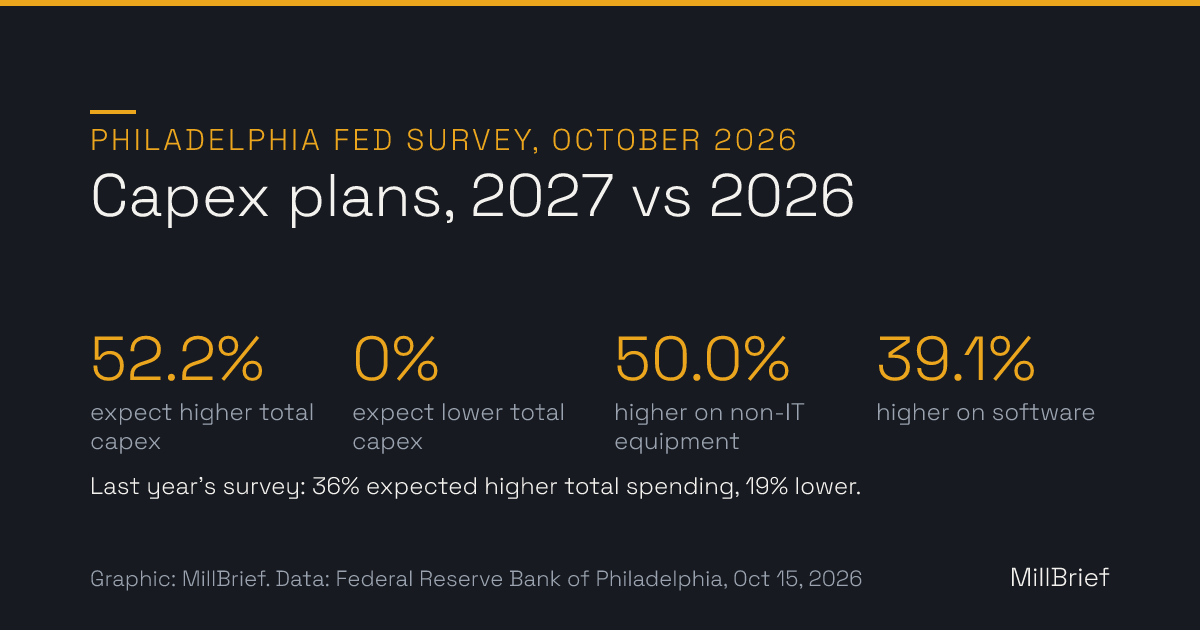
The Federal Reserve Bank of Philadelphia’s October Manufacturing Business Outlook Survey, released October 15, asked firms in its region how their capital spending in 2027 will compare with 2026. Of the firms that answered, 52.2% expect higher total capital spending, 47.8% expect it to stay the same and none expect it to fall. When the bank asked the same question a year ago, 36% expected an increase and 19% a decrease.
By category, plans to spend more were most widespread for noncomputer equipment, the category closest to automation hardware: 50.0% of firms expect to spend more and none expect to spend less. Software and computer hardware each came in at 39.1% higher and 8.7% lower. Energy-saving investments were the weakest category, at 27.3% higher and 13.6% lower. The bank notes that at least half of firms expect spending to stay the same in every category. The report does not say how many firms answered the special question; the percentages are consistent with about two dozen (our inference: for example, 12 of 23 is 52.2% and 2 of 23 is 8.7%), so treat the split as indicative rather than precise.
The rest of the survey was softer. The current general activity index fell from 37.8 in September to 20.9, the new orders index fell 25 points to 4.3, and the index for capital spending over the next six months edged down 2 points to 34.9. Prices are still rising on balance: the prices paid index was 43.2, with no firm reporting lower input prices, and the prices received index rose 9 points to 40.1, its highest reading since May 2025. Responses were collected from October 5 to October 12.
Why it matters: This is one region and a small sample, but the direction is clear: equipment budgets for 2027 are being set higher, not lower, at the firms that answered. If your plant is planning a cell for next year, other buyers are lining up for the same integrators and the same machines. Getting a written scope out early, using our RFQ guide or the RFQ generator, can help secure a place in an integrator’s schedule and leaves time to compare quotes. With prices paid and prices received both still rising, ask suppliers how long a quote is valid and what escalation terms apply if the order slips into 2027.
Source: Federal Reserve Bank of Philadelphia, October 15, 2026.
Machine tool orders reach their third-highest month, and job shops pick up
U.S. orders for metal cutting and metal forming machinery totalled $732.9 million in August, according to the U.S. Manufacturing Technology Orders report released October 12 by AMT, The Association For Manufacturing Technology. That is 21.0% above July and 36.3% above August 2025, and AMT says it is the third-highest monthly total recorded. Orders for the first eight months of 2026 reached $4.76 billion, up 36.9% on the same period last year. August made six consecutive months above half a billion dollars, which AMT calls the longest such streak on record. (When we covered July’s report in September, the figure was $605.8 million; our check: $732.9 million divided by $605.8 million is about 1.21, matching AMT’s 21.0% rise.)
AMT explains the size of the orders much as it did for July: since the current expansion began in September 2024, order values have grown nearly three times faster than the number of machines ordered. It credits a growing share of orders from aerospace manufacturers, which tend to buy high-value machinery, and “an ever-growing share of new machinery containing added automation.” American Machinist, reporting the release on October 13, notes that the West was the strongest region in August at $244.8 million, up 91.0% from July.
The new element is contract machine shops. AMT says the expansion so far has been driven mainly by OEMs, which it says generally have a greater appetite for automated machinery than job shops. In August, growth in orders from contract machine shops exceeded overall market growth, and AMT suggests that if job shop demand keeps recovering, orders for the rest of the year “could exceed expectations.”
Why it matters: Job shops are the closest match to many of our readers, and AMT’s data now shows them buying again. When order values run well ahead of unit counts, AMT reads it as buyers spending more on automation with each machine. If you are pricing a new machine tool, ask for quotes with and without the automation package, and compare the automated option against a separate machine-tending cell on an existing machine. Our TCO calculator helps put the options on the same footing.
Sources: AMT, October 12, 2026 (press release); American Machinist, October 13, 2026.
Fed data: machinery output up in September, and cost pressures persist
The Federal Reserve’s industrial production release for September, published October 16, shows manufacturing output up 0.3% after a 0.2% decline in August (revised from 0.3%). Within durable goods, primary metals, machinery, and electrical equipment, appliances and components each rose 1% or more, while motor vehicles and parts fell 3.0%. Output of business equipment was unchanged on the month but 6.7% above September 2025. Total industrial production rose 0.7%, with utilities output up 3.5%.
Capacity utilization in manufacturing rose 0.1 percentage point to 75.9%, which the Fed says is 2.3 points below its 1972 to 2025 average (our check: the average in the release is 78.2%, and 78.2 minus 75.9 is 2.3). In other words, U.S. factories overall still have spare capacity. Over the third quarter, manufacturing output grew at an annual rate of 0.7%, with durable goods up 3.8%, helped by a 28.4% gain in semiconductors and related components, and nondurable goods down 1.6%. The Fed plans an annual revision of these figures on November 24, so the recent months may change.
The Fed’s Beige Book, published October 14 from information collected on or before October 5, gives the qualitative side. Dallas reported robust, broad-based manufacturing growth, six other districts reported modest to moderate manufacturing growth, and the remaining five saw little or none. Shortages persisted for specialized, technical and skilled trade workers, and five districts reported that some firms had reduced staff through attrition, delayed hiring or expected to create fewer jobs after raising productivity by investing in AI. On prices, higher oil prices appeared in every district report, contacts in multiple districts cited price pressure from tariffs and insurance, and firms in several districts expect prices to rise further as contracts come up for renewal.
Why it matters: The pattern across these releases is uneven growth: machinery and metals output up, motor vehicles and parts down, and factories overall running below their long-run average utilization. For a smaller plant, that argues for justifying automation on labour and quality, where the Beige Book says skilled workers remain hard to find, rather than on a need for more capacity. Expect continued price pressure on components and installation, and build that into the budget along with the items in our list of hidden costs of automation.
Sources: Federal Reserve Board, G.17, October 16, 2026; Federal Reserve Board, Beige Book, October 14, 2026.
Sources
- Manufacturing Business Outlook Survey, October 2026 Report (Federal Reserve Bank of Philadelphia, 2026-10-15)
- Rally in Machinery Orders Extends Onto the Heels of IMTS 2026 (AMT, The Association For Manufacturing Technology (press release), 2026-10-12)
- Machine Tool Demand Continues to Grow (American Machinist, 2026-10-13)
- Industrial Production and Capacity Utilization, G.17 (Federal Reserve Board, 2026-10-16)
- Beige Book, October 2026: National Summary (Federal Reserve Board, 2026-10-14)