Industry Brief, October 20, 2026: FANUC academy, Yorkshire robot hub, vision tests
Today’s brief is about the parts of an automation project that sit around the robot: the people who will program and maintain it, the help a first-time buyer can get before signing a purchase order, and whether a vision-guided cell that works on the demo bench will still work under your lights. FANUC has opened a much larger training centre in Michigan, a new publicly funded hub in Yorkshire will walk small manufacturers from feasibility study to deployment, and KUKA has released vision software for its controllers just as a standards committee is drafting a test of how robots cope when their cameras see badly.
FANUC opens an $18 million training academy in Michigan
FANUC America has opened the FANUC Training Academy on its West Campus in Auburn Hills, Michigan, according to a company release dated October 19 and reported the same day by DBusiness. The company describes it as the largest corporate robotics and industrial automation training center in the United States. The three-story building represents an investment of more than $18 million and covers 132,000 square feet, of which 56,300 square feet is training space.
The academy replaces the training facility inside FANUC America’s Rochester Hills headquarters and raises the number of classrooms from 13 to 28, a little more than double (our check: 28 divided by 13 is about 2.15). FANUC says its training network, made up of the academy and eight other regional facilities, can now train about 17,500 participants a year and has more than 160 robots and over 40 CNC simulators. The release says the academy will host training for manufacturers and system integrators, educator certification, and community college and high school programmes. FANUC says the $18 million complements a $90 million Michigan manufacturing expansion it announced in March; U.S. Secretary of Labor Keith Sonderling, quoted in the release, put the combined figure at $108 million (our check: $18 million plus $90 million).
FANUC America CEO Mike Cicco said in the release that the availability of skilled workers “remains one of the industry’s greatest challenges.” The release does not give course prices or say whether the expanded capacity will shorten waiting times for classes.
Why it matters: For a small plant, the first robot usually brings a training bill: someone has to learn to program, recover and maintain the cell, and that means time away from the floor. More classroom capacity at a major robot maker could make course dates easier to get, but the course fees, travel and lost shifts are still part of your project cost. When you request quotes, ask whether operator and maintenance training is included, how many seats, and where it is delivered, and count anything outside the quote as part of the hidden costs of automation. Our list of questions to ask a system integrator covers training and support handover.
Sources: FANUC America release via Processing Magazine, October 19, 2026; DBusiness, October 19, 2026.
A £3.67 million Yorkshire hub will take small manufacturers from feasibility to deployment
The University of Bradford is leading a £3.67 million Yorkshire Robotics Adoption Hub, backed by £2.75 million of grant funding from Innovate UK, Robotics & Automation News reported on October 19. The 42-month programme brings together the University of Bradford, West Yorkshire Manufacturing Services (WYMS), the University of Huddersfield and Olympus Technologies. The article does not say where the remaining £0.92 million comes from (our arithmetic: £3.67 million minus £2.75 million).
The hub aims to engage more than 300 manufacturers, deliver 80 feasibility studies and support at least 30 robotics deployments. Support is stage-gated, moving small and mid-size manufacturers from first engagement through feasibility, business case and supplier selection to deployment, with demonstrators, ROI modelling and hands-on technical input. Myton Food Group and Groupe Atlantic will provide live use cases. The hub will operate across Yorkshire, focused on the M62 and M1/A1 corridors, with a central base at WYMS and a network of demonstrator and “lighthouse” sites.
The article gives the case for the hub: 73% of manufacturing SMEs say they intend to invest in automation, but relatively few go on to implement it, and the UK has around 104 robots per 10,000 manufacturing employees against a global average of 177 (our check: 104 is about 59% of 177).
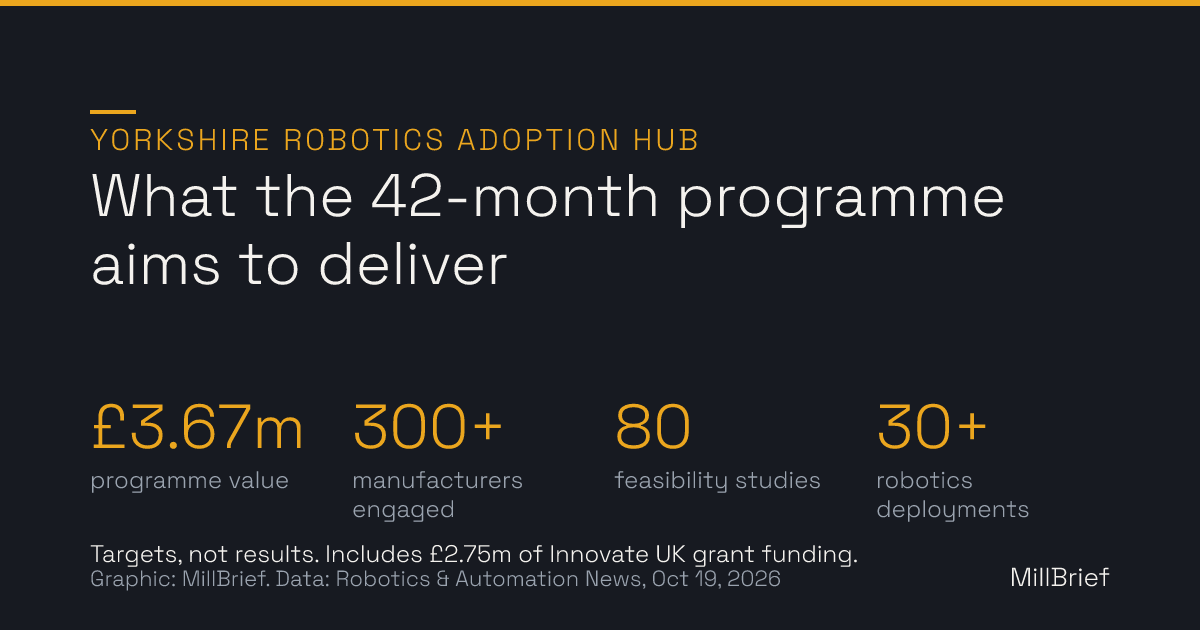
Why it matters: The targets themselves say something about how adoption works. If the hub hits them, about one in four engaged manufacturers gets a feasibility study and about one in ten reaches a deployment (our arithmetic: 80 of 300 is 27%, 30 of 300 is 10%, and 30 of 80 is 37.5%). That is a realistic picture: most first looks at automation should end at the study stage, and a funded study is a cheap way to find out. If you are a Yorkshire manufacturer, this is worth a call. Elsewhere, the stage-gated route is a sensible model to copy with your own integrator: pay for a scoped study first, then decide. Our guide to what to automate first and the RFQ generator can help you arrive with a defined problem.
Source: Robotics & Automation News, October 19, 2026.
KUKA puts AI vision in the controller, as ASTM drafts a test for when cameras see badly
KUKA Robotics has released iiQKA.AI Vision, software for 2D and 3D vision applications such as bin picking, assembly, quality control and depalletizing, according to a KUKA release dated October 19. Applications are set up in KUKA’s iiQWorks software with drag-and-drop tools, pre-built templates and guided workflows, which KUKA says lets integrators and users with limited vision experience build them. Image processing runs in the controller on the KUKA AI Extension Platform, a computing unit based on the NVIDIA Jetson Orin module, with no cloud connection required and images processed and stored on board. Cameras and other compatible components are available directly from KUKA. The company says the software works reliably with varying components and changing lighting; those are vendor claims, and the release gives no prices or performance figures.
Separately, Robotics & Automation News reported on October 19 that ASTM International’s robotics committee, F45, is developing a proposed test method, WK100792, for measuring how the task performance of robot arms and mobile manipulators changes when their optical signal is degraded in a controlled way. The work item page, which we checked on October 20, lists stressors including contrast, the optical properties of the workpiece, illumination, temperature, operating distance, motion during image capture and interference between active sensors. It covers cameras, stereo, structured light, time-of-flight and lidar, and names system integrators and end users among its intended users. ASTM member Aarati Noronha told the outlet that “many tasks that a robot can perform reliably under ideal conditions become much harder in the real world.” It is a proposed standard, not a published one.
Why it matters: Vision is often where a cell that ran cleanly at the integrator’s site starts missing picks on your floor, under different lights and with shinier or dirtier parts. Built-in tools like KUKA’s can lower the cost of adding vision, but they do not remove the need to prove it on your parts. Until a standard test exists, write your own into the RFQ: supply sample parts in their worst real condition, ask for a pick or inspection success rate under your lighting, and make that a condition of acceptance. The RFQ guide and our article on why automation projects fail cover acceptance testing.
Sources: KUKA Robotics release via Robotics Tomorrow, October 19, 2026; Robotics & Automation News, October 19, 2026; ASTM International, WK100792, checked October 20, 2026.
Sources
- FANUC opens largest automation training center in the US (Processing Magazine (FANUC America release via PR Newswire), 2026-10-19)
- FANUC Opens Largest Automation Training Center in the U.S. in Auburn Hills (DBusiness Magazine, 2026-10-19)
- New £3.67 million Yorkshire Robotics Hub will help manufacturers bridge automation gap (Robotics & Automation News, 2026-10-19)
- KUKA Simplifies Industrial Image Processing with AI-Powered Vision Software (Robotics Tomorrow (KUKA Robotics release), 2026-10-19)
- New ASTM standard aims to test how robots perform in the real world (Robotics & Automation News, 2026-10-19)
- WK100792: New Test Method for Measuring Task Performance of Manipulators and Mobile Manipulators Under Controlled Optical Signal Degradation (ASTM International, 2026-10-20)