Industry Brief, October 25, 2026: PHP flaw near plant systems, Eka's picker, FORT
The most urgent item today is not a robot. A pair of critical flaws in PHP, the scripting language behind a large share of the web, has industrial vendors checking their own products, and the exposure in a plant is likely to sit in the small web consoles nobody lists. Eka Robotics raised $150 million for a picking robot it says handles about 1,500 picks an hour, three Korean robot makers are moving AI into production lines, and FORT Robotics, whose safety platform sits inside other companies’ robots, has more money lined up before its planned Nasdaq listing.
PHP2Shell: the risk for plants is in the web consoles nobody lists
The PHP project released fixed versions 8.5.12, 8.4.27, 8.3.36 and 8.2.35 on October 21 for two critical flaws that can allow unauthenticated remote code execution, according to its security advisory. The project says every PHP installation serving web requests is at risk. PHP 8.1 and older no longer get updates from the project, though it published minimal fixes for 7.4, 8.0 and 8.1 for people who build from source.
Engineering.com reported on October 22 that the flaws, nicknamed PHP2Shell and rated 9.2 out of 10, had sat in PHP’s core code since 2012. Its point for manufacturers: ERP, PLM and MES systems are generally not built on PHP, so the exposure is more likely in device consoles, supplier portals, old dashboards and third-party add-ons. The US Cybersecurity and Infrastructure Security Agency (CISA) urged immediate patching and warned that PHP’s presence “may not be directly observable”, and had not seen active exploitation at the time. Cloudflare said it logged millions of exploit attempts within hours of the disclosure.
Industrial vendors are still sorting out what is affected. Engineering.com reports that Siemens acknowledged the flaws on its CERT advisory portal and said it is working on fixes for its infrastructure, OT environment and affected products. Cisco listed its Unified Industrial Wireless Software and IoT Control Center as “Under Investigation”. Palo Alto Networks warned that all versions of its PAN-OS and Panorama are affected; Engineering.com says the exposure is limited to the management web interface and fixes were still pending. A tracker run by the Dutch National Cyber Security Centre (NCSC-NL) listed 635 products from about 430 suppliers as of October 22.
Why it matters: A small plant rarely runs PHP on purpose, but it may own several machines that do: a web page on a gateway, a monitoring box from a machine builder, a building management panel. This week, ask your IT support, your integrator and the builders of any networked machine whether their equipment runs PHP and when a fix will ship, and check the vendor advisory pages and the NCSC-NL list. Keep management web pages off the internet and away from the office network. For new purchases, put security updates and a named contact for advisories into the contract; our questions to ask a system integrator are a starting point.
Sources: Engineering.com, October 22, 2026; PHP security advisory, October 21, 2026.
Eka Robotics raises $150 million for fast, force-aware picking
Eka Robotics, a Cambridge, Massachusetts, startup founded in 2024, has raised a $150 million Series A, The Robot Report reported on October 24. Andreessen Horowitz (a16z) and F-Prime led the round. TechCrunch reported on October 20 that the round values Eka at $1.45 billion post-money. The founders are MIT professor Pulkit Agrawal and former Google DeepMind researcher Tuomas Haarnoja.
Eka’s model is trained in simulation with reinforcement learning, and uses force sensing in the gripper as well as cameras. The company says its robots pick objects they were not trained on at roughly 1,500 operations an hour. TechCrunch reports the robot picks about 1,500 objects of up to 1 kg an hour, against about 600 for a person, and that Eka says it succeeds more than 95% of the time. By our arithmetic that is 2.5 times the human rate (1,500 / 600).
TechCrunch adds that Eka is running pilots, which it describes as secretive, with industrial customers in pick-and-place and wire handling. Agrawal told it the gripper costs less than $1,000 and is rated for 5 million duty cycles, against the 20 million cycle bar of standard industrial arms. University of Illinois professor Kris Hauser, who has seen the robot, said the big test will come when it must run on real lines “without breaking for an entire year”.
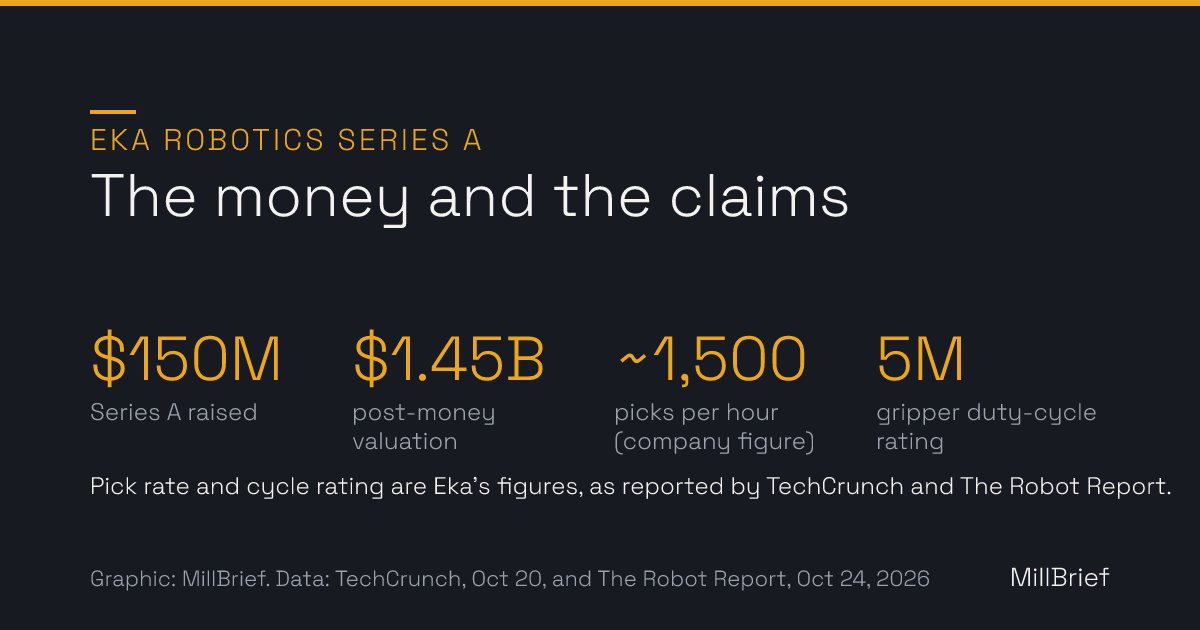
Why it matters: The speed and success numbers are Eka’s own, from demonstrations and pilots, not from a year on a production line. The cycle rating is the number to work through before any pilot. If one pick is one duty cycle, 5 million cycles at 1,500 picks an hour is about 3,333 hours of picking (5,000,000 / 1,500), or roughly 208 days on two 8-hour shifts (3,333 / 16). That is our arithmetic, not Eka’s, but it means a gripper replacement plan, and its cost, belongs in the quote. Put that and the success rate on your own parts into any total cost of ownership comparison.
Sources: The Robot Report, October 24, 2026; TechCrunch, October 20, 2026.
Korean robot makers put AI cobots into machining and PCB lines
Korean robot makers are pushing AI-based robots deeper into factory production lines, the Seoul Economic Daily reported on October 24 (its English edition notes the article is AI-translated from Korean). The most concrete example: cobot maker Neuromeka signed a 1.98 billion won ($1.4 million, the paper’s conversion) contract this month to supply automation equipment to auto parts maker DIC. The project pairs DIC’s existing gantry loader with an AI cobot on an automotive gear machining line, to cut the time it takes to reconfigure when the part type changes.
Neuromeka’s in-house platform lets a robot recognize a part with a camera and work out how to pick or move it, instead of engineers setting motions for each object, and is meant to handle parts it has not seen before. The company is aiming for use on an actual mass-production line in 2027. Power Auto Robotics says it has supplied 97 of its camera-guided PCB component insertion robots to 22 customers, and actuator maker Samhyun has developed a heavy-payload autonomous mobile robot for moving parts inside plants. The companies plan to show their products at Robot World at KINTEX, November 4 to 7.
Why it matters: The DIC project is a pattern a mid-size machine shop can copy: keep the loader you have and add a cobot to make changeovers faster, rather than replace the cell. If a vendor pitches “AI” for part changeovers, ask for the changeover time measured before and after on a line like yours, and how a new part is added in practice. Our anatomy of a first machine tending cell shows what else such a cell needs.
Source: Seoul Economic Daily, October 24, 2026.
FORT Robotics lines up about $20 million more before listing
FORT Robotics, the Philadelphia company whose safety platform is built into other companies’ robots, has about $20 million in new commitments from existing investors, according to a company release on RoboticsTomorrow dated October 22. Tiger Global is leading a financing of about $10 million with Mark Cuban Companies, expected to close that week, and has committed another $10 million to the share placement (PIPE) tied to FORT’s planned merger with Newbury Street II Acquisition Corp. FORT says that brings capital committed in connection with the deal to more than $50 million.
After the merger the company would be named FORT Robotics Holdings and trade on Nasdaq as “FROB”, subject to regulatory approvals. FORT says its platform is deployed in more than 19,500 units at over 600 customers, including Agility Robotics, DoorDash, Zoox and Textron, and that it will use the money to grow its team and capacity. We covered the merger plan on August 19.
Why it matters: Most buyers never sign a contract with FORT, but its safety platform may be inside a robot or vehicle you run, so its health affects support for parts of your safety system. When a mobile robot or humanoid is on your shortlist, ask the vendor which outside suppliers provide its safety functions and what happens to spares and updates if one of them changes hands. Note that these are commitments, and the merger has yet to close. Unplanned stoppages are among the hidden costs of automation.
Source: FORT Robotics release via RoboticsTomorrow, October 22, 2026.
Sources
- PHP2Shell: for manufacturers, the danger goes deeper than a website (Engineering.com, 2026-10-22)
- Security advisory: Critical remote code execution vulnerabilities, update now (The PHP Group (php.net), 2026-10-21)
- Eka Robotics raises $150M to scale its vision-force-action model for robots (The Robot Report, 2026-10-24)
- Eka is worth $1.45B thanks to a physical AI model that has experts raving (TechCrunch, 2026-10-20)
- Korean Robot Makers Push Deeper Into Factory Production Lines (Seoul Economic Daily, 2026-10-24)
- FORT Robotics Secures Approximately $20 Million in Additional Funding Led by Tiger Global and Mark Cuban Companies (RoboticsTomorrow (FORT Robotics release), 2026-10-22)