Industry Brief, October 26, 2026: UR adds Sereact AI, FCC rule's cost, blow-off math
A quiet weekend, so three items today, each about a cost a buyer can check. The company behind Universal Robots has partnered with an AI software maker whose picking system already runs on its arms in European warehouses. A research firm’s model of the US rule on foreign-made robots is back in the news, and the figures need reading with care. And a plain piece of arithmetic shows what the compressed air blowing parts clean on your line may cost a year. As always, vendor numbers are labelled as vendor numbers, and any arithmetic marked as ours is ours.
Universal Robots arms get Sereact’s picking AI through a formal partnership
Teradyne Robotics, the company behind Universal Robots (UR) and Mobile Industrial Robots (MiR), has partnered with Sereact, a maker of AI software for robots, The Robot Report reported on October 25. The companies announced it at NVIDIA GTC Berlin 2026. Sereact’s Cortex software runs UR arms on unstructured tasks such as returns handling and piece picking, and the companies say they have already shipped hundreds of UR robots in dual-arm systems to live customer sites across Europe.
The best documented site is a returns deployment with CEVA Logistics for the fashion retailer Zalando. At Zalando’s fulfillment centers in Greven, Germany, and Świebodzin, Poland, the robots now process returned fashion items on their own. The Robot Report describes this as the first phase of a wider effort to automate returns across Europe. Beyond retail, the use cases the two companies list include machine tending, kitting, packing and bin consolidation. Sereact opened a US headquarters in Charlestown, Massachusetts, this summer to bring the system to North America.
Sereact CEO Ralf Gulde said every application runs on “the same production model”, with no retraining for each new item or task, and that partnering gives Sereact access to Teradyne’s global distribution and integrator network. Teradyne Robotics chief commercial officer Jacob Pascual Pape said UR robots are proven through more than 100,000 industrial deployments. Both are company claims. The Robot Report adds that Cortex is trained in NVIDIA simulation tools and runs on NVIDIA Jetson Thor hardware at the robot cell.
Why it matters: For a mid-size plant, the useful part is the channel. If the system reaches North America through UR’s distributors and integrators, an AI picking cell may be quoted by the same people who already service your cobots. Ask for figures from a running site, not a demo: picks per hour on a mix like yours, the share of items that need a person, and what happens when a new part arrives. Ask too who supports the AI software and the computer it runs on, and what that costs each year. Put those numbers into a total cost of ownership comparison against a conventional cell.
Source: The Robot Report, October 25, 2026.
What IDC’s model says the FCC robot rule costs, read carefully
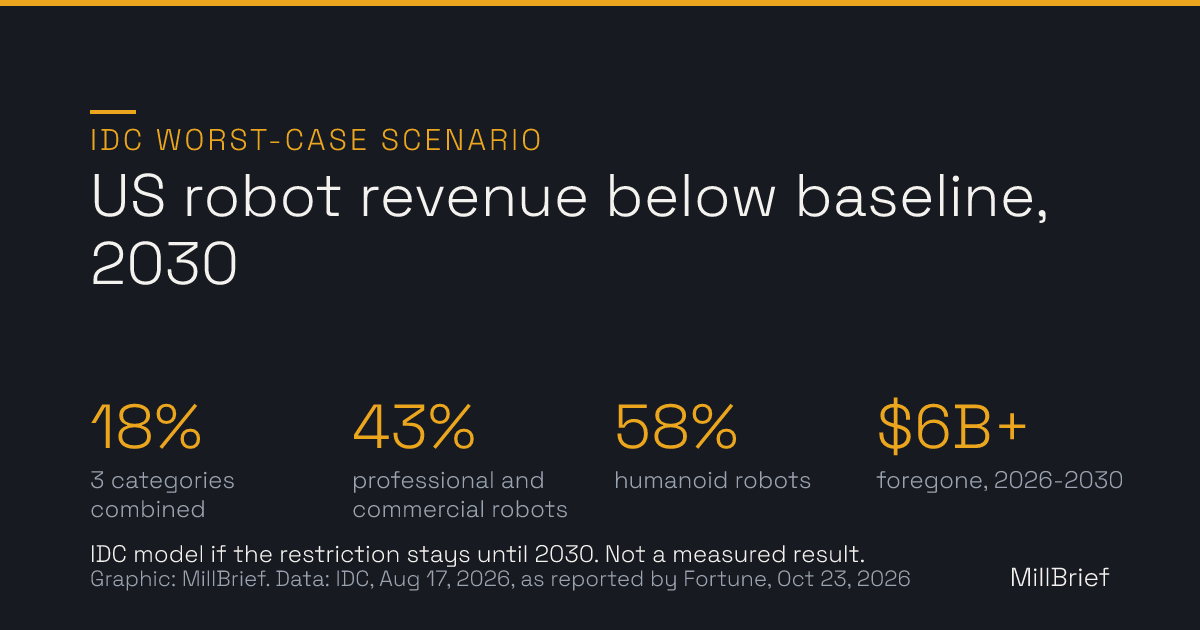
Fortune reported on October 23 that the US restriction on foreign-made robots could leave US humanoid robot revenue 58% below where it would otherwise be by 2030, citing the research firm IDC. The figure comes from an IDC analysis first published on August 17. It is a model, run on IDC’s worst-case scenario in which the restriction stays until 2030, not a measured result.
IDC’s own write-up shows the 58% applies to humanoids, whose US volumes are still small. Across the three categories it tracks in depth (household cleaning, professional and commercial, and humanoid robots), the US gap reaches about 4% below IDC’s baseline in 2027 and 18% by 2030. IDC says that cools US growth in those categories from about 13% a year to 9%, and adds up to more than $6 billion in foregone US revenue from 2026 to 2030. Professional and commercial robots trail their baseline by 29% in 2027 and 43% by 2030. IDC stresses that its figures do not cover the whole robotics market.
The reason humanoids fall furthest, in IDC’s reading, is supply: US humanoid builders still depend on China for motors, actuators, batteries and rare earth materials, and IDC does not expect them to reach scaled mass production until the end of 2028. The softer overall result rests on an assumption that models already authorized before the rule keep selling. That matches the FCC’s July 28 rule as Fortune describes it: new foreign-made models cannot get the authorization needed for US sale, previously authorized models can still be imported and sold, and vendors can seek conditional approval subject to a national-security review and commitments to shift production to the US.
Why it matters: The squeeze in IDC’s model falls on new models, not on machines already approved, so the practical risk for a plant is the next upgrade and the spare parts. One date helps: an FCC waiver issued on July 28 lets advanced robotic devices authorized before the rule keep receiving software and firmware updates that mitigate harm to US consumers, such as security patches, until at least January 1, 2029. Before you buy a foreign-made mobile robot, ask the vendor in writing whether the exact model was authorized before July 28, how it will be supported after January 2029, and whether a replacement model would need new approval. Our RFQ guide shows where such requirements go in a quote request.
Sources: Fortune, October 23, 2026; IDC, August 17, 2026; FCC, DA 26-789, July 28, 2026.
Pricing the compressed air that blows parts clean
An article in Robotics & Automation News on October 24 sets out how to put a yearly cost on blow-off, the compressed air that blows parts clean as they move down a line. It needs five inputs: the horsepower of the compressor feeding the blow-off, hours per day, days per week, the electricity rate, and the number of identical lines. Its example is one line fed by a 50 horsepower compressor running around the clock at $0.10 per kWh: 50 hp x 0.746 = 37.3 kW, times 8,736 hours a year (24 x 7 x 52), is about 325,900 kWh, or about $32,600 a year. We checked the figures and they hold.
The article is clear about the shortcuts. Treating nameplate horsepower as the electrical load leaves out motor efficiency; the US Department of Energy’s formula divides by 90%, which raises the figure by about 11%. By our arithmetic that is about $36,200 ($32,600 / 0.9). In the other direction, real compressors cycle, unload and idle, so the true cost is usually lower. Citing the DOE, the article says leaks can waste 20 to 30% of a compressor’s output, and a poorly maintained plant typically loses about 20%.
Its suggested order of fixes: find and repair leaks, and put a solenoid valve on each station so air flows only while a part is present; replace open pipes and drilled tubes with engineered nozzles; and, where a task needs lots of air at low pressure, as drying, debris removal and cooling often do, move it to a blower-driven system such as an air knife. Blowers do not suit cleaning blind holes, clearing fine passages or driving pneumatic actuators, and they bring their own noise, floor space and ductwork.
Why it matters: The same arithmetic works for a smaller shop. By our arithmetic, the same compressor on one shift of 8 hours, 5 days a week, runs 2,080 hours a year (8 x 5 x 52), or about 77,600 kWh (37.3 x 2,080), roughly $7,800 a year at $0.10. That is before the efficiency correction, and at full load, which a real compressor will not hold. The article’s best advice is to measure: put a logger on the compressor feeding your longest-running station for one production week and compare the reading with the estimate, since a gap usually means a leak or an idle load. Compressed air is one of the hidden running costs of automation, so ask any integrator quoting a new cell how much air it will draw.
Source: Robotics & Automation News, October 24, 2026.
Sources
- Teradyne Robotics partners with Sereact to scale physical AI in retail and logistics (The Robot Report, 2026-10-25)
- Washington's curbs on foreign robots could slash the U.S.'s humanoid robotics revenue by 58%, as companies lose access to China (Fortune, 2026-10-23)
- What Does the US Robotics Ban on Foreign Imports Really Mean? Here's IDC's Take (IDC, 2026-08-17)
- OET announces waiver of prohibitions on certain Class I and Class II permissive changes to covered foreign-produced advanced robotic devices and power inverters (DA 26-789) (Federal Communications Commission, 2026-07-28)
- Putting a Dollar Figure on Compressed Air Blow-Off (Robotics & Automation News, 2026-10-24)