Industry Brief, October 28, 2026: BMW driverless moves, Edeka meat robots, Comau food oil
Three items today, all about automation that is already running or about to ship, rather than demos. BMW and its software supplier Embotech say they have now moved a million finished cars around four plants with nobody behind the wheel, using sensors fixed in the building instead of on the vehicles. A German supermarket group has added two robots to pick chilled meat in a warehouse it automated seven years ago. And Comau is bringing robots lubricated with food-grade oil to a food technology fair in Parma this week. As always, vendor numbers are labelled as vendor numbers, and any arithmetic marked as ours is ours.
BMW has moved a million cars with nobody driving them
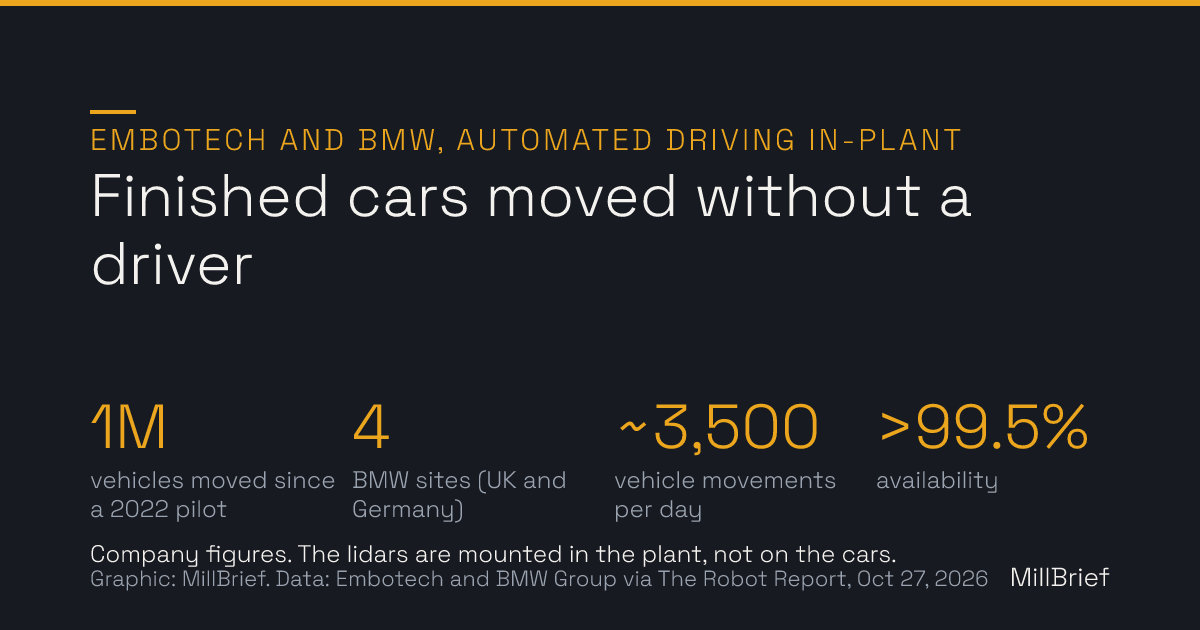
When a car comes off the end of an assembly line, someone usually has to get in and drive it to a parking area or a truck. Embotech, a Zurich company spun out of ETH Zurich in 2013, and BMW Group said on October 27 that they have now moved 1 million vehicles using Embotech’s automated driving system instead, across four sites: Dingolfing, Leipzig and Regensburg in Germany, and the MINI plant in Oxford, England, The Robot Report reported. The work started with a pilot in 2022. The companies put the system at about 3,500 vehicle movements a day, with more than 99.5% availability.
The design choice is the interesting part. Embotech’s chief commercial officer, Eva Beck, told The Robot Report that the perception sits in the infrastructure: Hesai lidars are mounted in the production environment, so the cars need no extra sensors or self-driving hardware of their own. Offboard computers and servers optimize the driving paths ten times a second, and the system connects to the car’s existing drive-by-wire controls. A separate safety layer, independently certified by TÜV SÜD, sets and enforces the safety boundary, and the system works alongside people and manually driven vehicles. Embotech describes itself as the first company to hold multiple TÜV-certified Level 4 systems; that is its own claim.
The pace is picking up, by the companies’ account. Embotech’s chief executive, Andreas Kyrtatos, said the first 500,000 moves took 15 months and the next 500,000 took seven. By our arithmetic that is roughly twice the monthly rate (500,000 / 15 = about 33,000 a month; 500,000 / 7 = about 71,000 a month). Beck said the companies are also looking to roll the system out at BMW’s Spartanburg, South Carolina, plant next year. No cost figures were given.
Why it matters: Few small or mid-size plants ship cars, but the idea carries over: put the sensing and the computing in the building, and the things being moved can stay simple. The same logic applies to carts, tuggers and pallet moves on a fixed route. Note too how the result is reported, as an availability figure at running sites rather than a demo video. When a vendor quotes you a mobile or driverless system, ask for the same thing: availability and moves per day at a live customer, and how that availability is defined. Our OEE explainer covers why the definition matters, and our hidden costs page lists what vendor quotes tend to leave out, from licenses and utilities to service contracts, which matters when part of the system lives in your building.
Source: The Robot Report, October 27, 2026.
Edeka adds two robots to pick chilled meat, seven years in
German supermarket group Edeka has added two Pick-it-Easy Robots from Knapp to the automated warehouse at its Nordfrische meat facility in Lüttow-Valluhn, east of Hamburg, Robotics & Automation News reported on October 26. Knapp installed the original system in 2019. The site supplies around 650 stores with some 2,500 fresh meat, sausage and deli products every day, and the system handles up to 40,000 containers a day in an 86,000 square foot area (about 8,000 square meters, by our conversion) held at +2°C.
The two robots use AI-supported vision to recognise and pick individual items, and they also scan barcodes and record the weight of each item. The announcement puts their performance at around 450 picks per robot per hour; that is a supplier-side figure, not an independent measurement. By our arithmetic, two robots at that rate would manage about 900 picks an hour, or 21,600 a day at that rate around the clock; the article says the robots operate 24/7 but gives no daily pick count. The robots sit beside two other picking methods: ergonomic goods-to-person workstations and pick-to-light stations, used for items with different turnover rates. Goods are stored in a shuttle system with around 70,000 locations, and Knapp’s KiSoft software runs the flows from goods-in to shipping.
The facility’s managing director, Matthias Biermann, said the robots let the site pick around the clock when needed and take strain off employees. No cost, payback or headcount figures were given.
Why it matters: This is how most automation actually grows: a system bought in 2019 gets two robots added in 2026, alongside people and other picking stations rather than replacing them. If you are buying a first system, ask how it can be extended later, whether the control software can take a robot cell without a rewrite, and who owns that integration. Edeka’s mix of robots, goods-to-person stations and pick-to-light for items with different turnover rates also shows the value of matching the method to the item. Our guide on what to automate first makes the same point for a factory floor, and our RFQ guide includes a copy-usable skeleton you can add that requirement to.
Source: Robotics & Automation News, October 26, 2026.
Comau’s food robots use food-grade oil instead of covers
Comau will introduce its Hygienic Oil (HO) Family of robots at CIBUS TEC 2026 in Parma, Italy, which runs from October 27 to 30, according to a company release published by RoboticsTomorrow on October 27. The HO robots use NSF H1 food-grade lubricants, which Comau says helps minimize contamination risks without the need for protective robot covers. The family spans several payloads, from its Rebel SCARA and its Racer and NJ articulated robots up to palletizing robots, and Comau pitches it at fast jobs such as pick-and-place, portioning, processing and handling.
On the stand, Comau is showing a dedicated four-axis food-grade articulated robot, the S-18-1.7 HO, a food-handling cell built on a Racer-5 SE with partners Progea Leonardo and Camozzi, and a pick-and-place cell for packaged products using its MyCo collaborative robot, developed with Innovision. Comau’s wholly owned Automha is showing a shuttle that travels rack aisles in all four directions and reaches deep-lane storage, plus a new version of its multi-depth pallet storage shuttle. The release gives no prices or delivery dates.
Why it matters: For a small food or beverage plant, robot covers can be a running cost: they wear and tear, and have to be checked and replaced to keep washdown and contamination controls intact. A robot built with food-grade lubricant could remove part of that burden, but that depends on your hygiene plan and your auditor, not on the brochure. Before you drop covers from a quote, ask which models in the family use H1 lubricant throughout, what washdown and ingress ratings each one has, and what your food safety auditor will accept for the zone the robot works in. Then put the cover savings, if any, into a total cost of ownership comparison against a covered standard robot.
Source: RoboticsTomorrow (Comau release), October 27, 2026.
Sources
- Embotech and BMW move 1M vehicles with automated driving technology (The Robot Report, 2026-10-27)
- Edeka adds Knapp robots to automate meat picking at German distribution center (Robotics & Automation News, 2026-10-26)
- Comau and Automha bring end-to-end automation for food & beverage to CIBUS TEC 2026 (RoboticsTomorrow (Comau release), 2026-10-27)