Industry Brief, October 31, 2026: Agility's smaller raise, a starter pallet shuttle
Three items today. Agility Robotics, the humanoid maker whose customers include Toyota and Schaeffler, now expects to raise about $465 million as it goes public, well short of what it projected in June. Jungheinrich and Automha are selling a pallet shuttle meant as a first step into automated storage, with the forklifts staying for now. And the head of an AGV navigation company argues that the costliest mistakes in mobile robot projects are made before the first vehicle arrives. Vendor numbers are labelled as vendor numbers, and any arithmetic marked as ours is ours.
Agility’s SPAC raise comes in at about $465 million
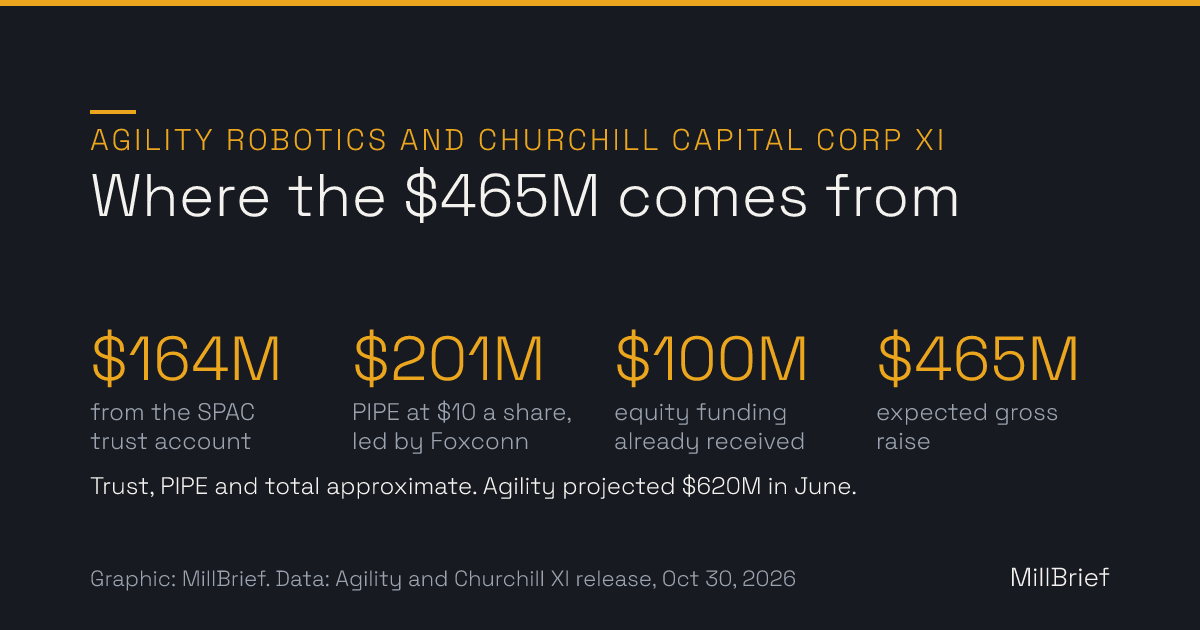
Agility Robotics and Churchill Capital Corp XI, the special purpose acquisition company (SPAC) it is merging with, said on October 30 that Agility expects to raise about $465 million before transaction expenses, in a press release filed with the SEC. The figure came after the deadline for Churchill XI shareholders to redeem their shares for cash. It is made up of about $164 million from Churchill XI’s trust account, about $201 million from a share placement (PIPE) at $10 a share led by Foxconn, and $100 million of equity funding Agility has already received since the deal was announced ($164M + $201M + $100M = $465M, our check).
The Robot Report notes that this is less than the $620 million Agility projected, at a $2.5 billion valuation, when it announced the deal in June. By our count that is $155 million less (620 - 465 = 155). The outlet also recalls that Agility reported $1.8 million in net sales for 2025 in its September S-4 filing.
Churchill XI shareholders vote on November 2. If they approve, the companies expect to close on November 4, and the combined company is expected to start trading on Nasdaq as “AGLT” on November 5. Agility says it remains on track to deliver its Digit 5 humanoid to early-access customers in the first half of 2027, with general availability targeted for the end of 2027. It repeats that it has more than $300 million in committed multi-year orders for Digit 5, and the release itself cautions that this figure is potential value over several years, depends on contractual milestones, features and specifications, and is not current revenue.
Why it matters: $465 million is still a lot of money, so this is not a warning sign on its own. But if you are in talks about a humanoid pilot, with Agility or anyone else, remember that the machine you would buy (Digit 5) is not targeted for general availability until the end of 2027, and the business behind it is still small in revenue terms. Put the supplier’s commitments on spares, software updates and support in the contract, ask what happens to them if the company is sold or changes direction, and price the pilot with our TCO calculator rather than on the hourly rate alone.
Sources: Agility Robotics and Churchill XI via SEC Form 425 and The Robot Report, October 30, 2026.
Jungheinrich and Automha sell a pallet shuttle you can start with forklifts
Jungheinrich, the German forklift and intralogistics company, has formed a strategic partnership with Automha, the Italian warehouse automation specialist, around a two-way pallet shuttle for high-density pallet storage called the UP-Carrier GTJ, reported Robotics & Automation News on October 30 and DC Velocity on October 26. Automha supplies the shuttle technology; Jungheinrich supplies system integration, software and lifecycle service.
The pitch is a staged route. The shuttle fits into existing warehouses and raises storage density without major building work, the companies say. At first, forklifts and other industrial trucks still carry pallets to and from the racking; transport can be automated later, and the system can be extended with other automation such as Jungheinrich’s mobile robots. Jungheinrich positions it below the four-way shuttles of its partner Movu Robotics, which it says are mainly used in fully automated, high-performance pallet warehouses. The companies say the shuttle went from concept to market readiness in nine months and is already used in more than 200 projects in over 25 countries. No prices were given.
Why it matters: For a plant whose raw material or finished goods store is full, a lane shuttle fed by the forklifts you already have is a much smaller first step than an automated warehouse. Before you take the “start small, grow later” pitch at face value, ask the vendor to put the later steps in writing: which racking, controls and software you buy now still work when transport is automated, and roughly what that second stage costs. Our page on what to automate first helps decide whether storage is the right place to start, and ask for a reference site among those 200 projects that is similar to yours.
Sources: Robotics & Automation News, October 30, 2026; DC Velocity, October 26, 2026.
Simulate the AMR fleet before it arrives, says a navigation vendor
In an opinion column for Robotics & Automation News, Nicola Tomatis, chief executive of BlueBotics (which sells navigation and fleet management software for AGVs and AMRs, and a vehicle simulator), argues that fleet size, routes, charging points and pick and drop locations are usually fixed before commissioning, and are expensive to change once the layout is built. A spreadsheet of mission volumes, distances and speeds may be enough for two or three vehicles on simple routes, he writes, but not for larger fleets, where vehicles slow in curves, wait at crossings and leave work to charge.
His examples come from his own company’s work. Vehicles with similar specifications can behave very differently: one may take five seconds to pick up or set down a pallet, another 10. In one simulated comparison, one vehicle configuration would have needed around 30% more vehicles for the same job. He puts the point where simulation becomes clearly worthwhile at roughly five to ten vehicles, earlier in a cramped layout. For a seven-vehicle, mixed-brand AGV fleet at a packaging producer in Japan, he says, simulation found potential deadlocks before commissioning, on-site commissioning took around two weeks, and the project team estimated it could otherwise have taken twice as long or more. BlueBotics says its simulator typically matches the real installation with more than 95% accuracy; that is the vendor’s claim, and he notes a margin is still needed for obstacles, emergency stops and people.
Why it matters: The vendor sells the tool, but the questions stand on their own. If an integrator quotes you a mobile robot fleet, ask how they arrived at the number of vehicles, whether the model includes real pick and drop times, charging and traffic at crossings, and who pays for extra vehicles if the fleet falls short. Write the throughput the fleet must reach into the acceptance test. Our RFQ guide and our page on why automation projects fail cover how to pin this down before you sign.
Source: Robotics & Automation News, October 30, 2026 (opinion column by the CEO of BlueBotics).
Sources
- Agility Robotics and Churchill Capital Corp XI Announce Expected Gross Capital Raise of Approximately $465 Million and Anticipated Closing of Business Combination (Form 425, Exhibit 99.1) (U.S. Securities and Exchange Commission (Churchill Capital Corp XI filing), 2026-10-30)
- Humanoid developer Agility now expects to raise $465M in SPAC deal (The Robot Report, 2026-10-30)
- Jungheinrich and Automha partner on warehouse automation (Robotics & Automation News, 2026-10-30)
- Jungheinrich teams with Automha to provide "entry point into warehouse automation" (DC Velocity, 2026-10-26)
- Opinion: The riskiest automation decisions happen before deployment (Robotics & Automation News, 2026-10-30)