Industry Brief, November 1, 2026: Mitsubishi's FA surge, assembly as a service
Three items today. Mitsubishi Electric, the Tokyo-based electronics group, says orders in its factory automation business rose by almost half in the six months to September, and it has raised its profit forecast for that business by about 32%. A startup called Foundry Robotics has raised $100 million to run robot assembly cells as a contract manufacturer. And CNBC looked at how Rivian, Ford and GM use 3D printers to make their own plant tools, which is something a much smaller plant can copy. Company figures are labelled as such, and arithmetic marked as ours is ours.
Mitsubishi Electric’s factory automation orders jump 48%
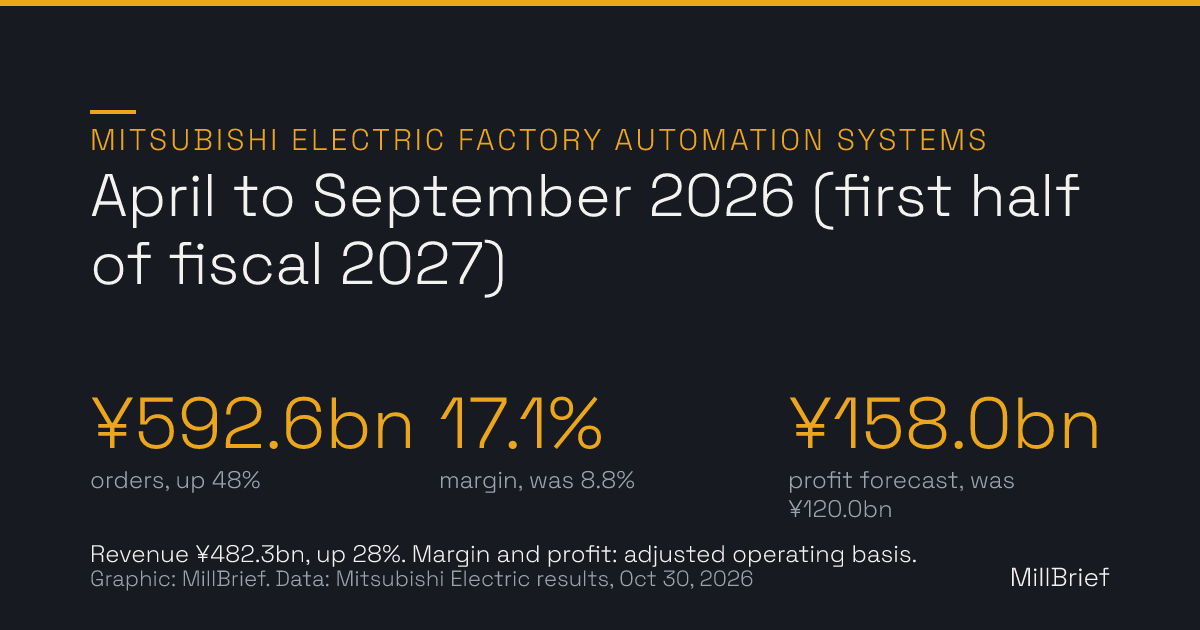
Mitsubishi Electric reported results on October 30 for the first half of its fiscal 2027, which runs from April to September 2026. In its results release and briefing slides, its factory automation (FA) systems business took ¥592.6 billion of orders, up 48% from ¥401.4 billion a year earlier. Revenue rose 28% to ¥482.3 billion, and adjusted operating profit rose 148% to ¥82.2 billion, lifting the margin from 8.8% to 17.1%. At the company’s own average rate for the half of ¥160 to the dollar, those orders are about $3.7 billion (592.6 / 160 = 3.70, our conversion).
The company explains the jump with capital spending on semiconductors, electronic components and servers, mainly in Japan, China and South Korea, driven by AI and chip demand. It also says FA profit was helped by the weaker yen, not just by volume. Order growth has been building: year on year, FA orders rose 23%, 15%, 17% and 30% in the four quarters of last fiscal year, then 42% and 54% in the two quarters just reported.
Mitsubishi Electric now forecasts FA revenue of ¥990.0 billion and adjusted operating profit of ¥158.0 billion for the full year, up from ¥900.0 billion and ¥120.0 billion in its July 31 forecast. By our count the profit forecast rose by ¥38.0 billion, or about 32% (158.0 / 120.0 = 1.32), and it is roughly double last year’s ¥75.2 billion. Across the whole group, the company’s forecast profit bridge for the year counts about ¥92 billion from price improvements, against about ¥112 billion of higher procurement costs for materials and components. The slides also note its decision to spin off the low-voltage power distribution business inside FA, which is going into the joint venture with ABB that we covered on October 21.
Why it matters: Mitsubishi Electric’s FA orders ran well ahead of its FA revenue in the half (¥592.6 billion against ¥482.3 billion, our comparison), so it is booking work faster than it ships it. That demand comes mostly from chip and electronics plants in Asia, but they buy from the same component makers that small plants do. If a project of yours depends on a particular brand of controls, drives or motion parts, ask the integrator for current lead times at the quote stage, not at order, and ask how long the quoted price holds. Our RFQ guide covers how to write delivery dates and price validity into the request.
Our read: With FA orders up year on year for six straight quarters and growing faster each of the last four, we expect quotes for automation components to stay firm on price and lead time over the next six months rather than soften. A sign we are wrong would be Mitsubishi Electric’s next quarterly results showing year-on-year FA order growth falling back below 20%.
Sources: Mitsubishi Electric results release and briefing slides, October 30, 2026.
Foundry Robotics raises $100 million to sell robot assembly as a service
Foundry Robotics has announced a $100 million Series A round led by Marlinspike Partners, reported Robotics & Automation News on October 31. Early backers Khosla Ventures and Red Glass Ventures took part, along with new investors SE Ventures, Wing VC and Axiom Ventures and existing investors Hanabi and Zero Shot Fund.
Foundry builds and runs its own factories for complex assembly, combining robot cells with experienced manufacturing staff, and sells the output on what it calls a manufacturing-as-a-service model. It says it has grown its footprint twentyfold to a 130,000-square-foot facility in Emeryville, and that it serves defense and commercial customers making high-value electromechanical products, such as drones, wire harnesses, autonomous vehicle subassemblies, rugged computers and satellites. The company claims it can take customers from design to production in weeks, without the customer paying for a new line or retooling, and that its AI models let the same cell learn a new product. Those are the company’s claims; no customer volumes, prices or quality data were given. The president of HII Unmanned Systems is quoted backing the approach. Foundry was co-founded by chief executive Adarsh Kulkarni and Emmanuel Lamacchia, formerly program manager for Tesla’s Model Y.
Why it matters: If you assemble low-volume electromechanical products for defense or industrial customers, Foundry is aimed at your work, and its investors are betting that flexible robot cells can win it. If you buy that kind of assembly, it is one more way to add capacity without buying a line. Either way, judge it like any contract manufacturer: ask for first-pass yield, quality certifications, who owns the fixtures and programs, and what happens to your product if volumes change. Our page on what to automate first helps decide whether assembly is the right step to automate in your own plant instead.
Source: Robotics & Automation News, October 31, 2026.
Carmakers print their own plant tools, and say it pays
CNBC toured the 3D printing operations of Rivian, Ford and GM, which now use the machines for factory tools and some production parts, not just prototypes. Rivian says it has spent more than $5 million on printers, with materials now costing about $1.7 million a year. Jared Beck, who heads its additive manufacturing, told CNBC the machines typically pay for themselves within a year, by cutting supplier tooling and logistics costs and shortening lead times for parts from weeks to days or hours. Rivian has printed screw guides for tooling, stamping press inserts and some trim parts, and is installing a bay of printers at its plant in Normal, Illinois, so employees can print parts on demand.
Ford says its program has more than 200 machines and that it expects to have 3D printing labs at more than 23 plants by the end of this year. At its River Rouge plant, an engineer used roughly two dozen machines to print thousands of tools, such as torque bit sockets, hood jackers and adhesive smoothing tools, and Ford has put in a vending machine stocked with printed parts for F-150 production. Ford also printed a stand-in for a large machining wheel to keep a line running until the supplier’s replacement arrived; the engineer said it did not perform as well as the bought part, but kept the plant running. GM uses 135 printed components on its Cadillac Celestiq. CNBC notes printers range from hundreds of dollars to hundreds of thousands, depending on part size and material.
Why it matters: Jigs, fixtures, gripper fingers and spare guards are a quiet cost in every automation project, and they are often what holds up a robot cell when a part changes. A plant does not need a $5 million program to start: a couple of printers and someone who can model a fixture can cut the wait for small tooling from weeks to days. Treat printed parts as stopgaps or low-load tools until they have proved themselves, as Ford’s own engineer did. Our page on production line automation cost lists end-of-arm tooling and a spares kit among the budget lines to plan for.
Source: CNBC, October 31, 2026.
Sources
- Mitsubishi Electric Announces Consolidated Financial Results for the Second Quarter (First Half) of Fiscal 2027 (Mitsubishi Electric, 2026-10-30)
- Consolidated Financial Results Briefing for the Second Quarter of Fiscal 2027 (Mitsubishi Electric, 2026-10-30)
- Foundry Robotics raises $100 million to build 'America's first autonomous factory for assembly' (Robotics & Automation News, 2026-10-31)
- Automakers like Rivian and Ford are 'democratizing 3D printing' to reduce costs and increase speed (CNBC, 2026-10-31)