Industry Brief, November 2, 2026: Robot regret survey, Walmart's $6B, CMMs at the cell
A quiet weekend for automation news, so three items today, and two of them are about the same question: what you are signing up for after the purchase order. A warehouse robot maker surveyed buyers on why automation disappoints, and the answers are mostly about cost, accountability and timing rather than the robots. Walmart has committed about $6 billion more to Symbotic, a long single-vendor relationship at a scale no small plant will see. And an article on coordinate measuring machines makes the case for checking parts beside an automated cell instead of down the hall. Company figures are labelled as such, and arithmetic marked as ours is ours.
A vendor survey says one in four automation buyers would choose differently
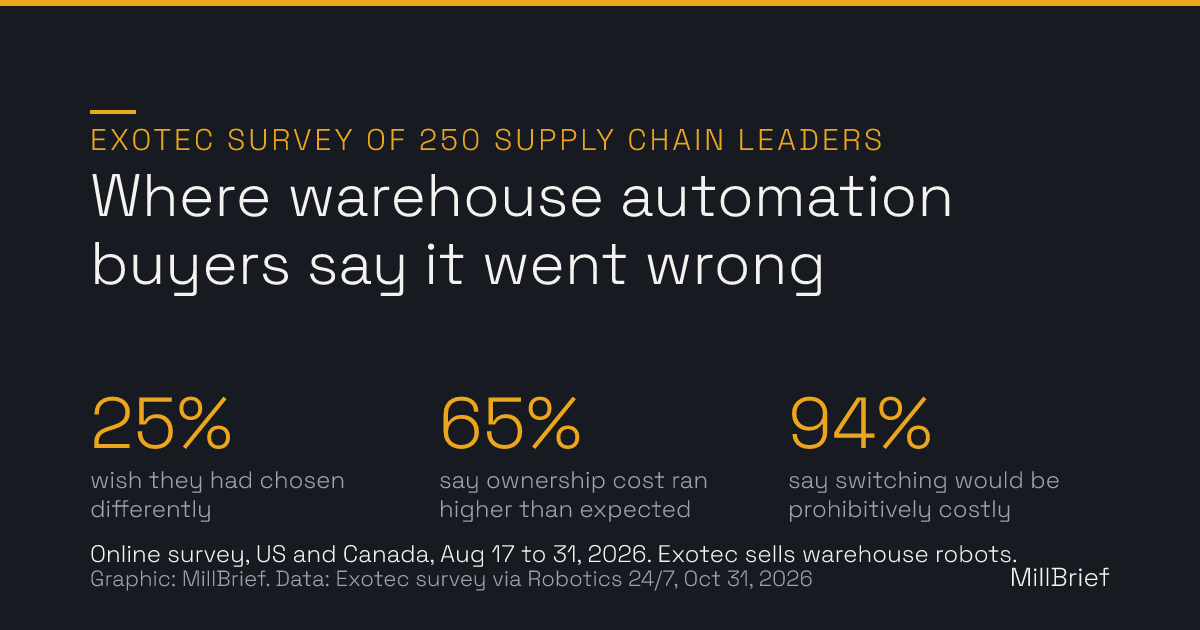
Exotec, which makes warehouse robot systems, has published a report called “Avoid Robot Regret”, based on an online survey of 250 supply chain decision-makers in the United States and Canada, reported Robotics 24/7 on October 31. The survey was prepared by Method Research, distributed by RepData, and run from August 17 to 31, 2026. One in four respondents said they wish they had gone a different way, and 94% said that once the decision was made, switching providers would be prohibitively expensive, which Exotec says leaves most buyers with their system for 10 to 15 years.
Exotec traces the regret to three decisions made before installation. On cost, 65% said total cost of ownership came in higher than expected, 70% said undisclosed costs had raised their annual maintenance spend, and among those whose systems underperformed, 43% said total costs ran 26% to 100% above expectations. On accountability, 60% had a system designed by more than one company, and one in seven said they had not seen the benefits because no vendor takes full responsibility for performance. On timing, 27% said their operation was not ready when they invested. Buyers who chose low-cost providers were the most likely to say they picked the wrong vendor (24% against 5% of other buyers, nearly five times as likely; 24 / 5 = 4.8, our check), and 59% of all respondents said low-cost providers hide costs and common complications up front.
Size did not protect anyone: companies with more than $1 billion in revenue were more likely than smaller ones to say their biggest automation investment underperformed (21% against 13%). Keep in mind who is asking. Exotec sells its own warehouse robot systems, and its chief executive, Romain Moulin, draws the conclusion that a single partner should own the whole system’s performance. That is the company’s argument, not a finding the survey proves.
Why it matters: The sample is warehouse operators, not factories, but the three failure points apply to any robot cell. A quote that leaves out spares, software licences, service and training is how ownership cost “comes in higher than expected”, so ask for those lines in writing and run them over the system’s life. If two or more companies supply parts of the system, put in the contract who owns a fault that sits between them. Our page on the hidden costs of automation lists what quotes tend to leave out, and the TCO calculator puts them into a lifetime figure.
Source: Robotics 24/7, October 31, 2026.
Walmart commits about $6 billion more to Symbotic
Symbotic, a developer of AI-enabled robotics for the supply chain, and Walmart have announced an expanded commercial agreement, reported Robotics & Automation News on October 30. It brings more Symbotic automation to 25 of Walmart’s US regional distribution centers and opens further opportunities across Walmart’s global supply chain. The agreement includes an initial commitment of about $6 billion in spend, covering work over several years at multiple locations. No split by site or year was given.
Symbotic chief executive Rick Cohen said the partnership started with a single product more than a decade ago and now covers a full end-to-end offering. Symbotic’s range today includes a BreakPack each-picking system and the SymMicro micro-fulfillment system for e-commerce. Walmart’s Rob Montgomery, who runs US supply chain operations, said the work helps the retailer improve service, grow capacity, simplify work for staff and lower costs. Walmart says it will use the added automation to support upstream e-commerce inventory management, add storage capacity and make replenishment more reliable. Symbotic is also the company that bought the German sortation maker cellumation, which we covered on October 14.
Why it matters: Few manufacturers will ever sign a deal like this, but it is a clear picture of what the Exotec survey calls lock-in, chosen on purpose: a buyer that stayed with one supplier for more than ten years, then committed to years more. That can work when you have the volume and leverage to hold the supplier to account. A smaller buyer has less of both, so the terms matter more: spare parts pricing, software support periods, access to programs and data, and what happens if the vendor is bought or changes direction. Our list of questions to ask a system integrator covers spares, documentation and commercial terms.
Source: Robotics & Automation News, October 30, 2026.
Why inspection is moving out of the lab and next to the cell
An article on Robotics & Automation News on October 30 argues that as automated cells run longer with fewer people, the walk to the measurement room is becoming the slowest step. A cell that runs overnight can finish a whole batch before anyone carries the first part to the coordinate measuring machine (CMM), and if a tool wears or an offset drifts, every part made while waiting for the report may need rework. Putting a CMM beside the cell lets the first part off a new setup be measured straight away, and a robot can load sample parts on a schedule so trends show up before they become scrap.
The article is frank about the catch. Citing Ted Doiron of the US National Institute of Standards and Technology, it notes that 20 °C has been the reference temperature for industrial length measurement since 1931, because parts change size with temperature. Shop floors rarely hold 20 °C, so floor-ready CMMs use temperature sensors and compensation, and letting freshly machined parts settle for a short time helps readings stay consistent. Bridge CMMs in controlled rooms remain the best choice for the tightest tolerances, so many plants run both: a CMM at the cell for process checks and a lab machine for first article inspection and audits. For results to change anything, they have to reach the cell controller; the article points to the MTConnect data standard as a way for machine tools, robots and inspection equipment to share data. The piece also promotes CMMXYZ, an independent measurement provider in Mississauga, Ontario, that sells refurbished CMMs; it says each unit is restored through a 31-point inspection, with final calibration on the customer’s floor.
Why it matters: If you are planning an unattended machine tending cell, decide how parts will be checked before you decide how many hours it will run alone. A cell that can make a night’s worth of scrap before anyone looks is not saving labour. Options range from in-machine probing to a shop-floor CMM fed by the robot; whichever you choose, ask how it handles temperature on your floor, not in a showroom. Our shop report on a first machine-tending cell walks through the cost lines of a typical first cell.
Source: Robotics & Automation News, October 30, 2026.
Sources
- Report: Exotec says 25% of supply chain leaders regret warehouse automation decision (Robotics 24/7, 2026-10-31)
- Walmart expands Symbotic warehouse automation deal with $6 billion commitment (Robotics & Automation News, 2026-10-30)
- Why Automated Cells Are Pulling Inspection Onto the Shop Floor (Robotics & Automation News, 2026-10-30)