Industry Brief, November 3, 2026: ISO 21423 is out, robots by the hour, 48 V drives
Three items today, and two of them are about mobile robots on a shared floor. The ISO standard meant to let robots from different vendors coordinate in one building has been published, which changes what you can reasonably ask for in an AMR quote. Tutor Intelligence has raised $75 million to grow a model in which customers pay for robot work by the hour or by the pick instead of buying the robot. And Siemens has added a low-voltage drive package for battery-powered vehicles, aimed at the companies that build them. Company figures are labelled as such, and arithmetic marked as ours is ours.
ISO 21423, the mixed-fleet mobile robot standard, is published
The Association for Advancing Automation (A3) announced on November 2 the publication of ISO 21423:2026, an international standard for communication and interoperability among industrial mobile robots (IMRs) regardless of vendor or model, reported Robotics & Automation News; A3’s release also ran on Robotics Tomorrow. Developed by ISO Technical Committee 299, it specifies how mobile robots, fleet managers and other equipment exchange information and request actions. Robots can share their location, speed, direction, condition, tasking and availability with each other, which A3 says should mean fewer cases of robots getting in each other’s way.
The scope goes past the robots themselves. The standard also covers communication with machines tended by robots, enterprise resource planning (ERP) software, and building systems such as lifts, automated doors and alarms, and people with mobile devices can share similar information so their work is coordinated with the robots. Carole Franklin, A3’s director of standards development for robotics, said many leading industrial users had asked for an interoperability standard for years. A3 says it is the first non-safety robot standard it has helped produce, and that a common protocol should increase competition. The document costs $373 from the A3 online store, or $320 for A3 members.
When we covered InOrbit’s open-source reference implementation on September 15, ISO 21423 was still described as upcoming. It is now a published standard you can cite.
Why it matters: Most small plants start with one AMR vendor, then find the second vendor’s robots cannot see the first. A published standard gives you something concrete to write into a request for quote: ask whether the robot and its fleet manager support ISO 21423 today, on a roadmap with a date, or not at all, and whether the lift and door interfaces are covered. Publication does not mean products comply yet, so ask for the answer in writing. Our RFQ guide and RFQ generator show where such a requirement belongs.
Sources: Robotics & Automation News and Robotics Tomorrow (A3 release), November 2, 2026.
Tutor Intelligence raises $75 million to sell robot work by the hour
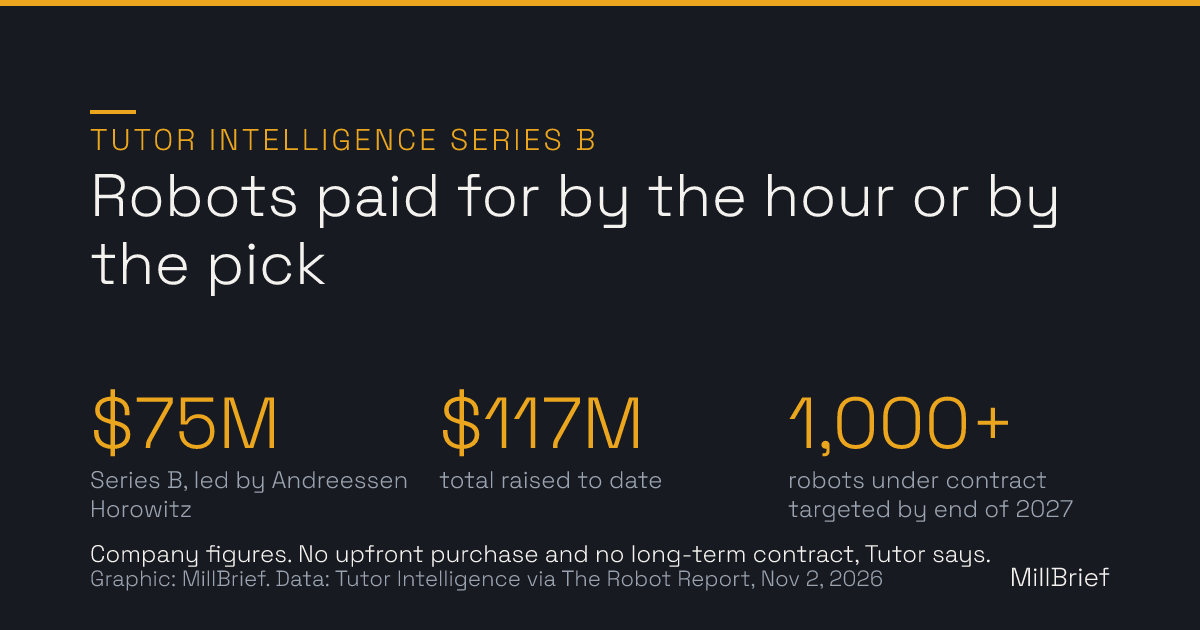
Tutor Intelligence, a Watertown, Massachusetts company spun out of MIT’s Computer Science and Artificial Intelligence Laboratory in 2021, has raised $75 million in Series B funding, reported The Robot Report on November 2. Andreessen Horowitz led the round, with Union Square Ventures and Neo also taking part, bringing the company’s total raised to $117 million (so about $42 million before this round; 117 minus 75, our arithmetic).
The commercial model is the part buyers should notice. Tutor says customers pay by the hour or by the pick, the way they pay for manual labour, with no upfront purchase and no long-term contract, and that it handles deployment, maintenance and software upgrades. Its robots are connected to the internet and get help from remote operators it calls “tutors”; that real-world data trains its AI models. Tutor says its robots will be built in and deployed from the US; The Robot Report adds that the tutors may be overseas. Its products are Sonny, a two-armed robot for each picking, and Cassie, a mobile manipulator for case picking and palletizing, handling goods such as cereals, snacks, candy, cosmetics, home goods and toys.
The company’s own traction figures: twice as many robots working in almost four times as many facilities as a year ago, nearly a third of organisations that received robots in the past 12 months were existing customers adding more, and a target of more than 1,000 robots under contract by the end of 2027. The funding goes to training its robot foundation models and to building and deploying Sonny and Cassie. No hourly or per-pick rates were disclosed.
Why it matters: Paying per hour or per pick moves the risk of a robot that underperforms from your balance sheet to the vendor’s, which is attractive for a packing or palletizing line you are not sure you can justify. The trade-offs are different, not absent: compare the rate with your loaded labour cost per hour or per case, ask what happens to throughput when a remote tutor is slow to respond, who owns the data the robots collect on your floor, and what notice either side must give to end the arrangement. Our automation ROI and payback page sets out the labour-cost side of that comparison.
Source: The Robot Report, November 2, 2026.
Siemens adds a 24 V and 48 V drive package for AGVs and AMRs
Siemens has introduced the Sinamics E210 converter and Simotics E-1EE1 servomotors, a drive package for battery-powered mobile systems such as automated guided vehicles (AGVs) and autonomous mobile robots (AMRs), according to a Siemens release on Robotics Tomorrow on November 2. The E210 is a compact regenerative converter for 24 V and 48 V systems that controls traction and wheel drives as well as steering, lifting and auxiliary axes. It connects directly to the battery, without an extra voltage conversion stage, and supports PROFIsafe, PROFINET IRT and integrated safety functions, with engineering in Siemens’ TIA Portal and its Simove modular system.
The E-1EE1 motors come in shaft heights 40 to 63. Siemens says their 14-bit BiSS-C safety encoder and internal dual-channel design support safety functions up to SIL 2, and an electronic nameplate lets the converter read motor data automatically to simplify commissioning. Holding brakes and several gearbox options are available. The release gives no prices or delivery dates. Siemens’ pitch to vehicle builders is less development effort and simpler safety concepts; those are the company’s claims.
Why it matters: You are unlikely to buy these parts directly; Siemens is aiming them at the vehicle makers and system integrators whose AGVs and AMRs you would buy. If your plant already runs Siemens PLCs, a vehicle using the same drive family and safety bus can be easier for your maintenance team to diagnose and get spares for. When you compare vehicles, ask what drives and safety controllers are inside and how long parts are supported; our list of questions to ask a system integrator covers spares and documentation.
Source: Robotics Tomorrow (Siemens release), November 2, 2026.
Sources
- New ISO standard enables mobile robots from different vendors to work together (Robotics & Automation News, 2026-11-02)
- New ISO Interoperability Standard Helps Mobile Robots from Different Vendors Work Together (Robotics Tomorrow, 2026-11-02)
- Tutor Intelligence raises Series B to scale model training, robot deployments (The Robot Report, 2026-11-02)
- Siemens launches new ELV drive solution for AGVs and mobile robotics (Robotics Tomorrow, 2026-11-02)