Industry Brief, November 4, 2026: Stretch Gen 2, Hexagon buys Waygate, robot disputes
Three items today, and all of them are about what happens after the purchase order. Boston Dynamics has released a second generation of its Stretch trailer unloading robot, rebuilt around the faults that took the first one offline. Hexagon has closed its purchase of Waygate Technologies, the inspection business it bought from Baker Hughes, which changes who you call for CT scanning and ultrasonic testing equipment. And an opinion column makes a practical case for rehearsing, before go-live, what an operator does when they think the robot has made a mistake. Company figures are labelled as such, and arithmetic marked as ours is ours.
Boston Dynamics rebuilds Stretch around uptime and repair time
Boston Dynamics unveiled Stretch Gen 2, the next generation of its autonomous mobile robot for unloading trailers, on November 3, according to the company’s release on Robotics Tomorrow; Interesting Engineering also reported the launch. The company says it analysed data from more than 100,000 operating hours and tens of millions of boxes unloaded by the first generation to find the most common causes of unplanned downtime, and it describes Stretch as having more deployments than any competing product in logistics (its claim).
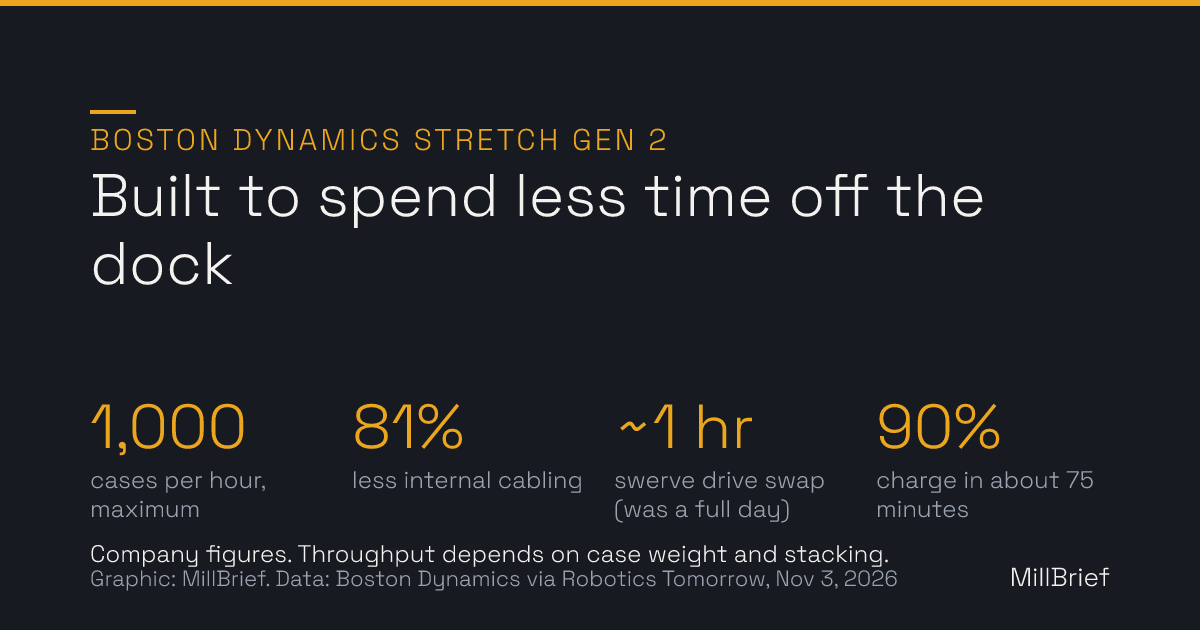
Most of the changes are about keeping the robot running. Internal cabling is cut by 81 percent, about half a mile of it, which Boston Dynamics calls the biggest source of intermittent electrical faults. It uses automotive-grade connectors to cope with vibration, an upgraded gripper with new valves and more precise sensing, and joints that rotate continuously instead of hitting hard stops. The emergency stop now sits lower and is recessed, and new exterior panel materials make it less likely that a falling box trips an unintended safety stop or breaks a panel.
Repairs are meant to be quicker when they are needed. The company says a full swerve drive swap now takes about one hour instead of a full day, dynamic cables and complex harnesses are gone, standardised fasteners reduce tool changes, and new onboard diagnostics let a customer’s own maintenance team handle more routine service. Boston Dynamics rates Stretch Gen 2 at up to 1,000 cases per hour, a figure it says depends heavily on case weight and how neatly the load is stacked. The battery lasts two shifts, a fast charger reaches 90 percent in about 75 minutes, and onboard lighting lets it work in dark trailers. No price was given.
Why it matters: Many small plants will not unload enough trailers to justify Stretch itself, but the release is a useful checklist for any robot you buy. A second generation that targets cabling, connectors and hard stops tells you what failed in the first one, so ask any vendor what its top field failure modes are and what changed because of them. “Up to” throughput depends on your mix: ask for a rate measured on your own cases. And ask which repairs your team can do in house and how long a drive or gripper swap takes, because those hours belong in your cost model. Our page on the hidden costs of automation lists the service items buyers tend to leave out.
Sources: Robotics Tomorrow (Boston Dynamics release) and Interesting Engineering, November 3, 2026.
Hexagon closes its $1.45 billion purchase of Waygate Technologies
Hexagon has completed its previously announced acquisition of Waygate Technologies, a non-destructive testing (NDT) business, from Baker Hughes, reported Engineering.com on November 3. Waygate’s products cover industrial radiography and computed tomography (CT), remote visual inspection, and ultrasonic testing and imaging. It has about 1,500 employees across 25 locations and had revenue of about $630 million in fiscal 2025. The enterprise value is about $1.45 billion on a cash and debt free basis, roughly 2.3 times that revenue (1,450 divided by 630 is about 2.30, our arithmetic).
Waygate was consolidated from November 1 and will operate within Hexagon’s Manufacturing Intelligence business area. Hexagon says combining Waygate’s CT systems with its own Volume Graphics software and metrology portfolio gives it an end-to-end inspection and quality offering, and that the deal extends the division into maintenance, repair and operations (MRO). The purchase was paid for with cash and existing debt facilities.
The financial detail says something about what comes next. On a pro forma fiscal 2025 basis, Hexagon says the deal lowers the Manufacturing Intelligence margin by about 300 basis points and the group margin by about 150. Its plan is to lift Waygate’s margins to the division’s target range of 21% to 24% (EBITAC), through Hexagon’s operating model, localised manufacturing, cross selling and what it calls potential portfolio optimisation. It expects transaction, carve-out and integration costs of about €50 million.
Why it matters: If you own Waygate CT, X-ray or ultrasonic equipment, your supplier is now part of Hexagon, and a margin improvement plan that mentions portfolio optimisation can mean product lines are merged or retired. Before your next renewal, ask in writing how long your models will be supported, whether service terms and software licensing change, and whether replacement parts and calibration stay local. If you are buying inspection equipment now, a vendor that sells both the CT scanner and the metrology software may simplify integration, but get pricing for each part separately so you can compare.
Source: Engineering.com, November 3, 2026.
Rehearse the moment an operator thinks the robot is wrong
In an opinion column for Robotics & Automation News on November 2, behavioural scientist Gleb Tsipursky, chief executive of Disaster Avoidance Experts, argues that a new robot can hit its cycle time target and still fail an important test: what happens when an experienced operator believes the machine is wrong. The column’s example, labelled hypothetical, is a vision system that flags a batch as defective while a veteran operator suspects residue on the camera lens.
Tsipursky keeps safety separate. A process for disputing a decision, the column says, cannot replace physical safeguarding, lockout/tagout, emergency stops or task-based risk assessment, and workers should never have to enter a robot’s hazardous area to contest a decision. The proposal is three rehearsals during commissioning: a plausible false positive the operator must flag and get resolved by the quality lead; a conflicting instruction, such as a planner pushing throughput while a technician wants to investigate a pattern, resolved by a map of who can pause, investigate and restart; and a shift changeover where a fault seen overnight must survive a reset rather than vanish from the morning dashboard.
The column also suggests adding measures to the commissioning scorecard beyond speed, accuracy and uptime: time to register an operator challenge, time to reach a qualified decision maker, the share of challenges resolved with documented evidence, and recurring faults found across shifts. The column follows the BlueBotics piece on simulating fleets before go-live that we covered on October 31. The author’s note at the end links to Tsipursky’s book on AI adoption at work.
Why it matters: For a small plant, the first serious dispute between an operator and a new cell may well come on a night shift with nobody from the integrator on site. Writing the three rehearsals into your acceptance test costs some commissioning time and tells you whether alarms, logs and decision rights actually work before production depends on them. Our pages on why automation projects fail and questions to ask a system integrator cover where acceptance criteria belong.
Source: Robotics & Automation News, November 2, 2026.
Sources
- Boston Dynamics Launches Next Generation Stretch Robot (Robotics Tomorrow, 2026-11-03)
- Boston Dynamics cuts Stretch robot cabling by 81%, speeds up repairs in Gen 2 upgrade (Interesting Engineering, 2026-11-03)
- Hexagon completes acquisition of Waygate Technologies (Engineering.com, 2026-11-03)
- Opinion: What happens when the robot is wrong? (Robotics & Automation News, 2026-11-02)