Industry Brief, November 5, 2026: Robot service contracts, ESTUN in RoboDK, ABB simulation
Three items today, two of them about the software you program robots with and one about the paperwork that decides how fast a broken robot gets fixed. A field service company founder has published a detailed guide to robot service contracts, with a clause checklist worth stealing. ESTUN, which describes itself as China’s largest industrial robot maker, has signed a partnership that puts its robots in RoboDK’s offline programming software. And ABB says RobotStudio HyperReality, its simulation upgrade built with NVIDIA, is now available to all RobotStudio users. Company claims are labelled as such, and arithmetic marked as ours is ours.
A practical guide to the robot service contract you will live with
In a guest article for Robotics Tomorrow on November 4, Qi Shi, founder of KeepRobots, a robot field service company in Vancouver, argues that buyers spend months on the purchase agreement and a few days on the service agreement, even though the service contract governs every fault and site visit for the next five to ten years. KeepRobots sells the kind of service the article describes, so read it as a practitioner’s view from the provider side. The author says it is not legal advice.
The article compares four pricing models by who carries the risk. Time and materials is the most transparent but gives the provider no reason to fix things the first time and the buyer no cost ceiling; the minimum billable increment and what counts as billable time (travel, safety induction, waiting for parts) matter more than the hourly rate. Per-call pricing suits routine faults if you settle in writing what happens after the time cap and whether a repeat visit for the same fault is a new call. Annual service level agreement (SLA) packages move failure risk to the provider, which prices it in. A resident technician buys presence, not outcomes. The author suggests running time and materials for the first six to twelve months, logging every fault, then negotiating a package with that log as the baseline.
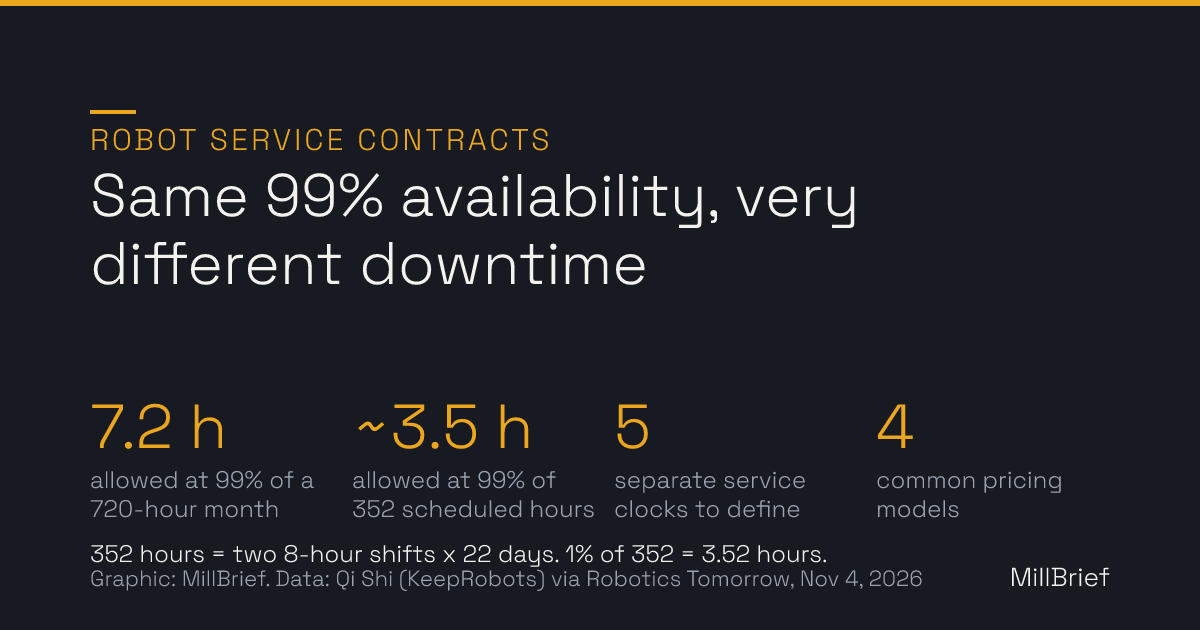
Most disputes, the article says, come from definitions. It recommends separate targets for acknowledgment, remote engagement, on-site arrival, restoration and permanent fix, with every pause in the clock listed. Availability is the trap: 99 percent of a 720-hour month allows 7.2 hours of downtime, while 99 percent of 352 scheduled hours (two 8-hour shifts, 22 days) allows about 3.5 hours. We checked both: 1 percent of 720 is 7.2, and 1 percent of 352 is 3.52. The guide also covers lockout when an outside technician works on your robot, citing the outside personnel and group lockout paragraphs of OSHA’s 29 CFR 1910.147, plus insurance endorsements, data and remote access, spare parts ownership and exit terms.
Why it matters: For a small plant with one or two robots, the service contract usually arrives as the vendor’s standard terms, and nobody reads the clock definitions until the first Friday night fault. Before you sign, ask which of the five clocks the response time actually promises, write availability against your scheduled hours rather than the calendar, and find out whether service credits are your only remedy. The guide’s checklist fits neatly into an RFQ: our RFQ generator and questions to ask a system integrator show where to put it, and our TCO calculator is the place to price a bad service year, not just an average one.
Source: Robotics Tomorrow (guest article by Qi Shi, KeepRobots), November 4, 2026.
ESTUN robots added to RoboDK for simulation and offline programming
ESTUN Robotics and RoboDK have signed a strategic partnership, according to a release published on Robotics Tomorrow on November 4. The agreement was formalised at ESTUN Robotics Iberia’s headquarters in DFactory Barcelona, and follows several months of joint work in which the two companies’ technical teams developed and tested the integration. RoboDK founder and chief executive Albert Nubiola says ESTUN robots are fully integrated into the platform, so integrators and customers can simulate cells, generate programs directly for ESTUN controllers and cut commissioning time.
ESTUN, founded in 1993 and based in Nanjing, says it became China’s largest industrial robot manufacturer in 2025 and that its European strategy rests on competitively priced robots, a factory in Poland and local technical support teams it is expanding. RoboDK, founded in 2015, says its software works with more than 1,500 robots from over 80 manufacturers. ESTUN’s sales director for Iberia, Ignacio Moreno, pointed to RoboDK’s open post-processors, which let each integrator adapt the generated code to the application. The companies plan to extend the partnership to ESTUN’s other European operations, including the Polish factory. No pricing or timetable was given.
This is the second offline programming tie-up for ESTUN in Europe that we have covered, after its partnership with Ency Software on October 6.
Why it matters: A lower-priced robot can lose its advantage if every program has to be taught on the pendant by one engineer who knows the brand. Support in a widely used offline tool means you can model a cell with ESTUN alongside better-known brands before you buy, and an integrator who already uses RoboDK does not need a new toolchain. Ask for a simulated cycle time on your own part, ask who maintains the post-processor when ESTUN updates its controller, and check that local service is actually staffed in your region.
Source: Robotics Tomorrow (ESTUN and RoboDK release), November 4, 2026.
ABB opens RobotStudio HyperReality to its 60,000 RobotStudio users
ABB Robotics says RobotStudio HyperReality is now available to 60,000 RobotStudio users worldwide, according to a release on Robotics Tomorrow on November 4 timed to NVIDIA GTC in Berlin. The company claims the tool closes the gap between simulation and the real cell “with 99% accuracy”; the release does not say how that is measured. ABB developed it with Enodo Robotics, drawing on Enodo’s work with OpenUSD, a format for exchanging 3D data between design and simulation tools.
When ABB first announced the product in March, The Robot Report reported that it builds NVIDIA Omniverse libraries into RobotStudio and would be sold as a subscription alongside the existing free and paid Premium tiers. ABB’s president of robotics, Marc Segura, claimed then that it could cut setup times by up to 80 percent and costs by 40 percent. Named early users were Foxconn and Workr, which builds automation for small and mid-sized manufacturers. Neither source gives a subscription price.
The same November 4 release launches an ABB and NVIDIA education programme in physical AI, with hands-on work in RobotStudio and NVIDIA Omniverse and a certificate on completion. A white paper from the two companies says 53 percent of companies are building AI fluency but 84 percent have not redesigned jobs around AI.
Why it matters: If you run ABB robots, the question is whether the subscription pays for itself in commissioning time on your work. Ask ABB or your integrator for the price, what “99% accuracy” refers to (cycle time, path or contact behaviour), and a trial on one changeover you do often. Treat the setup and cost figures as ABB’s until a plant like yours reports them. Our page on system integrator rates helps put a value on engineering hours saved.
Sources: Robotics Tomorrow (ABB release), November 4, 2026; The Robot Report, March 9, 2026.
Sources
- Writing a Robot Field Service Contract: Pricing Models, SLA Traps and the Clauses That Matter (Robotics Tomorrow, 2026-11-04)
- ESTUN Robotics and RoboDK announce strategic partnership at DFactory Barcelona to simplify and accelerate the adoption of industrial robots in Europe (Robotics Tomorrow, 2026-11-04)
- ABB Robotics sets out blueprint for physical AI education at NVIDIA GTC Berlin (Robotics Tomorrow, 2026-11-04)
- ABB boosts RobotStudio with NVIDIA Omniverse libraries (The Robot Report, 2026-03-09)