Industry Brief, November 8, 2026: Agility lists, a 24-hour humanoid test, midmarket cells
Three items today. Agility Robotics, the humanoid maker whose customers include Toyota and Schaeffler, is now a listed company, and its first public numbers tell you a lot about how young the humanoid business still is. A Chinese robot maker put six of its humanoids through a full day in a real shop, and published the failures along with the successes. And a column on robot cells at midsize manufacturers is a good reminder of what to ask for when a vendor shows you a case study. Vendor claims are labelled as such, and arithmetic marked as ours is ours.
Agility is now a listed company: what its first numbers say
Agility’s shares began trading on the Nasdaq on November 5 under the ticker AGLT, after it completed its merger with Churchill Capital Corp XI, a special purpose acquisition company (SPAC), according to the company’s release on Robotics Tomorrow. Agility describes itself as the first US-listed pure-play humanoid company with active commercial deployments. The deal and related financings raised about $465 million before expenses, and Agility says it will use the money to fill customer orders, expand deployments and scale production of Digit, its humanoid.
The Robot Report adds that Churchill XI shareholders approved the deal on November 2 with more than 84 percent of votes cast in favour, and that it closed on November 4. It also recalls Agility’s figures for 2025: revenue of $1.78 million (up from $310,000 in 2024), a net loss of $138.1 million, about 64 percent of revenue from related parties, and $103 million of cash at year end. In a second report, the outlet says the shares opened at $11.26, above the $10 a share used in the SPAC deal, ranged between $8.40 and $12.15, and closed at $11.49, on a day when, the outlet notes, many tech stocks fell. By our arithmetic the close was about 2 percent above the open ((11.49 - 11.26) / 11.26 = 2.0%) and about 15 percent above the $10 deal price ((11.49 - 10) / 10 = 14.9%).
On customers, the release says Digit works with GXO, Schaeffler and Toyota Motor Manufacturing Canada, and that GXO will add Digit at two more US logistics sites in early 2027, on top of a site in Georgia where Digit has moved more than 100,000 totes. AGCO has signed for a Digit pilot expected to start in 2027, and three more manufacturers (an automaker, an automotive components developer and a consumer products maker, none named) are in paid programs. Agility repeats that it has more than $300 million in committed multi-year orders for Digit 5, subject to contractual milestones, features and specifications, with early customer access expected in the first half of 2027 and general availability targeted for the end of 2027. The company says a Nyobolt battery will let Digit 5 recharge in nine minutes and work more than 20 hours in a 24-hour day, and that its Salem, Oregon factory is designed for up to 10,000 robots a year. CEO Peggy Johnson said going public “gives us access to more resources.” The Robot Report also notes Agility is exploring wheeled or smaller robots and could license its technology to other humanoid developers.
Why it matters: For buyers, the useful part of a listing is disclosure. Agility now reports as a public company, so you can track its revenue, cash and order book over the next year instead of relying on the sales pitch. The 2025 numbers are a reminder of scale: under $2 million of revenue, most of it from related parties, against a loss of more than $138 million. That does not make Agility a bad supplier, and about $465 million of new capital buys time. But if you are offered a humanoid pilot by any vendor, write spares, software support and data access into the contract, ask what happens to them if the product line changes (Agility itself is exploring new form factors), and cost the pilot with our TCO calculator.
Sources: Agility release via Robotics Tomorrow and The Robot Report (listing, first day), November 5, 2026.
Six humanoids worked a 24-hour shop shift, and two failed review
AGIBOT, the Chinese robot maker, ran six of its G2 wheeled humanoids for 24 hours in an operating convenience store in Shanghai’s Xuhui district, from 10 a.m. on November 2 to 10 a.m. on November 3, reported Interesting Engineering on November 7. The robots split the work: customer service, handling products, making coffee, serving hot food, restocking shelves and cleaning. The shift covered the lunch rush, the evening peak, overnight and the next morning’s breakfast rush, and was livestreamed.
AGIBOT says the six completed 1,730 tasks between them: 683 customer interactions, 369 product pickups and deliveries, 147 coffee orders, 126 breakfast servings, 277 shelf inspection and restocking tasks and 128 table cleanings (our check: those add up to 1,730). It judged each robot on time on duty, task completion, customer feedback, response time and handling of the unexpected. Four passed. The two on cleaning and on shelf inspection and restocking did not, and were moved to an observation group for further work.
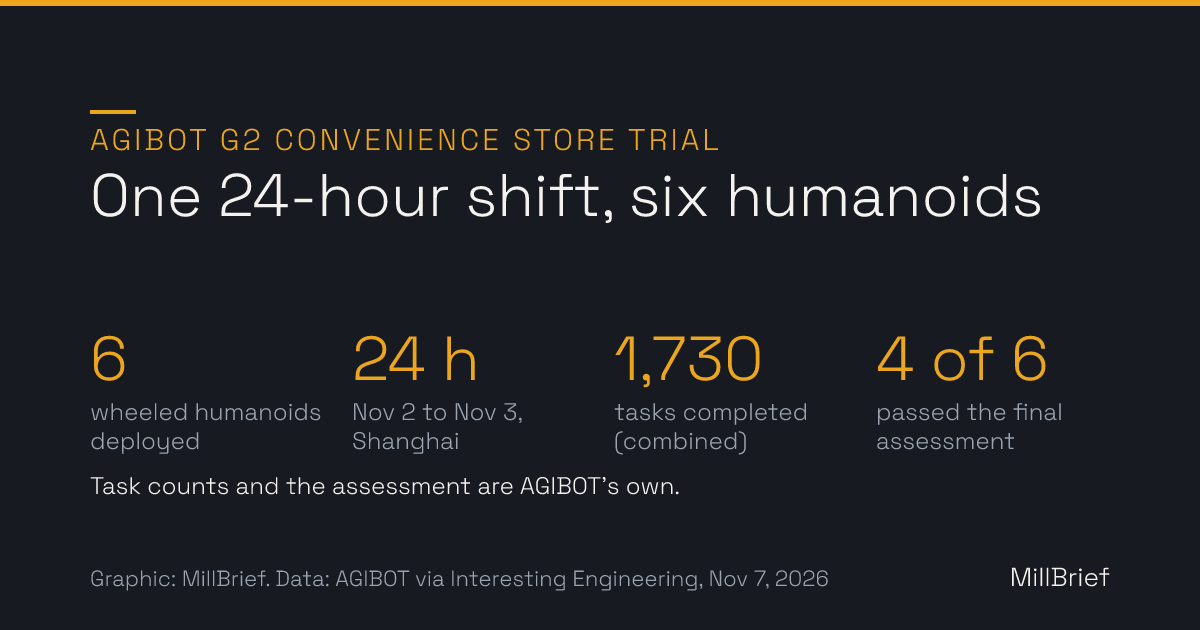
The failures are the instructive part. Citing TechSpot and the Chinese outlet ITHome, Interesting Engineering says the cleaning robot met a full trash bin blocking its planned route, left its path, went out of the store and did not return to its position. The restocking robot reportedly did not keep up with spotting and refilling products as they sold. Evaluators also set deliberate tests, such as telling regular from sugar-free Coca-Cola and blocking an aisle with a person and a box. AGIBOT says its software keeps a record of successes and failures and turns fixes into training data.
Why it matters: This is a shop, not a plant, but the lesson carries over. A robot that follows a planned route can still fail on the first blocked aisle or overflowing bin, and those are everyday events on a factory floor too. A headline task count (1,730 here, or about 72 an hour across the store by our arithmetic: 1,730 / 24 = 72.1) says little about what happened when something went wrong. When a vendor shows you a trial, ask how many times a person had to step in, what the robot does when its path is blocked, and who set the pass mark. Our why automation projects fail page covers the same ground for conventional cells.
Source: Interesting Engineering, November 7, 2026.
Four midmarket robot cells, and the numbers that were left out
A column by Lou Farrell, a senior editor at Revolutionized, republished with permission by The Robot Report on November 7, argues that high-precision automation is no longer only for large companies. Its reasons are general ones: lower cost and smaller footprints, lead-through programming that needs less operator training, vision and force sensing, and cobots that can work near people without extensive guarding.
It then gives four examples, each linked to a vendor’s website and illustrated with vendor-credited photos. Torneria Novoletto, an Italian company specialising in components for the chemical, medical and pharmaceutical sectors, used SCHUNK’s R-C2 concept, combining clamping devices and grippers with robot handling, and the column says setup and changeover times were significantly reduced and that the system helped the company pursue unmanned, around-the-clock operation. Telesis, a marking company, paired its laser marking system with a Universal Robots force- and power-limited arm, which the column says gave it a streamlined marking process without complex safety enclosures. Northern Kentucky Machine, a job shop, used FANUC M-20 series robots with Automation Within Reach’s RC-2 machine tending system, which the column says enabled lights-out running on longer jobs. PrecisionForm, a maker of small custom metal parts, used Universal Robots’ ActiNav bin picking on a UR5 cobot to feed its CNC machines.
None of the four examples gives a figure: no changeover time, utilisation rate, cost or payback period.
Why it matters: The applications are the right ones for a small or midsize shop: machine tending, part marking and bin picking are where many first cells pay off. But a case study without numbers is a brochure. Before you rely on one, ask the vendor or integrator for the before and after: changeover minutes, spindle hours, unattended hours per week, what the cell cost installed and how long payback took. And “without complex safety enclosures” is something your own risk assessment has to confirm for your parts and layout, not something to take from a case study. Our anatomy of a first machine tending cell and what to automate first give you the numbers to ask for.
Source: The Robot Report (column republished from Revolutionized), November 7, 2026.
Sources
- Agility Becomes First U.S. Publicly Listed Pure-Play Humanoid Robotics Company, Begins Trading Today on Nasdaq as AGLT (Robotics Tomorrow, 2026-11-05)
- Agility Robotics begins trading on Nasdaq (The Robot Report, 2026-11-05)
- How did Agility Robotics perform on its first day on the stock market? (The Robot Report, 2026-11-05)
- Six humanoid robots in China work 24-hour shift in a store, two fail assessment (Interesting Engineering, 2026-11-07)
- Robot integration brings high-precision production to midmarket manufacturers (The Robot Report, 2026-11-07)