Industry Brief, November 14, 2026: Robot density, Festo safety module, dark factory MOU
Three items today. The International Federation of Robotics has published its latest ranking of how many robots each country’s factories use per worker, and the U.S. remains in eighth place. Festo is showing a safety module for pneumatic valve terminals at next week’s Automation Fair, and its own releases show the availability date has moved from 2025 to 2027. And a Korean software company has signed an agreement with Intel Korea to work on “dark factory” control software, a term buyers will keep hearing. Vendor claims are labelled as such.
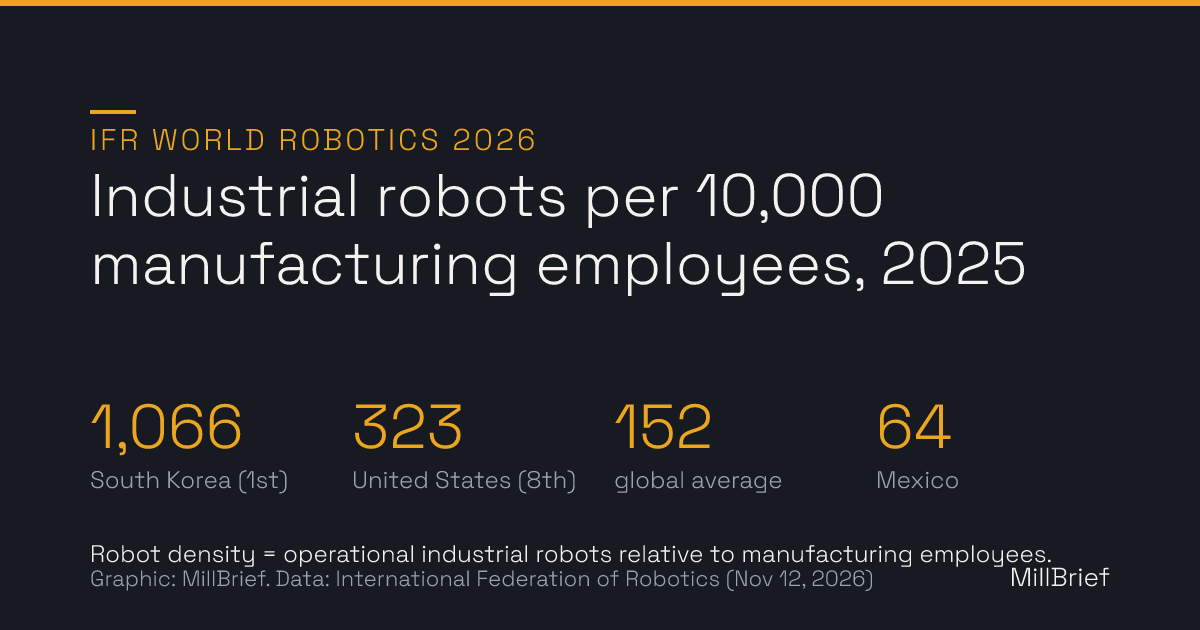
The U.S. stays eighth in robot density; the global average is 152
The International Federation of Robotics (IFR) said on November 12, in a release from its World Robotics 2026 report, that robot density in manufacturing has reached a new peak. Robot density is the number of operational industrial robots relative to the number of manufacturing employees, expressed per 10,000 employees. South Korea leads with 1,066, followed by Singapore with 873 and Germany with 469; Japan is fourth with 452. The global average has risen to 152.
The United States remains eighth worldwide with 323 robots per 10,000 employees, according to the IFR. Canada has 242 and Mexico 64, and North America as a region reached 214, up about 24% from 2020 to 2025. The European Union reached a record 240, up about 35% over the same five years, and five of the ten most automated economies are EU members: Germany, Sweden, Denmark, Slovenia and the Netherlands. Asia as a region reached 144, up about 47%.
China, the world’s largest market for industrial robots, has 193 robots per 10,000 employees and ranks 19th, the IFR says. It adds that this figure is based on employment data from China’s National Economic Census and that China’s density rose 147% from 2020 through 2025. The release was also carried by Robotics Tomorrow on November 13.
To put the U.S. figure in plant terms (our arithmetic): 323 per 10,000 is about one robot for every 31 manufacturing employees (10,000 / 323 = 31.0), against about one for every 9 in South Korea (10,000 / 1,066 = 9.4) and one for every 66 on the global average (10,000 / 152 = 65.8). The U.S. figure is a little over twice the global average (323 / 152 = 2.1).
Why it matters: A national average says little about any one plant. What the ranking does show is that U.S. manufacturers as a whole still run with far fewer robots per worker than competitors in Korea, Japan or Germany, so the question for a small or mid-size plant is less whether automation is proven and more which job to start with. Our guide to what to automate first and the TCO calculator are the practical next steps. If you compete with or buy from plants in Mexico, note that its figure of 64 is about a fifth of the U.S. level (64 / 323 = 0.20).
Sources: International Federation of Robotics, November 12, 2026; Robotics Tomorrow (IFR release), November 13, 2026.
Festo’s networked safety module for valve terminals now targets 2027
Festo will preview its CPX-AP-A CIP Safety module at Automation Fair in Boston, November 16 to 19 (booth 861), according to a company release carried by Robotics Tomorrow on November 13. The module mounts on a Festo valve terminal and connects safety devices over CIP Safety, the ODVA protocol (CIP is the basis of EtherNet/IP) that lets safety controllers, interlocks, light curtains and drives share the network used for machine control instead of a separate safety network. Festo says this cuts wiring and that the module can prevent a machine restarting unexpectedly without venting its air, which saves energy and recharge time.
Each module has six single-channel or three dual-channel safe inputs (for E-stops and light curtains, for example) and three safe outputs that can switch valve zones, pilot air, exhaust valves or a servo drive’s Safe Torque Off. Up to four modules fit on one valve terminal, giving up to 24 safe inputs and 12 safe outputs (4 x 6 = 24 and 4 x 3 = 12). Festo says the module is TÜV-certified up to PL e, Category 4 and SIL 3, fits its VTUX, MPA-S and VTSA valve terminal families, and is scheduled for availability in 2027. No price is given; Festo directs machine builders to its sales staff and distributors.
Festo has announced a CIP safety module before. Its own press release of November 20, 2024 introduced a “new CIP safety module” for MPA-S and VTSA valve terminals, described it as offering one safe zone up to Category 4, PL e and SIL 3, and said it would be available in 2025. The 2026 release gives 2027, adds the VTUX family and lists the input and output counts; it does not mention the earlier announcement or say whether the design changed.
Why it matters: Most small and mid-size plants buy safety hardware inside a machine rather than on its own, so this matters when you specify a new pneumatic machine or a retrofit with a builder whose controls use EtherNet/IP and CIP Safety. If a quote leans on a part that is only “previewed”, ask whether it ships today, put the delivery date in writing, and agree what the builder will fit instead if it slips: here, the announced availability has moved two years in Festo’s own releases. Whatever the hardware, ask for the safety assessment and the PL or SIL each safety function actually achieves as a deliverable. Our RFQ generator and questions to ask a system integrator cover how to write that in.
Sources: Robotics Tomorrow (Festo release), November 13, 2026; Festo press release, November 20, 2024.
A Korean dark factory software pact with Intel, at the agreement stage
Daim Technology, a Korean provider of AI-based factory automation software, said on November 13 that it had signed a memorandum of understanding with Intel Korea to develop AI-based “dark factory” technology, meaning plants that run with minimal human involvement, according to the Seoul Economic Daily. The article is AI-translated from Korean, and the outlet notes that quotes may not reflect the exact original wording.
The plan is to run Daim’s software, which integrates and operates different types of robots and production equipment, on Intel computing: Core Ultra and Xeon processors, Arc GPUs and Intel’s OpenVINO toolkit for optimising AI models. The areas of cooperation are managing different types of robots as a single system, factory simulation and production optimisation, and AI agents in plant operations. The two companies will run a joint proof of concept in an environment resembling a real plant to check whether varied robots and equipment can be linked into one system, and to test in-plant logistics and production scheduling. The work will use Kairoverse, Daim’s platform based on Kairos37, an unmanned factory demonstration platform built by KAIST with government support. No timetable, customers, prices or results are given.
Why it matters: This is an agreement to test, not a product or a deployment. The underlying problem is real for smaller plants too: robots and machines from several brands that each need their own software and programming. When a vendor offers one system to run them all, ask which brands and controller versions it has actually run in a working plant, what happens to production if that software or its server fails, and who supports each layer. Our note on why automation projects fail covers the integration risks to price in.
Source: Seoul Economic Daily (AI-translated from Korean), November 13, 2026.
Sources
- Robot Density Highest in South Korea, Singapore and Germany (International Federation of Robotics, 2026-11-12)
- Robot Density Highest in South Korea, Singapore and Germany - IFR Reports (Robotics Tomorrow (IFR release), 2026-11-13)
- Festo Features at Automation Fair a Robust Suite of Pneumatic Safety Solutions (Robotics Tomorrow (Festo release), 2026-11-13)
- Festo Introduces a Robust Suite of Pneumatic Safety Solutions (Festo, 2024-11-20)
- Daim Technology, Intel Partner on Dark Factory Technology (Seoul Economic Daily, 2026-11-13)