Industry Brief, November 15, 2026: Foundation payroll, OpenAI robotics, 50,000 lb mover
Three items today, two of them about the companies behind robots rather than the robots themselves. CNBC reports that Foundation, a San Francisco humanoid robot startup, has not paid its staff since missing payroll on October 30. Fortune reports that OpenAI has broken up its stand-alone robotics team and moved the researchers into its general AI work. And a material handling builder describes a low-profile transporter that moves engine assemblies of up to 50,000 lb into a test room. Vendor claims are labelled as such.
A humanoid startup misses payroll, CNBC reports
Foundation Future Industries, a San Francisco maker of military humanoid robots, has failed to pay employees since missing its October 30 payroll, according to a CNBC report by Hugh Son published on November 14. The report is based on people with direct knowledge of the matter who asked not to be named. Eric Trump, the president’s son, is an investor in and adviser to the company. A spokesman for chief executive and co-founder Sankaet Pathak acknowledged receiving the main points of the story but did not respond to requests for comment, CNBC says.
According to CNBC’s sources, Pathak borrowed $4.6 million from the company last year, which he called a short-term loan at the time, and public records show an LLC naming him as sole principal bought a $4.6 million property in Sausalito, California, in October 2025. Pathak is Foundation’s only board member and owns most of its shares, the people said. The company also ran short of cash for payroll in August, when staff waited about two days before a bridge loan from an existing investor came through. Pathak told employees in a memo this week that he was working on finding money to pay back wages, CNBC reports, and he has been trying since at least January to raise hundreds of millions of dollars at a $3 billion valuation.
CNBC’s sources also dispute a figure that has been widely reported: they say the $24 million in Pentagon contracts credited to Foundation actually comes from government research contracts held by Boardwalk Robotics, a Florida company Foundation acquired in late 2024. CNBC adds that in 2024 it reported letters from Pathak to prospective investors citing a $300 million purchase order from General Motors, a claim the carmaker rejected.
Why it matters: Foundation sells to the military, not to factories, but the warning applies to any young robot vendor. A startup’s press coverage, contract claims and valuation tell you little about whether it will still be supporting your robot in three years. Before you sign, ask who sits on the board, how many months of cash the company has, and for references you can call directly rather than customer names in a slide deck. Tie payments to delivery and acceptance rather than large deposits, and get spare parts, software licences and service terms in writing, including what happens if the vendor stops trading. Our questions to ask a system integrator and RFQ guide cover how to put that into a contract.
Source: CNBC, November 14, 2026.
OpenAI folds its robotics team into its general AI work
OpenAI has disbanded its stand-alone robotics team and reassigned its researchers to other teams, the company confirmed to Fortune in an exclusive published on November 13. Robotics research now sits in the main research team under Chief Research Officer Mark Chen, and the applied robotics and hardware teams have moved to the Applied organisation, which reports to President Greg Brockman. A spokesperson told Fortune that robotics remains a core part of OpenAI’s long-term vision and that the change is meant to speed up work on general-purpose robots, not abandon it.
OpenAI’s explanation, as reported by Fortune, is that its general-purpose frontier models, including GPT-6 Astra, have shown they can be applied directly to robotics, so a separate team building specialised models is no longer the best route. Fortune cites an Nvidia study in which an Astra-powered agent reached a 74.8% success rate on a simulated manipulation benchmark, against 51.0% for the best specialised robot models on that leaderboard, a gap of 23.8 percentage points (our arithmetic: 74.8 - 51.0). The test was run in simulation, not on a real robot. OpenAI has said it is developing its own humanoid robot, and Fortune reports that chief executive Sam Altman is targeting a first public demonstration in 2027.
Not everyone quoted reads the move as the end of specialised robot AI. Guanya Shi of Carnegie Mellon University’s Robotics Institute told Fortune that large language models are slow and need to be hosted in the cloud, which means a constant network connection, and that smaller models running on the robot’s own computer are still needed. Russ Tedrake, an MIT professor and chief executive of Walden Robotics, argued that robot companies keep an advantage from the data their machines collect working in real places such as factory floors.
Why it matters: More robot makers will advertise “brains” from large AI labs, and the labs’ own plans are changing fast: OpenAI’s 2024 partnership with Figure ended in February 2025, Fortune notes. For a plant, the practical questions are unchanged. Ask which functions run on the robot and which depend on a cloud connection, what the cell does if the network drops, and whether safety functions are completely independent of the AI. Judge any system on trials with your own parts in your own conditions, not on a simulated benchmark. Our note on why automation projects fail lists the integration risks to plan for.
Source: Fortune, November 13, 2026.
A 21-inch-high mover for 50,000 lb engine assemblies
Align Production Systems, a U.S. builder of custom material handling equipment, says it has delivered a 50,000 lb capacity omnidirectional transporter to an engine manufacturer it describes only as “a leading engine manufacturer”, according to a company release carried by Robotics Tomorrow on November 12. The customer moves engine assemblies weighing up to 50,000 lb (about 22,700 kg; 50,000 x 0.4536 = 22,680) and measuring 10 to 14 feet tall into a test room whose doorway is about 14 feet high. Its previous transport unit was too tall, so each engine had to be taken apart before testing. The plant has overhead cranes, but Align engineer Walter Para says tight spaces on the route were part of the reason a transporter was needed instead.
The flatbed is about 21 inches (about 53 cm) high and is driven by an operator with a radio remote control; the release does not describe it as autonomous. It can steer in any direction and has a pivot mode in which the operator picks any steering wheel as a fixed pivot point, for tight 90 degree turns into the test room. Because engines arrive with residual oil, the top plates have a textured traction surface, and gaskets and internal gutters drain fluid away from the electrics, though Align says it is not fully waterproof. If the transporter breaks down or loses power, air casters can be fitted to lift and move it without taking it apart. It has an emergency stop at each corner, plus lights and a horn. Align says the customer now moves fully assembled engines straight into test, saving hours of dismantling and reassembly; no price, cycle times or payback figures are given.
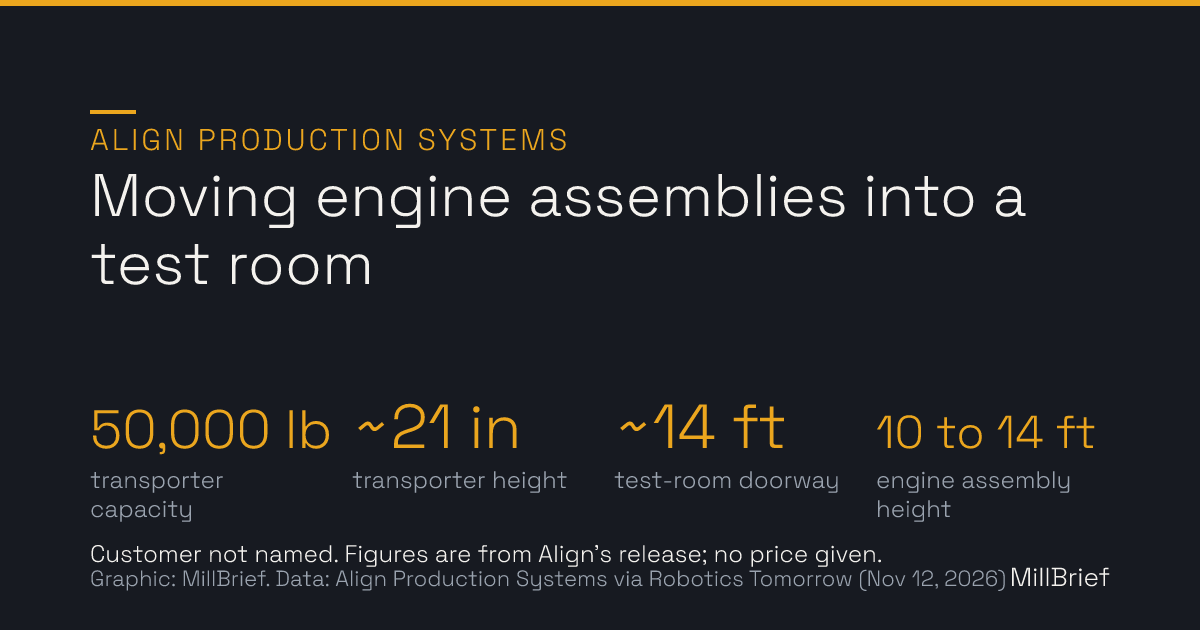
One check the release leaves open (our arithmetic): 21 inches is 1.75 feet, so a 14-foot engine on the deck would stand about 15.75 feet (14 + 1.75), higher than a 14-foot doorway. Taken at face value, only assemblies up to about 12.25 feet (14 - 1.75) would pass, before any safety margin. The release does not explain how the tallest assemblies get through.
Why it matters: Not every handling problem needs a robot or an automated vehicle. For heavy, low-volume moves, an operator-driven transporter built around your route can remove a whole process step, here dismantling and reassembly. When you specify one, do the height stack-up yourself (load plus deck plus margin against every doorway and obstruction), confirm floor loading on the full route, and ask how the machine is recovered if it fails mid-move. Our guide to the hidden costs of automation covers the site work that often goes unpriced.
Source: Robotics Tomorrow (Align release), November 12, 2026.
Sources
- Eric Trump-backed robot soldier startup can't pay staff after founder borrowed $4.6 million from company to buy home (CNBC, 2026-11-14)
- Exclusive: OpenAI disbands its stand-alone robotics team as its general models start running robots (Fortune, 2026-11-13)
- From Assembly Line to Test Room: Align Solves Complex Transport Challenge (Robotics Tomorrow (Align release), 2026-11-12)