Industry Brief, November 16, 2026: Gemini at Mercedes, open Praxis-1, robot touch
A quiet news weekend, so today’s brief collects three stories from the past week that we had not yet covered, each with its original date. Google DeepMind says its new robot AI model ran a humanoid on Mercedes-Benz production lines at a 96% success rate. Runway has released its Praxis-1 robot model with open weights that anyone can download and adapt, including for commercial use. And three companies released hardware and software meant to give robot fingers a usable sense of touch. Vendor claims are labelled as such.
A humanoid picks parts for Mercedes-Benz at 96%, DeepMind says
Google DeepMind introduced Gemini Robotics 2.5, which it calls its most capable vision-language-action model to date, in a blog post on November 10. The headline result is a proof-of-concept with Apptronik and Mercedes-Benz, in which Apptronik’s Apollo 2 humanoid did automotive kitting on active production lines in Kecskemét, Hungary, and Sindelfingen, Germany: reaching into bulk bins, picking metal brackets and placing them into sequencing containers in the order each vehicle needs. DeepMind reports a 96% success rate. A second model, Gemini Robotics ER, keeps track of the workflow while Gemini Robotics 2.5 controls the arms and hands. Apptronik chief executive Jeff Cardenas says the models improved dramatically in a few weeks of post-training and carried over to Mercedes-Benz production with very little drop-off.
DeepMind says it tested the model on more than 200 distinct tasks, such as serving food with tongs and pipetting a liquid, and that it achieves 30% to 100% higher success than previous baselines, depending on the task type, while finishing tasks 20% to 30% faster. On safety, it says reasoning guidance applied while the robot runs raised safe task completion by 33% around obstacles and by 43% around nearby people. It also released ASIMOV-Jailbreak, an open benchmark of prompts that disguise unsafe requests, on which it says its Gemini 4 Argon model resisted 99.5% of attempts, against 82% for the previous baseline, Gemini Robotics ER 2. All of these are DeepMind’s own figures. The model is rolling out to DeepMind’s robotics partners; the post gives no public access, pricing or timetable.
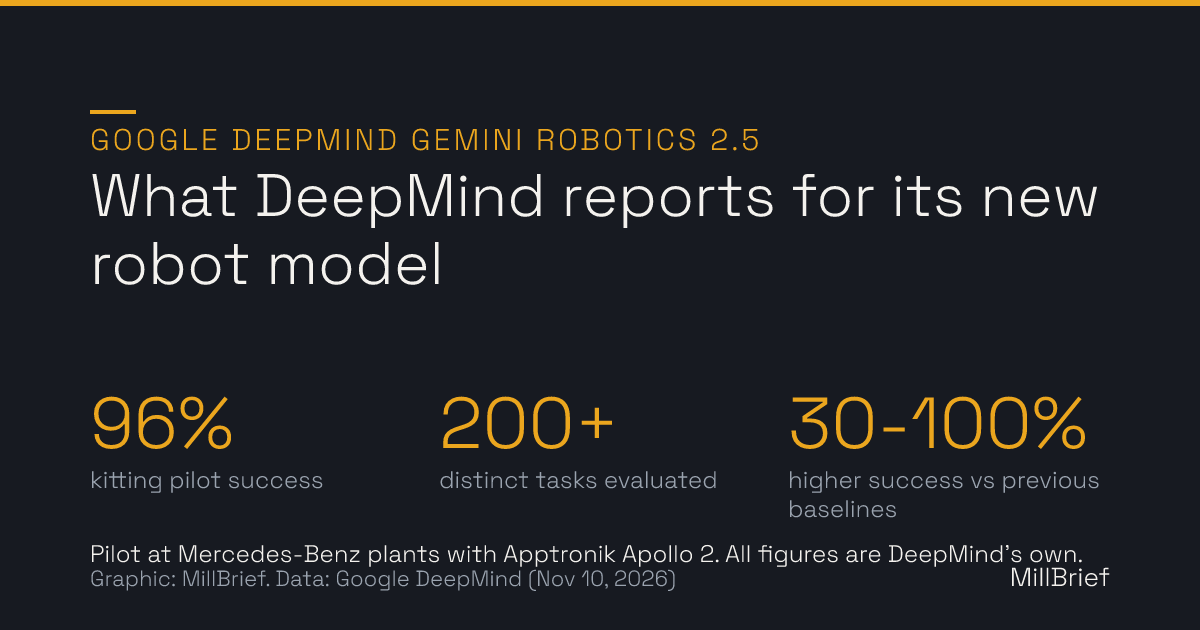
Why it matters: Kitting from bulk bins is a job many plants would love to hand over, and a 96% result on a real line is a meaningful step. It also means 4 misses in every 100 attempts (our arithmetic: 100 - 96), or about 40 in every 1,000 picks, and someone has to catch and fix each one before it reaches the line. The post does not say how failures were counted, how fast the robot picked, or how many hours the pilot ran. If a vendor shows you results like these, ask for the success rate, the picks per hour and what happens on a miss, all measured with your parts, and compare the total against what the job costs today. Our guide to what to automate first helps rank candidate tasks.
Source: Google DeepMind, November 10, 2026.
Runway releases an open robot model that runs on a cobot
Runway, a New York company that builds AI video models, released its Praxis-1 model for robots on November 11 with open weights under the Apache 2.0 licence, which allows commercial use, The Robot Report reported on November 12. The release includes the weights and the code to run and fine-tune the model on your own hardware, on GitHub and Hugging Face. Runway first announced the model in September with three launch partners, which have since run it on their own machines: Noble Machines’ legged humanoid, a six-axis arm from Standard Bots, which sells arms for jobs such as machine tending and palletizing, and Ultra’s dual-arm order packing stations.
Praxis-1 is a 27-billion-parameter model built on Runway’s video models, and it predicts video and robot actions together. Runway says it runs on NVIDIA hardware from data centre GPUs down to the Jetson Thor computer mounted on a robot. Andy Chen, Runway’s head of robotics, told The Robot Report that the model learned a plank picking task for Noble Machines from half an hour of examples and got it right 15 times out of 15, then cleared an unfamiliar messy pile of planks into bins in 6 of 10 attempts. On NVIDIA’s simulated RoboLab-120 benchmark it reached 46.2% success over 1,200 episodes, against 42.9% for the next model cited, 3.3 points lower (our arithmetic: 46.2 - 42.9), and it ranks fifth overall on that leaderboard. These are Runway’s figures.
Why it matters: Open weights give integrators and arm makers a capable starting point they can adapt and run on the robot itself, without depending on a lab’s partner programme or a cloud connection, which could widen the choice of AI-driven picking offers reaching smaller plants. But a 46% benchmark score and a 6-in-10 result on a messy pile are research numbers, not production ones. For now, treat “AI-trained” cells as something to trial alongside conventional programming, and judge them on cycle time and reliability with your own parts. Our cobot price tracker shows what the arms themselves cost.
Source: The Robot Report, November 12, 2026.
Three launches aim to give robot fingers a sense of touch
Belgian sensor maker Melexis introduced the MLX90901 Tactile Fingertip Module on November 12, according to its release carried by Robotics Tomorrow. It is a complete fingertip, with sensor, magnet, elastomer and electronics, that measures force in three axes: normal force over a range of 15 N and shear force over 4 N, with 10% full-scale accuracy, a typical resolution of 200 mN (0.2 N) and an I²C connection. Read as plus or minus 10% of full scale, that is up to about 1.5 N on the normal axis (15 x 0.10) and 0.4 N in shear (4 x 0.10), by our arithmetic. An evaluation kit is available now; the release gives no price and is aimed at makers of humanoid hands.
A day later, Engineering.com reported that Microchip has introduced the ATFCD52, a chip that reads grids of capacitive touch sensors so a processor can work out normal and shear forces and spot the start of a slip. It handles up to 52 channels (32 transmit plus 20 receive lines), frame rates of up to 800 Hz depending on the size of the sensor array, and capacitance changes below 1 femtofarad, with frequency hopping to cope with electrical noise from servo motors. A development board is offered; no price is given. On the software side, Humanoids Daily reported on November 10 that Robbyant, part of Ant Group, has released LingBot-Touch under Apache 2.0, a model that turns signals from different types of touch sensor into one shared format. In the paper’s tests on 26 tasks with two robot hands, adding it raised four robot control models’ average success by 13.9 to 24.8 percentage points; in one test, twisting a bottle cap went from 56.25% without touch to 90% with it.
Why it matters: Many robots still use simple grippers with no touch feedback, as Melexis notes, which is one reason soft, fragile or slippery parts remain hard to automate. These launches are components and research for robot and gripper makers, not products you can bolt on today. For now, if a project involves delicate handling, ask your integrator what force or slip sensing the proposed gripper has, and what the cell does when a part starts to slide. Our article on why automation projects fail covers the part-handling risks to plan for.
Sources: Robotics Tomorrow (Melexis release), November 12, 2026; Engineering.com, November 13, 2026; Humanoids Daily, November 10, 2026.
Sources
- Gemini Robotics 2.5 accelerates real-world general dexterity (Google DeepMind, 2026-11-10)
- Runway's Praxis-1 world action model for robotics is now available (The Robot Report, 2026-11-12)
- Melexis Gives Humanoid Robots Sense of Touch with Its First Tactile Fingertip Module (Robotics Tomorrow (Melexis release), 2026-11-12)
- Microchip introduces tactile sensing digitizer for robotics (Engineering.com, 2026-11-13)
- Robbyant Open-Sources LingBot-Touch, One Tactile Model for Three Sensor Types (Humanoids Daily, 2026-11-10)