Industry Brief, November 17, 2026: AMR forecast cut, Agile Robots $500M, GXO humanoids
Today’s brief has three stories. A market research firm has cut its mobile robot forecast because of the FCC rule on foreign-made robots, and its numbers say something about where prices are heading. Agile Robots, the German company that owns Franka Robotics, has raised $500 million. And GXO has signed a letter of intent that could lead to as many as 1,000 Apptronik humanoids in its warehouses, but only if trials hit agreed targets. The GXO and Agile Robots announcements came out on November 12; the forecast is from yesterday. Vendor and analyst claims are labelled as such.
The FCC robot rule changes mobile robot price forecasts
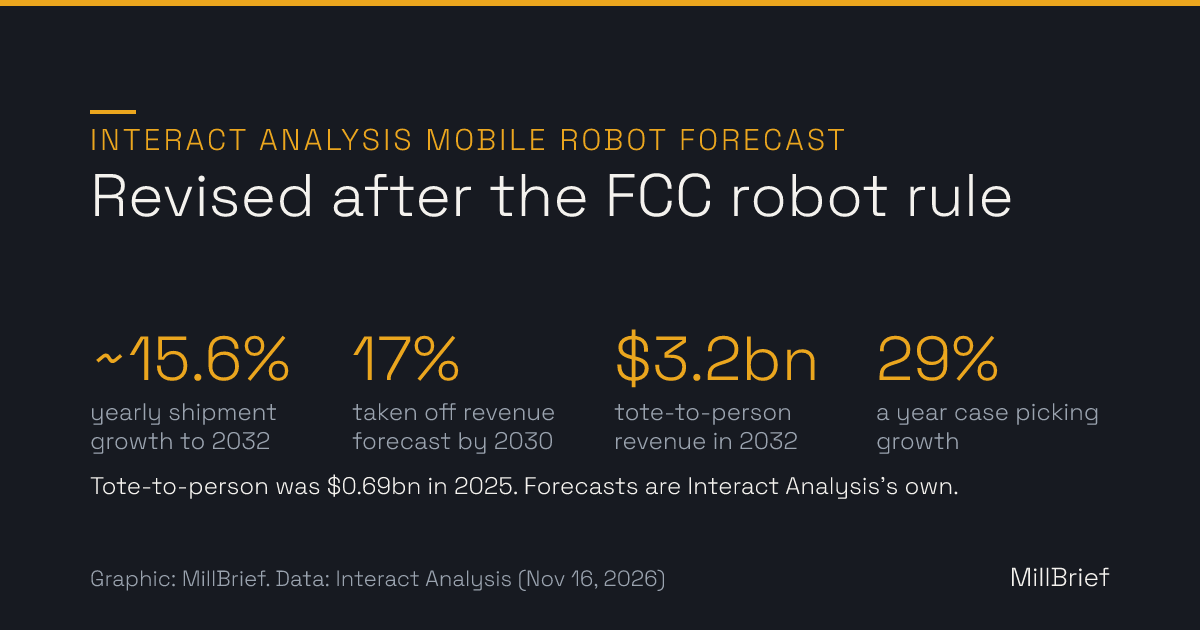
Market research firm Interact Analysis has updated its mobile robot forecasts to reflect the Federal Communications Commission’s decision in July 2026 to add “advanced robotic devices” to its Covered List, according to a release carried by Robotics Tomorrow on November 16. The firm says the ruling has delayed supplier choices and the conversion of projects into orders, but it still expects global mobile robot shipments to grow by about 15.6% a year until at least 2032.
The firm has also lowered the revenue forecast it published in May 2026, because prices are falling faster than it expected, and says the effect takes 17% off total revenue by 2030. The regional picture splits in two. With less competition from low-cost Chinese suppliers, Interact Analysis expects pricing pressure to ease in the Americas, so the yearly decline in US average revenue per unit should be softer. Chinese vendors are instead putting their resources into Europe, the Middle East and Africa and the rest of Asia-Pacific, which the firm says will sharpen competition and speed up price falls there.
By product, tote-to-person systems, which bring totes of parts or goods to a worker, show the largest growth, from $0.69 billion of revenue in 2025 to $3.2 billion in 2032, about 4.6 times as much (our arithmetic: 3.2 / 0.69 = 4.64). Case picking grows fastest, at 29% a year on average, but reaches only $431 million in 2032; the release puts tote-to-person at $3.18 billion that year, about 7 times as large (3,180 / 431 = 7.4). Tote-to-person, AMR conveyors and AGV forklifts together make up about 65% of the 2032 revenue forecast. Senior analyst Jonathan Sparkes says the ruling “significantly disrupted” the short-term outlook, and cites a 13% compound annual growth rate from 2026 to 2032; the release does not say whether that figure refers to units or revenue. All forecasts are the firm’s own.
Why it matters: If you are pricing an AMR or AGV project, this forecast suggests the bargains will look different depending on where your plant is. In the US, fewer low-cost Chinese bids should mean prices fall more slowly than they otherwise would; in Europe and Asia, the same vendors are likely to compete harder for your order. Either way, get quotes from more than one supplier, ask whether the model you are buying has the FCC authorisation it needs for US sale and future replacement units, and price spare parts and software support for the life of the fleet. Our TCO calculator helps compare offers on total cost rather than sticker price.
Source: Robotics Tomorrow (Interact Analysis release), November 16, 2026.
Agile Robots raises $500 million to build more robots
Munich-based Agile Robots has raised $500 million in a Series F round led by SoftBank Group, with NVIDIA, Hitachi Group (Hitachi and Hitachi Ventures) and T.Capital taking part, The Robot Report reported on November 16. The round values the company at $8.5 billion and brings its total funding to $2 billion. Tech Times reported that the company announced it on Thursday (November 12), and that the amount is below the roughly $800 million Bloomberg reported in June.
Agile Robots builds humanoids, mobile robots, robot arms and robot hands, and the software behind them. Founded in 2018 as a spin-off from the German Aerospace Center (DLR), it has deployed 20,000 industrial robots in automotive, consumer electronics, logistics and other industries, according to The Robot Report. Its subsidiaries include Franka Robotics and Krause Automation, an industrial deployment specialist it recently bought from thyssenkrupp. The company says the money will go on production capacity, including in Germany, and on expansion into key markets, with a stronger presence in the United States. Its plant at Fürstenfeldbruck, near Munich, opened earlier this year and can build up to 10,000 legged and wheeled humanoids a year, by the company’s account. Tech Times notes that this is a capacity figure, and that Agile Robots has not disclosed how many humanoids it has shipped or has on order.
Why it matters: For buyers, a big round is a vendor health signal: Agile Robots now has more money behind its existing robot business and its subsidiaries Franka Robotics and Krause Automation, and it says it wants a larger US presence, which could mean more local sales and service. But the valuation leans on a humanoid business with no public delivery figures. If you are offered its humanoids, ask for delivered units, uptime and reference sites, not factory capacity. For its conventional arms, the usual checks apply: local support, spare parts lead times and integrator experience. Our cobot price tracker shows what collaborative arms from other makers cost.
Sources: The Robot Report, November 16, 2026; Tech Times, November 13, 2026.
GXO plans up to 1,000 Apptronik humanoids, if trials pass
GXO Logistics, which runs warehouses for other companies, has signed a letter of intent with Apptronik to widen trials of its Apollo humanoid and work out a Robotics-as-a-Service (RaaS) arrangement for larger deployments, GXO said in a press release on November 12. The trials, beginning in 2027, will cover goods-to-person and person-to-goods picking, case and tote movement, packing and sortation in live operations, with each use case judged against productivity, safety and operational targets the two companies agree. The release does not publish those targets.
If the deployments succeed and meet the agreed targets, the companies intend to move toward a global rollout of up to 1,000 Apollo robots over the next four years, starting in North America in late 2027. The commercial terms are expected to follow a RaaS structure, in which GXO pays for robots as a service rather than buying them. No prices or contract values are given. The partnership began in 2024 with a proof of concept; earlier this year Apollo completed a pilot with GXO in the US picking small consumer goods, and the companies have tested more than 50 logistics tasks at Apptronik’s training facility, according to the release. GXO says it has more than 1,000 facilities, so even the full 1,000 robots would average fewer than one per site (our arithmetic).
Why it matters: Large logistics firms are where humanoids are being proved, and the structure of this deal is the useful part for smaller buyers: trials first, agreed performance and safety targets, and a service contract instead of a capital purchase. Those are the right terms to ask for with any new kind of robot. Note too what the release does not say: there is no binding order, no price and no published target. If a vendor pitches you a humanoid or RaaS deal, ask for the measured results that would let you check its claims. Our list of questions to ask a system integrator covers how to set acceptance targets before you sign.
Source: GXO Logistics, November 12, 2026.
Sources
- FCC ruling prompts lower mobile robot market forecasts, despite strong growth outlook to 2032 (Robotics Tomorrow (Interact Analysis release), 2026-11-16)
- Agile Robots raises $500M to increase production capacity (The Robot Report, 2026-11-16)
- Agile Robots Raises $500M Series F: Humanoid Factory Capacity Is Public, Shipment Count Is Not (Tech Times, 2026-11-13)
- GXO and Apptronik Expand Humanoid Robotics Partnership (GXO Logistics, 2026-11-12)