Industry Brief, November 18, 2026: GM automation goal, Atlas at a chip fab, Locus picking
Today’s brief has four stories, all from yesterday. Reuters reports that General Motors wants 20% more automation in its North American plants by 2028 and, according to other sources, is scoring suppliers bidding on new contracts on their automation plans. GlobalFoundries will be the first company outside the car industry to test Boston Dynamics’ Atlas humanoid, and the two companies have published inspection figures for the Spot robots GF already runs. Locus Robotics has put numbers on a book picking deployment at a Penguin Random House operation in Barcelona. And BlueBotics now lets one system send jobs to both manual forklifts and mobile robots. Vendor claims are labelled as such.
GM reportedly targets 20% more automation, and asks suppliers for plans
General Motors is aiming to increase its use of robots and other automation by 20% at its North American factories by 2028, two people familiar with the matter told Reuters in an exclusive published on November 17, as GM grapples with higher labour and onshoring costs. The report does not say what the 20% is measured against (robot count, share of work or spending) or give a baseline. According to the same people and two others, GM is developing its own robots and assembling them at its Kokomo, Indiana, plant, and is focused on using autonomous mobile robots to move parts around its plants. Reuters notes that GM still buys robotics equipment from outside suppliers, and that executives outlined the in-house effort last year.
The part that reaches beyond GM’s own plants: according to two other people familiar with its supply base, GM is asking parts suppliers bidding on new contracts to submit automation plans for their own operations, rating those efforts on a scorecard and considering the scores in contract decisions. Reuters gives no scorecard criteria. GM did not immediately respond to a request for comment; the company has said it uses automation to improve safety, quality and efficiency.
Reuters adds context on cost. GM said its 2023 UAW contract would add about $575 in labour costs per vehicle, while Ford put its added cost at $900 per vehicle. The UAW, which represents about 50,000 GM factory workers, called the company’s automation efforts a job-cutting tactic, and automation is likely to be a key issue in the union’s next round of negotiations with GM, Ford and Stellantis, before the contracts expire in spring 2028.
Why it matters: If you supply GM, or supply someone who does, expect automation plans to become part of the bid package, not just price and quality. The useful response is a written plan with real numbers: which operations you would automate, the cost, the payback and the timeline. Even if you never sell to an automaker, large customers tend to copy each other’s supplier requirements. Our guide to what to automate first and our automation ROI and payback page are a starting point for that plan. Bear in mind that the 20% target rests on unnamed sources and GM has not confirmed it.
Source: Reuters, syndicated by WBOW, November 17, 2026.
A chip maker will test Atlas, after years of inspections with Spot
GlobalFoundries (GF), the semiconductor manufacturer, will become the first customer outside the automotive industry to test Boston Dynamics’ Atlas humanoid, with testing starting in early 2027, The Robot Report reported on November 17. According to the companies’ release, the testing will happen on site at GF facilities as part of Boston Dynamics’ Atlas early adopter programme and a skills development workshop, whose goals are to evaluate possible humanoid uses, assess readiness and integration needs, and begin training Atlas for specific tasks. The companies did not say how many Atlas robots are involved, which facilities will host them or what the first tasks will be. No prices or commercial terms were given.
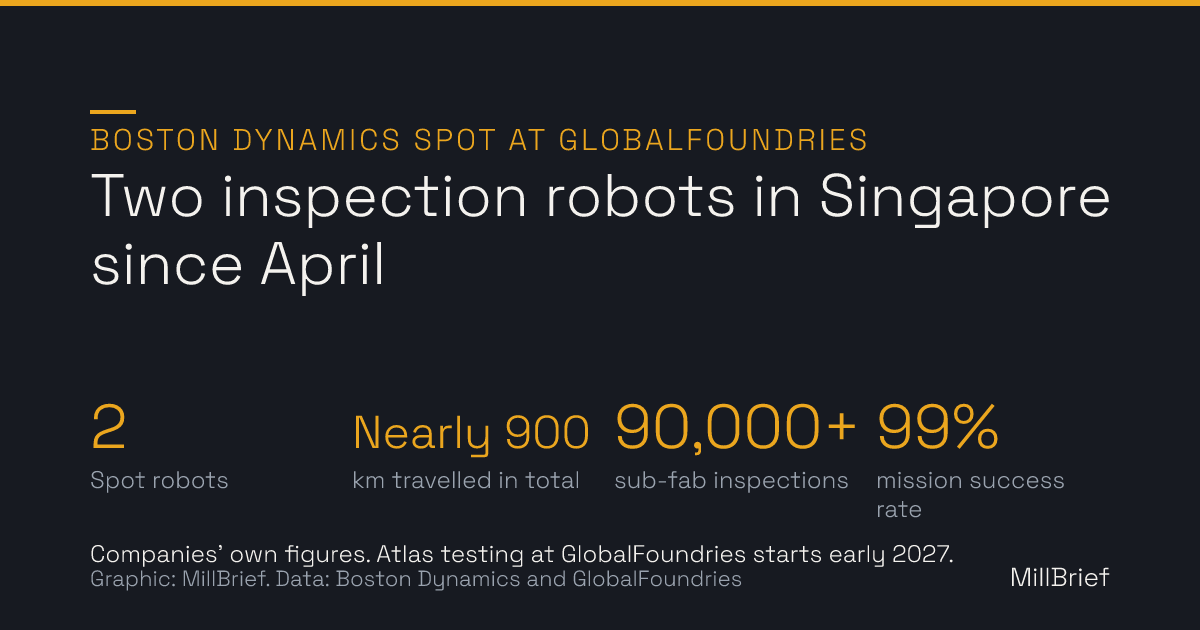
The more practical half of the news is about Spot, the four-legged inspection robot. GF has run Spot at its Burlington, Vermont, site for more than four years, and Spot deployments will expand across its sites in Malta, New York; Burlington; Dresden, Germany; and Singapore, the release says. At Singapore, two Spot robots have collectively travelled nearly 900 km (559 miles) since April and completed more than 90,000 inspections in sub-fab areas, with a 99% mission success rate, according to the companies. That averages just under 450 km per robot (our arithmetic: under 900 / 2); the split between the two is not given. The companies also say GF “redeployed 875 routine inspections” in two weeks. Pradip Singh, GF’s chief manufacturing officer, says Spot helped the company shift “from reactive to predictive maintenance”.
Why it matters: Atlas is still a trial with no published tasks or price, so it is not something a smaller plant can plan around yet. The Spot figures are more useful: GF ran Spot at one site for years before spreading it, and the companies now report concrete measures (inspections completed, mission success rate, distance covered). If you are offered a mobile inspection robot, ask the vendor for the same measures from a comparable site, and work out what a 1% mission failure rate means for inspection points you cannot afford to miss. Our page on the hidden costs of automation covers the support and integration costs that sit behind a pilot.
Sources: The Robot Report, November 17, 2026; Robotics Tomorrow (Boston Dynamics release), November 17, 2026.
Locus says its robots doubled picking rates at a Barcelona book warehouse
Locus Robotics says Penguin Random House Grupo Editorial (PRHGE), part of Bertelsmann, now sustains more than 510 units per hour of picking at its Barcelona operation, up from 253 units per hour when picking was manual, Robotics & Automation News reported on November 17. That is about 2.0 times the manual rate (our arithmetic: 510 / 253 = 2.02). The site handles more than one and a half million units a month through the Locus system.
The deployment started small. Since the June 2022 launch of the LocusONE platform, the article says, it has grown from 14 Locus Origin robots covering 100 SKU locations to 40 robots covering nearly 1,000 SKU locations, about 2.9 times the robots for about ten times the locations (40 / 14 = 2.86). PRHGE moved to a new facility in October 2024 and reached nearly ten times its original SKU coverage within 10 months, the article says. The robots handle fast- and medium-moving inventory, while high-density storage systems in the same facility support slower-moving titles. The article does not say when the latest figures were measured. Martí Torra, PRHGE’s logistics and distribution director for Spain, called the system “very easy to implement”. No prices, contract value or payback figures were given. All figures come from Locus’s account.
Why it matters: The detail worth copying is the shape of the project, not the headline number. The site started with 14 robots on a small slice of its stock, added robots as its SKU coverage grew and it moved site, and left slow movers to other systems. The doubling is measured against manual picking, so if you already have some automation, ask a vendor for a baseline that matches yours. Our list of questions to ask a system integrator covers how to agree a baseline and acceptance targets before a pilot.
Source: Robotics & Automation News, November 17, 2026.
BlueBotics sends jobs to forklift drivers and robots from one system
BlueBotics, whose release is datelined St-Sulpice, Switzerland, has updated ANT locator, its forklift and payload tracking product, so that its ANT server fleet manager can dispatch missions to any vehicle, whether an AGV, an AMR or a manually driven forklift, from one platform, according to a release carried by Robotics Tomorrow on November 17. A new in-cab operator interface (HMI) lets drivers report that they are available and accept missions from the cab. The company says ANT locator can also connect to a customer’s existing WMS, MES, ERP or fleet management system.
Chief executive Nicola Tomatis says running separate systems for mobile robots and manual forklifts creates “unnecessary cost and complexity”. BlueBotics claims fewer licences and no task overlap, and says the product adds heatmaps and analytics, but it gives no measured results. The release gives no price or availability date.
Why it matters: Most plants that add AGVs or AMRs keep manual forklifts for years, and two dispatch systems can mean two people sending the same pallet move. One dispatcher for both is worth asking about on any mobile robot quote. Ask whether your existing WMS or ERP link is included, what the licences cost per vehicle and per in-cab HMI, and what happens to manual jobs if the server goes down. Our RFQ generator can help you put those questions in writing.
Source: Robotics Tomorrow (BlueBotics release), November 17, 2026.
Sources
- Exclusive-GM plans 20% boost in robotics as factory costs rise (Reuters (syndicated by WBOW), 2026-11-17)
- Boston Dynamics' Atlas humanoid lands first non-automotive trial (The Robot Report, 2026-11-17)
- Boston Dynamics and GlobalFoundries Expand Robotics Collaboration (Robotics Tomorrow (Boston Dynamics release), 2026-11-17)
- Penguin Random House doubles book picking productivity with Locus Robotics (Robotics & Automation News, 2026-11-17)
- BlueBotics unifies mission management across manual forklift and mobile robot fleets (Robotics Tomorrow (BlueBotics release), 2026-11-17)