Industry Brief, July 10, 2026: palletizing, virtual planning, software-defined cells
Four items this week that share one theme: making automation cheaper to change, not just cheaper to buy. A palletizer pitched at shops whose products won’t sit still, a headset that walks you through a line before anyone welds a frame, a software-defined workcell architecture backed by names you know, and fresh money for bolting autonomy onto machines you already own. As always, we summarize in our own words and link to the original outlet; we report only what each source’s own reporting supports.
A palletizer built for products that keep changing
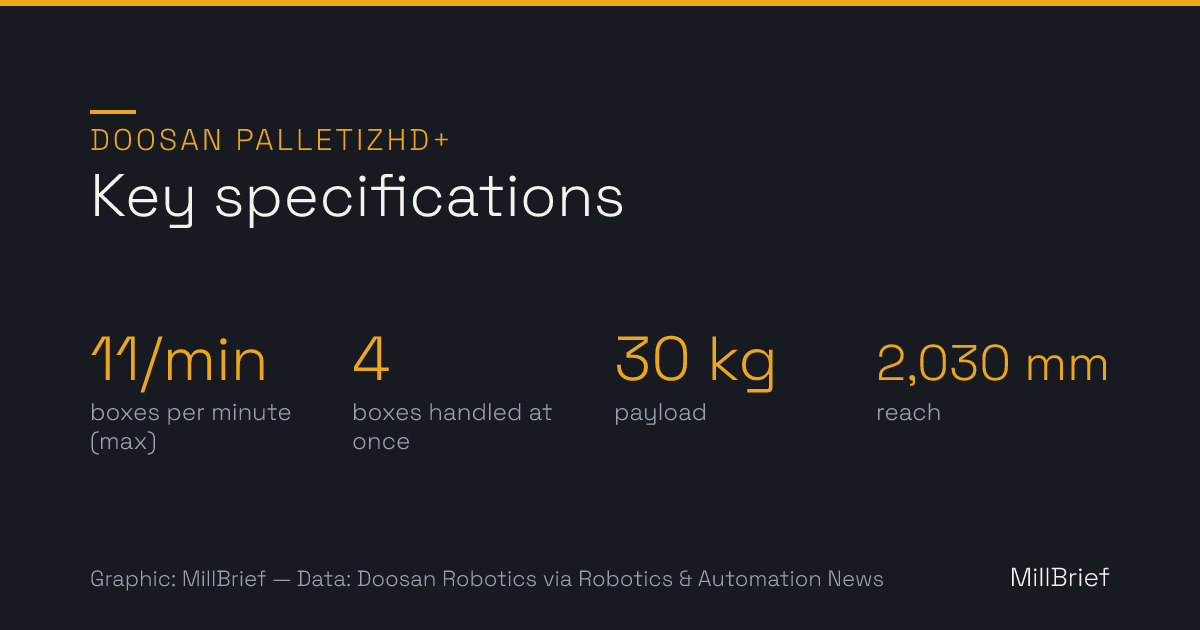
Robotics & Automation News covers Doosan Robotics’ launch of PalletizHD+ at Automate 2026: a production-ready palletizing system built on the company’s PalletizOS platform and aimed squarely at the high-mix problem: adapting palletizing to changing products, packaging formats and production demands without extensive reprogramming. The system handles up to 11 boxes per minute and up to four boxes at once, takes payloads up to 30 kg with a 2,030 mm reach, and uses AI to generate pallet patterns from specifications. Doosan’s headline claim is operational: operators can configure a new pallet pattern in under two minutes through a drag-and-drop interface, with no specialist robotics knowledge.
Why it matters: Palletizing is the classic first automation project, and “my products change too often” is the classic reason small shops rule it out. Vendors are now competing directly on that objection: the cost of change, not the cost of the arm. When you compare quotes, ask for a live demonstration of a product changeover, timed, by one of your own operators. Our Q&A on what to automate first explains why end-of-line tasks usually win, and the cobot cost guide covers what a deployed cell (not just the arm) should cost.
Source: Robotics & Automation News, July 9, 2026.
Walk the line before you build it
Robotics & Automation News reports that Eclipse Automation, an automation builder serving life sciences, transportation, energy, electronics and consumer/industrial markets, has unveiled Eclipse RealitySync at Automate 2026. The platform uses Apple Vision Pro headsets to put engineering, operations and leadership teams inside a virtual version of a planned production environment, where they can walk the line, review layouts, workflows and automation systems, and work through issues with Eclipse specialists before anything is physically built. The pitch is de-risking: decisions made earlier, problems found before steel is cut. The article offers no quantified savings claims.
Why it matters: Most automation overruns are discovered at commissioning, which is the most expensive possible time to learn your layout doesn’t work. Immersive review won’t replace a proper front-end engineering study, but it attacks the same risk (misunderstanding between the people who run production and the people who design the system) much earlier and much cheaper. Before you get to any vendor’s showroom, our production line automation cost guide covers what full-line projects actually run, and the automation RFQ guide helps you specify what the virtual walkthrough should be checked against.
Source: Robotics & Automation News, July 9, 2026.
Intrinsic’s software-defined workcell, with Fanuc and Foxconn attached
Robotics & Automation News profiles the Automate 2026 showing from Intrinsic, Google’s AI robotics company, whose “software-defined factory” argument is that production cells should be reconfigured through software updates rather than mechanical redesigns. The concrete pieces: a modular “Intelligence Cell” reference workcell running IntrinsicOS, an electronics assembly demonstration with Fanuc, a pilot deployment planned with Foxconn later in 2026, and integration work with Trinity Automation and MartinSystems on CNC automation. The claimed payoff for high-mix manufacturing is reduced engineering effort and faster deployment; the article gives no specific numbers.
Why it matters: Custom integration engineering is roughly a fifth to a third of most cell budgets, and it recurs every time the product changes. That is the line a software-defined cell is trying to shrink. This is a direction to watch rather than a product most small shops can buy today, but names like Fanuc and Foxconn signal it has moved past the lab. When an integrator quotes you, our breakdown of what integrators charge and why shows where those engineering hours sit in the price.
Source: Robotics & Automation News, July 9, 2026.
$15M for teaching your existing machines to drive themselves
The Robot Report covers HIVE, a London-based physical-AI startup with offices in Norway, which raised a $15 million pre-Series A led by SuperSeed with Veriten, Skyfall and Nysnø participating. Rather than selling new robots, HIVE retrofits existing industrial vehicles (wheel loaders, warehouse vehicles, production-line equipment) with sensors and cameras so they can run autonomously or by remote operation. Deployments are live at several Scandinavian sites; one retrofitted wheel loader works a Norwegian mountain crossing at Vikafjellet, letting operators control it from a supervisor room instead of the cab in avalanche terrain. The company’s own projection is that its fleet-wide learning loop can cut productive machine-hour cost by 80% (a forward-looking claim, not a measured result).
Why it matters: Retrofit is the under-discussed alternative in most automation business cases: the machine is paid for, the operators know it, and the capex is a fraction of replacement. The trade-off is integration risk on hardware the vendor didn’t build: support, spares and liability need extra scrutiny in the contract. If you’re weighing retrofit against new equipment, our guide to the hidden costs of automation lists the line items that decide which one actually comes out cheaper.
Source: The Robot Report, July 7, 2026.
Sources
- Doosan Robotics launches AI-powered palletizing solution for high-mix manufacturing (Robotics & Automation News, 2026-07-09)
- Eclipse Automation unveils immersive factory planning platform at Automate 2026 (Robotics & Automation News, 2026-07-09)
- Intrinsic's vision for physical AI: Building the software-defined factory (Robotics & Automation News, 2026-07-09)
- HIVE brings in $15M to build physical AI for industrial machines (The Robot Report, 2026-07-07)