Industry Brief, July 12, 2026: robot safety deadlines, virtual gyms, forever Linux
Three items today, and the thread running through them is lifecycle: the safety standard your next robot will be certified against, the simulation work that should happen before a robot ever reaches your floor, and how long the operating system under your line’s software will keep getting patches. None of these show up on a robot’s sticker price; all three show up later. As always, we summarize in our own words and link to the original outlet; we report only what each source’s own reporting supports.
Your next robot’s safety cert has a deadline attached
The Robot Report carries an Interact Analysis piece on supplier readiness for ISO 10218:2025, the updated industrial-robot safety standard that will become mandatory for CE-marked products in Europe under the new Machinery Regulation (EU 2023/1230), which supersedes the 2006 Machinery Directive on January 20, 2027. One critical step is still pending as of mid-2026: the standard’s formal listing in the Official Journal of the EU; and when the 2011 edition went through the same process, it took more than a year. In the US, the aligned ANSI/A3 R15.06-2025 standard was released in September 2025; it is voluntary, but the article notes integrators and major customers often require it in procurement specs and OSHA can use it as an enforcement reference. The analyst interviews found a sharp readiness split: established global vendors say they are prepared, while midsize and emerging suppliers, particularly newer Asian entrants targeting Europe, show significant awareness gaps.
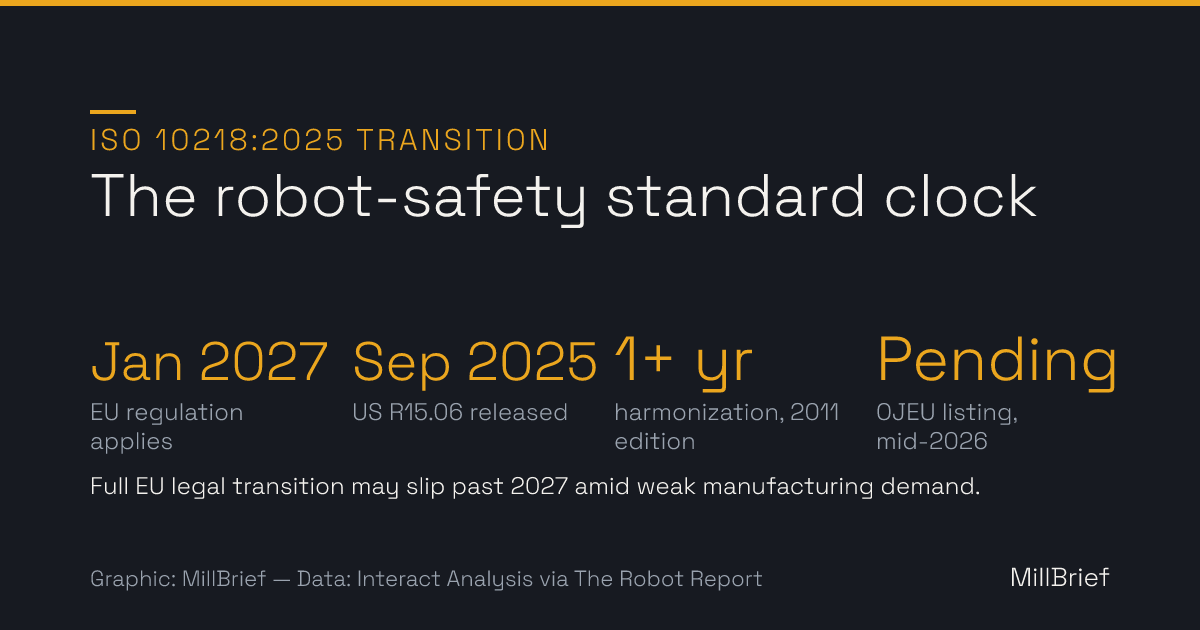
Why it matters: A robot cell is a long-lived asset, so the standard it is certified against outlives the purchase order. If a supplier is underprepared for ISO 10218:2025, the risk lands on you as market-access disruption mid-life: spares, support, and future cells from a vendor that may struggle to keep CE market access. The buying defense is cheap: ask which edition of ISO 10218 (or R15.06) the quoted cell will be certified against and what the vendor’s 2025-edition transition plan is. Our cobot cost guide covers what the 2025 revision means for risk assessments and why that line in a quote is not padding, and our questions to ask a system integrator piece is where a supplier-readiness question belongs.
Source: The Robot Report, July 11, 2026.
Train in the gym before the factory floor
Also in The Robot Report, a contributed piece by SoftServe robotics architect Mariusz Janiak argues that “virtual gyms” (high-fidelity simulation environments combining digital twins, synthetic data, reinforcement learning and hardware-in-the-loop testing) are becoming a standard stage of robot deployment, because collecting failure experience on real hardware is expensive, slow and sometimes unsafe. The piece is vendor-authored, but the numbers it reports are concrete: in a Toyota Material Handling Europe project, SoftServe says a forklift-perception model trained on synthetic data hit 89.6% precision and 84.7% recall on real-world data where a simulator-only model managed 49.4% recall, rising to 99.5% precision and 92.8% recall after post-training matched the visuals to the client’s environment. The author also reports virtual commissioning cutting commissioning time by 30-50% in industrial projects.
Why it matters: You don’t need to buy a simulator; you need to know whether the people deploying your robot used one. Many automation projects die in the gap between a working pilot and production, usually on the variability the demo never saw: different packaging, changed lighting, a crowded aisle. When you evaluate a vendor or integrator, ask how the system was validated before commissioning (simulation coverage, synthetic-data testing, hardware-in-the-loop) and get the answer in writing in the spec. Our RFQ guide shows where validation requirements belong in a request, and why automation projects fail covers the pilot-to-production gap this whole approach exists to close.
Source: The Robot Report, July 11, 2026.
Pay-forever Linux, and your line’s software lifecycle
ZDNET reports that Red Hat has introduced a “Long-Life Add-On” for Red Hat Enterprise Linux (informally, RHEL Forever): an annually renewed extension that keeps a specific RHEL release under vendor support for as long as the customer keeps paying. It sits on top of the Extended Life Cycle Premium subscription and delivers critical-rated security patches, selected urgent bug fixes and 24x7 support, with fixes backported so the API/ABI stays stable. That extends an already long ladder (RHEL’s standard 10-year lifecycle, 14 years with Extended Life Cycle Premium), and the competition is stretching too: ZDNET notes Canonical now offers up to 15 years for Ubuntu and SUSE up to 19 years. Pricing is not public; Red Hat positions it as a negotiated, account-specific extension aimed at industries with multi-decade horizons.
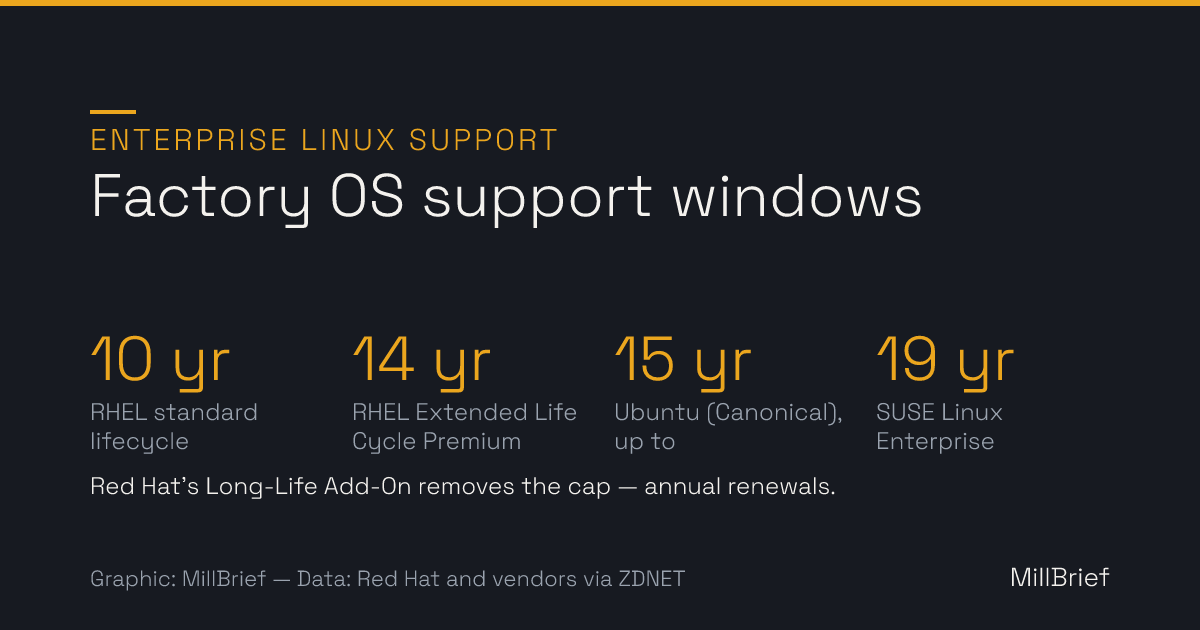
Why it matters: Production lines run on software that outlives its operating system: the vision PC, the MES server, the cell controller nobody wants to touch because it works. When the OS under that stack loses support, the real choice is an expensive revalidation-and-migration project or running unpatched. And now, increasingly, a third option: paying a vendor to keep the old release alive. None of these are free, and the “forever” tier is deliberately unpriced until you negotiate. The practical move is to put OS support windows on the same total-cost sheet as the hardware: ask what OS every quoted system runs, when its support ends, and what an extension costs. Our TCO calculator shows how recurring annual costs stack on top of a project price, and hidden costs of automation covers the lifecycle items that quotes leave out.
Source: ZDNET, July 10, 2026.
Sources
- Are suppliers ready for new robot safety standards? (The Robot Report, 2026-07-11)
- Why robotics teams need virtual gyms before deployment (The Robot Report, 2026-07-11)
- Red Hat will support your RHEL forever now - for a price (ZDNET, 2026-07-10)