Industry Brief, July 18, 2026: Agility scales up, 1X robot hands, site dogs in the UK
Three items today: a humanoid maker opening a big new facility on its way to the public markets, a set of robot hands whose spec sheet is worth reading even if you will never buy the robot, and autonomous quadrupeds taking the inspection job on UK construction sites. As always, we summarize in our own words and link to the original outlet; we report only what each source’s own reporting supports.
Agility Robotics opens a 60,000 sq ft Fremont facility ahead of going public
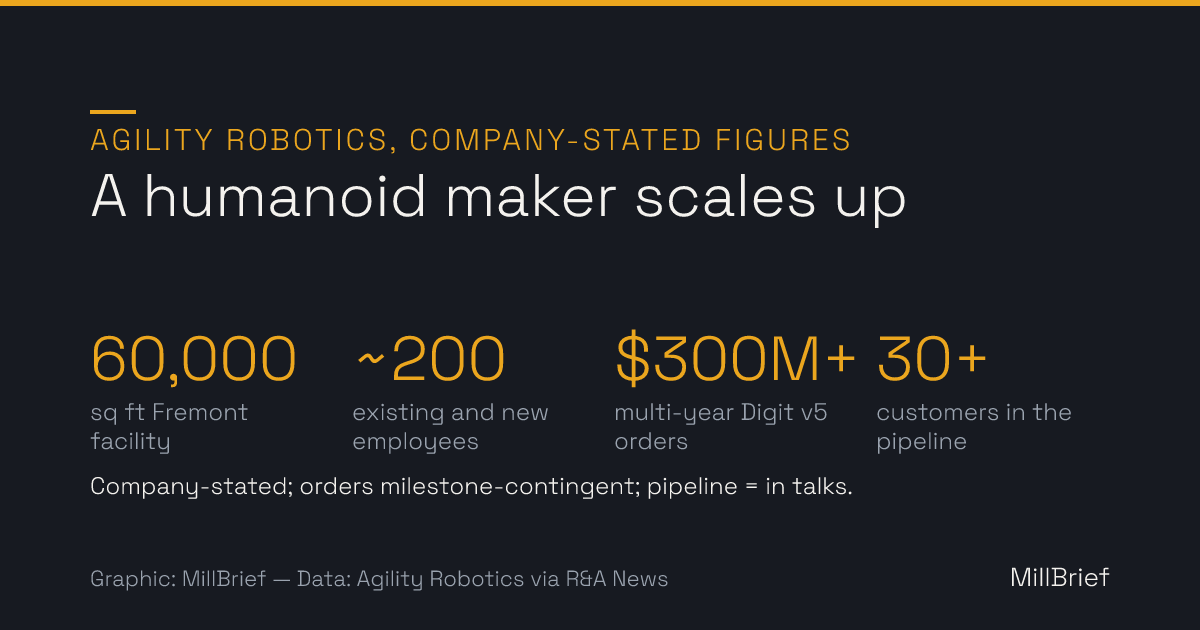
Agility Robotics has opened a 60,000-square-foot facility in Fremont, California, covered by both TechCrunch and Robotics & Automation News. Per R&A News, the site will house nearly 200 existing and new employees across hardware engineering, AI/ML software engineering, and field operations, and serves as a software and Digit-training hub alongside the company’s RoboFab manufacturing plant in Salem, Oregon. Both outlets put Agility’s order book at more than $300 million (R&A News specifies multi-year orders for the upcoming Digit v5, subject to the realization of certain contractual milestones), with a pipeline of more than 30 customers in talks. Named deployments differ slightly by outlet: TechCrunch lists Amazon, GXO, Schaeffler, and Toyota Motor Manufacturing Canada, and reports Digit robots have moved 100,000 totes at a GXO logistics facility; R&A News names Schaeffler, GXO, Toyota Motor Manufacturing Canada, and Mercado Libre. Per TechCrunch, today’s Digit works in human-free zones, while Digit v5, expected to be unveiled this fall, is designed to sense people and work outside a robot-only cage. The expansion comes ahead of a planned public listing via a business combination with Churchill Capital Corp XI that would make Agility, per R&A News, the first publicly listed US pure-play humanoid robotics company.
Why it matters: For a manufacturing buyer, the useful part of this story is not the square footage; it is the shape of the evidence. Agility is the humanoid vendor with the least demo-shaped proof points: a named customer facility where robots have moved 100,000 real totes, a dedicated factory, and order figures that the company itself qualifies as milestone-contingent, which is exactly the honest caveat to look for, since contingent orders are not revenue. Our watch-don’t-buy stance on humanoids for small and mid-size plants stands, and the v5 human-safe claim is a promise to test, not a spec to buy. But when a humanoid pitch does eventually land on your desk, this is the bar: ask for tote-count evidence from a named site, not a video, and put the human-safety claim through the same acceptance-criteria questions and RFQ gates you would apply to any cell. A vendor going public also means its claims will soon face securities-grade scrutiny; watch what survives.
Sources: TechCrunch, July 17, 2026; Robotics & Automation News, July 17, 2026.
1X shows 25-degree-of-freedom hands for NEO: the hard part of humanoids
Robotics & Automation News covered 1X’s unveiling of new hands for its NEO humanoid. The vendor-stated specifications: 25 degrees of freedom (22 fully actuated joints in the fingers and palm plus three at the wrist), driven by tendons from motors housed in the forearm at gear ratios of roughly 5:1 to 15:1, with force-controlled, backdrivable joints. The company says the hands carry high-resolution tactile sensing that measures pressure, contact location, and shear force across the fingers, are rated IP68 for water resistance with food-safe materials, and have survived millions of test cycles. Demonstrated tasks in the announcement include assembling LEGO models, picking up screws and coins, installing light bulbs, using screwdrivers, rotating objects in-hand, zipping jackets, sorting grapes, pouring tea, and plugging in USB-C connectors. 1X says it has set up a dedicated production line capable of up to 10,000 units during the year. No pricing, grip-force figures, or deployment timeline were stated.
Why it matters: Hands are the unsolved, expensive part of humanoid robots: most industrial deployments today sidestep dexterity entirely by carrying totes. So a manufacturable, washable, tactile-sensing hand at claimed 10,000-unit volume is a real signal about where the category is heading, even though NEO itself is aimed at homes, not factories. Two cautions keep it in perspective: every number above is the vendor’s own, and a task list of demonstrations is not a cycle-time or a success-rate; “sorts grapes” tells you nothing about sorting your parts, all shift, every shift. If dexterous manipulation is the bottleneck in your plant, the near-term economics still favor conventional grippers and fixtures engineered for the part; run the comparison honestly with our TCO calculator before waiting for hands to arrive.
Source: Robotics & Automation News, July 17, 2026.
McLaren Construction puts FieldAI quadrupeds on UK sites
Robotics & Automation News reports that UK contractor McLaren Construction has partnered with FieldAI to deploy autonomous quadruped robots on its construction sites, FieldAI’s entry into the UK market, building on operations the company says span hundreds of sites across Europe, Asia, and North America. The initial scope is inspection-shaped: capturing 360° site imagery, generating point-cloud data, progress verification, model-to-site deviation analysis, safety-compliance patrols, and quality assurance, with the companies naming site logistics, dexterous manipulation, and multi-robot coordination as future directions. FieldAI’s robots run on its Field Foundation Models (combining data-driven AI with physics-based reasoning and uncertainty quantification) and, per the company, operate without prior maps, supporting infrastructure, or pre-planned routes. The partners also say they will work through UK regulatory and data-security requirements together. No robot counts, site numbers, timeline, or financial terms were disclosed.
Why it matters: Note what the robots will actually do first: walk, look, and measure. Scan-and-inspect is the proven entry job for site robotics because it produces value (progress data, deviation catches, safety documentation) without touching the work itself, the same start-small logic as choosing your first automation project in a factory. The absence of numbers matters too: “at scale” with no robot count, site count, or timeline is a statement of intent, and the honest reading is a staged rollout whose real scale will show up later. FieldAI is becoming a name to track: its foundation models also drove the autonomy layer of the R-noid humanoid we covered in Tuesday’s brief. A software brain spreading across robot bodies is exactly the pattern that determines which platforms survive.
Source: Robotics & Automation News, July 17, 2026.
Sources
- Agility Robotics plants its flag in Tesla's backyard (TechCrunch, 2026-07-17)
- Agility Robotics opens new Fremont facility to accelerate physical AI development (Robotics & Automation News, 2026-07-17)
- 1X unveils 25-degrees-of-freedom humanoid robot hands for NEO (Robotics & Automation News, 2026-07-17)
- McLaren Construction to deploy autonomous robots at scale in partnership with FieldAI (Robotics & Automation News, 2026-07-17)