Industry Brief, August 5, 2026: Humanoid economics, China-free robots, UK farm funding
Tuesday’s three items are all, one way or another, about where the money actually goes: a veteran warehouse-robotics CTO arguing that humanoid economics still lose to specialized automation, a Wired interview with the startup that built a mostly China-free robot before the import ban made that valuable, and £20 million of UK government money aimed at farm robots. Our own words, links to the original outlet, vendor numbers labelled as vendor numbers.
The case that humanoids lose on unit economics, from someone selling the alternative
The Robot Report runs an opinion piece by Shaun Edwards (co-founder and CTO of parcel-handling automation firm Plus One Robotics, and before that founder of the ROS-Industrial open-source program) arguing that the barrier to humanoids on factory floors is not AI but unit economics. His numbers, offered without cited sources but from someone who builds picking systems for a living: the best humanoid demos hit around 1,000 picks per hour in controlled conditions, while specialized parcel-sorting robots run 1,300 to nearly 3,000 depending on application. One leading humanoid developer, he says, prices its robot at several hundred thousand dollars, at which point a multi-shift operation could buy specialized automation with more throughput and a faster payback instead. His model for the human side is supervision rather than teleoperation: one person overseeing 50 or more robots, stepping in on exceptions, with every intervention becoming training data, involvement that “never hits zero.” And his bet on who wins is about manufacturing, not models: scale production is what drags component costs down, which is why he picks Tesla’s Optimus to reach viable prices first. Note the vantage point: Edwards sells the specialized systems humanoids would displace, and The Robot Report flags the piece as the author’s opinion.
Why it matters: Discount for the author’s book and the argument still deserves a place in any humanoid evaluation, because it’s the same arithmetic we push for conventional automation: price per unit of actual throughput, not capability per demo. The pick-rate gap is the concrete version of a general rule: a specialized cell optimized end-to-end for one workflow beats a general-purpose machine at that workflow, so the humanoid case rests on flexibility you’d actually use. If your product mix doesn’t change often enough to exercise it, you’re paying a large premium for optionality. That’s a question to answer from your own changeover history, not from a vendor’s video.
Source: The Robot Report (opinion), August 4, 2026.
What a China-free supply chain actually looks like, part by part
Wired’s Paresh Dave interviews Saurabh Chandra, founder of Ati Robotics, a company founded in 2017 that builds tuggers and pallet movers in Bangalore and now claims several hundred robots in operation across more than 50 customers, with its first humanoid (a heavy-bin mover) due in service later this year. The timing is the story: after the FCC ban on new Chinese-made robots, Ati believes it uses fewer Chinese parts than almost any robotics company selling in the US. The part-by-part detail is what makes this worth reading. The 10,000-pound tugger is, per Chandra, genuinely China-free (down to induction motors chosen so even the magnets don’t come from China, at a small efficiency cost) and uses US-made Ouster lidar. The pallet mover is under 5 percent Chinese parts but keeps a Chinese solid-state lidar because no alternative exists. The humanoid’s arm and actuator are built in Bangalore, but the harmonic drive and frameless motor still come from China; battery cells are Chinese but swappable to Korean or Japanese suppliers. Ati got there partly by piggybacking on India’s electric two- and three-wheeler component base, and is setting up an assembly facility in Madison Heights, Michigan. On the industry’s reaction to the ban: “Everyone’s in denial. It’ll get real.”
Why it matters: This is the most granular public accounting we’ve seen of what “de-risked supply chain” means at the component level, and it gives buyers a concrete checklist: motors and magnets, gearboxes and harmonic drives, lidar, battery cells (asked per model, not per vendor). Note that even a company that made independence a design principle still has single-source Chinese components where no alternative exists, and its substitutes cost more (German or Japanese gears) or perform slightly worse (induction motors). That’s the honest shape of the tradeoff, and it belongs in RFQ diligence now that origin restrictions can strand a deployment, alongside the vendor-risk questions the ban already raised. All operational figures here are the founder’s claims.
Source: Wired (interview), August 4, 2026.
The UK puts £20M behind farm robots
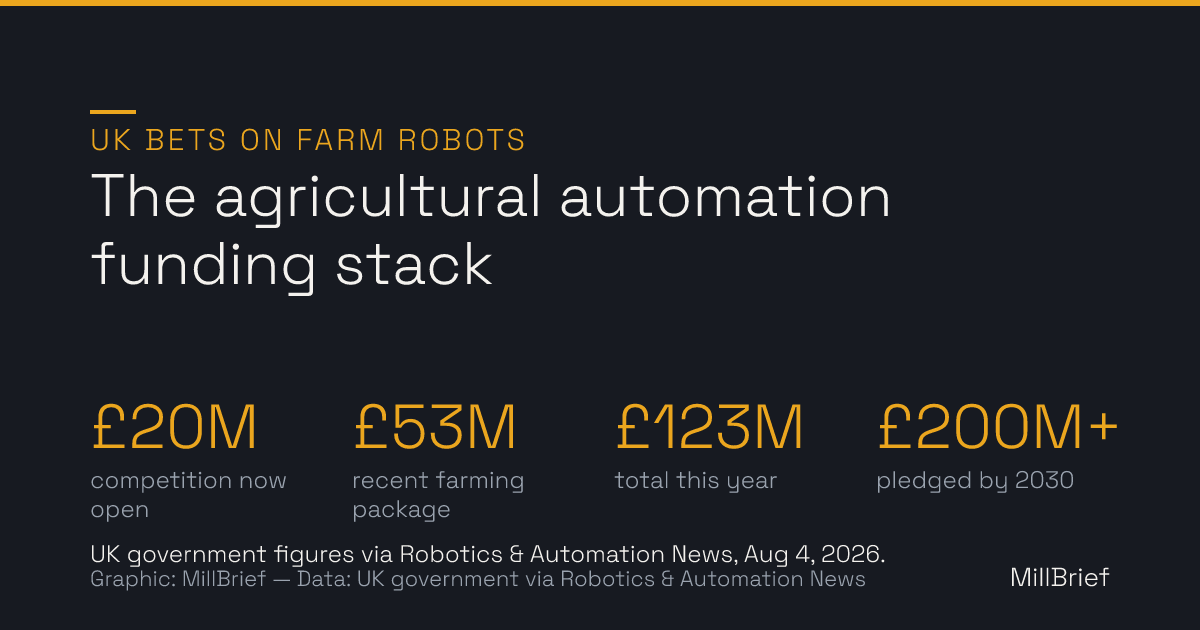
Robotics & Automation News covers a new UK government funding competition: £20 million for agri-tech businesses working with researchers and farmers on robots that plant, monitor, and harvest crops, announced by farming minister Stephen Morgan and delivered with Innovate UK under the Farming Innovation Programme. The stack behind it: the competition follows a recent £53 million package, bringing this year’s farming research and technology funding to £123 million, inside a commitment to invest at least £200 million in farming innovation by 2030. Unlike the 2023 round, this one also covers livestock, forestry, and ornamental horticulture. The government’s own examples of what it’s funding: Fieldwork Robotics’ raspberry-picking robot, currently being hardened for commercial deployment, and Roboscientific’s DETECT project, which analyses dairy-cow breath to catch bovine respiratory disease before symptoms show. Applications are open through Innovate UK’s Innovation Funding Service.
Why it matters: Agriculture is a preview of automation economics under hard labor constraints: seasonal workforces you can’t reliably hire are the extreme version of the shortage arguments driving factory automation, and the technologies funded here (durable outdoor manipulation, crop-by-crop vision, disease detection from sensor data) tend to migrate into food processing and packaging lines. For UK-adjacent readers the practical note is that the competition is open now and explicitly wants consortia of businesses, researchers, and working farms. For everyone else, the signal is that governments are increasingly willing to subsidize the what-to-automate-first experiments in sectors where labor supply, not capital cost, is the binding constraint. The two showcase projects are government-selected examples, not measured outcomes.
Source: Robotics & Automation News, August 4, 2026.
Sources
- Humanoids won't scale on factory floors until costs drop (The Robot Report (opinion), 2026-08-04)
- How One Startup Built a (Mostly) China-Free Robot (Wired (interview), 2026-08-04)
- UK government launches £20 million funding competition for agricultural robots (Robotics & Automation News, 2026-08-04)