Industry Brief, August 1, 2026: 100 driverless trucks, FedEx trailer robots, $845M deal
Four items to close the week: the most concrete autonomous-trucking numbers we’ve seen all year (with a committed ramp to 100 driverless trucks), FedEx moving trailer-loading robots from pilot to a production hub, an $845 million bet that construction software needs robot eyes, and a veteran reviewer’s argument that this week’s robot import ban regulates the wrong thing. Our own words, links to the original outlet, vendor numbers labelled as vendor numbers.
28 driverless trucks today, 100 by mid-2027, with receipts
Atlas Energy Solutions and Kodiak AI announced an expansion of their driverless sand-hauling operation in the Permian Basin, and the company-supplied numbers are unusually complete: 28 driverless trucks operating across 15 routes as of March 31, roughly 7,000 loads and more than 450,000 tons of proppant hauled since the first deployments in 2024, over 23,500 driverless hours in Q1 2026 alone, and a single-day record of 176 loads on July 20. The new agreement commits to a fleet of 100 autonomous trucks by mid-2027 and adds a second load-out point on the 42-mile Dune Express conveyor: two depots about 90 minutes apart, running simultaneously across Texas and New Mexico. The companies also say they’ve run the first autonomous triple-trailer operation (a combined loaded weight over 135 tons) and target public-road operation in early 2027, “subject to regulatory and operational milestones.” Kodiak’s CEO calls it “the world’s largest fleet of driverless big-rig trucks” (a vendor claim we can’t independently rank).
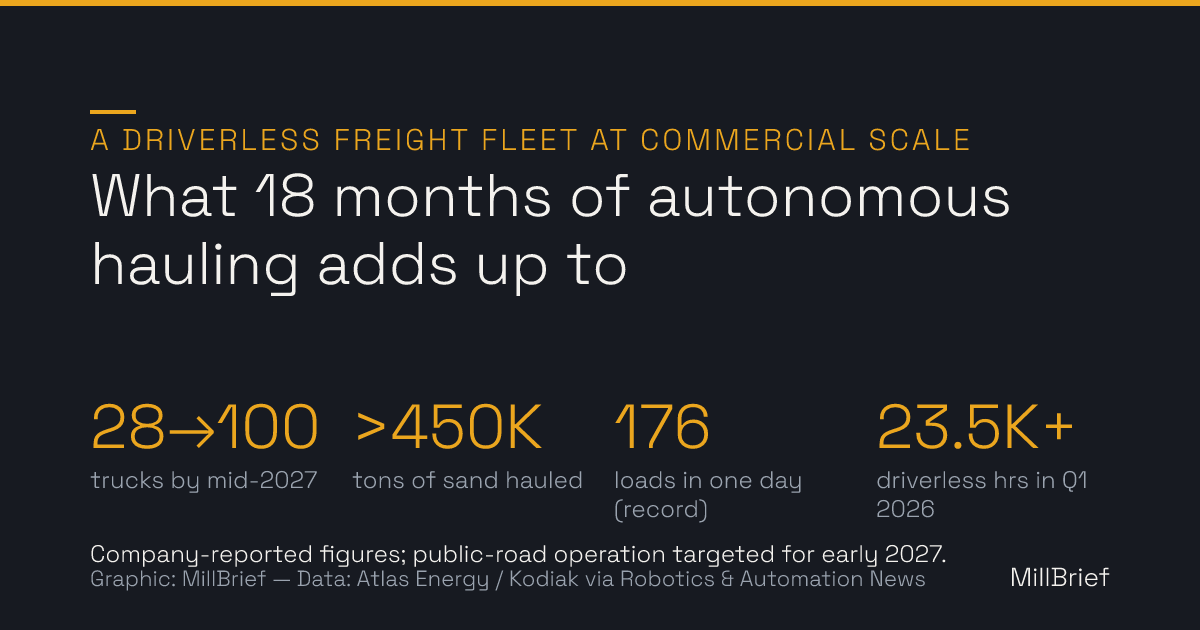
Why it matters: Strip the “world’s largest” superlative and what’s left is still the most instructive autonomy deployment pattern going: private roads first, one commodity, fixed routes, depot-to-wellsite (the highest-repetition, lowest-variability slice of the job), then scale the fleet before touching public roads. That is what-to-automate-first logic applied to trucking, and it’s why this operation ships tonnage while robotaxi programs ship demos. For anyone moving bulk materials (quarries, mines, cement, ag), the load-count and hours numbers are the useful benchmark: ask any autonomy vendor for their equivalent of “176 loads in a day, 23,500 hours in a quarter” on a comparable route profile, and treat the absence of such numbers as an answer. The ROI question here is utilization: a driverless truck earns its premium on route-hours a human crew can’t legally or economically sustain.
Source: Robotics & Automation News (company announcement), July 31, 2026.
FedEx moves trailer-loading robots from pilot to a production hub
FedEx and Dexterity announced an expanded deployment of Dexterity’s Mech trailer-loading robots (dual-armed, built for heavy work but compact enough to operate inside a trailer) at the FedEx Hagerstown Hub in Maryland, moving the program beyond the pilot site where the technology was validated over several years. The stated problem is well chosen: trailer loading is one of the most physically demanding jobs in parcel logistics, FedEx loads tens of thousands of trailers daily across its US network, and the task has historically resisted conveyor-style automation. Dexterity’s Foresight “world model” combines vision, depth, and touch to decide package placement for space, stability, and speed. Worth noting: the announcement contains no robot counts, throughput rates, or cost figures: the expansion is real, the scale is not disclosed.
Why it matters: The pattern to copy is the sequencing: years at one validation site, then expansion into one production hub with explicit attention to how the robots integrate with destination planning, trailer assignment, maintenance, and workforce processes. That integration list is the honest part: a loading robot that doesn’t talk to trailer assignment is a demo, and those integration line items are exactly the hidden costs that separate a robot’s price from a working system’s price. The missing-numbers caveat cuts the other way: when a marquee logistics name expands a deployment without publishing throughput, the technology is promising enough to scale but not yet cheap enough to brag about. Put “packages per hour, sustained, per cell” at the top of your vendor questions if this category is on your roadmap.
Source: Robotics & Automation News (company announcement), July 31, 2026.
Procore pays $845M for DroneDeploy’s robot eyes
The Robot Report covers Procore’s agreement to acquire DroneDeploy for approximately $845 million in cash, expected to close later this year pending regulatory approval. DroneDeploy’s reality-capture platform (drones, ground robots, and mobile, fixed, and wearable cameras feeding 3D imaging) has been used on over 3 million job sites in more than 180 countries, per the company. Procore’s CEO is explicit about the plan: immediate cross-selling both ways, then folding DroneDeploy’s perception data into Procore’s AI to build “digital co-workers that track what’s happening on a project, make sense of it, and then take action.” The companies frame the combination as replacing manual jobsite inspections with continuous multi-modal perception that can “automatically initiate appropriate responses.”
Why it matters: This is the same consolidation logic as ABB’s Rotork deal earlier this week: platform companies buying the sensing layer, but pointed at construction. If you use either product, the standard acquisition diligence applies: DroneDeploy customers who don’t use Procore should ask about standalone-product roadmaps and data portability before renewal, because “deeply integrated into Procore” is the stated destination. The broader signal for industrial buyers: perception (cameras, drones, scanners) is being valued not as hardware but as the data feed for AI decision layers, worth remembering when a vendor’s pitch bundles “free” site-capture into a platform subscription, because the data’s residence and portability become the real price.
Source: The Robot Report, July 31, 2026.
A veteran reviewer’s case that the ban regulates the wrong thing
The Verge published a pointed analysis of the FCC robot import ban (consumer-focused, but the argument transfers). The author’s case: the ban judges robots by where they’re built, not how secure they are; a meaningful standard would mandate encrypted map storage, security audits, vulnerability disclosure, and data-retention rules, none of which the ban requires. Documented breaches across major robot-vacuum makers are real, but the millions of devices already in US homes are untouched by the ban, and current models can keep selling: “if these really are a risk… why leave the largest source of that risk exactly where it is?” The piece also flags an enforcement precedent: the FCC’s analogous router bans have already produced waivers for companies that don’t appear to be reshoring, and one practical detail: the FCC doesn’t regulate software patches unless they change a device’s radio characteristics, so existing fleets keep getting updates. The counterpoint is quoted too: Matic’s co-founder argues consumer-robot volume builds exactly the domestic supply chains that defense, industrial, and healthcare robots will need.
Why it matters: Swap “robot vacuum” for any connected industrial robot and the security argument lands unchanged: country of origin is a proxy for security, and a weak one: a domestically-built robot with unencrypted maps, no disclosure program, and cloud-only operation is still a liability. The practical move for buyers is to put the real criteria in the RFQ regardless of the vendor’s flag: where the maps and production data live, whether object recognition runs locally, what the vulnerability-disclosure process is, and what happens to the fleet if cloud service ends. The waiver-enforcement history is also worth filing: as we said yesterday, ban mechanics are turning out to be more negotiable than the headlines; plan on the rules being applied unevenly, and get vendor commitments in writing rather than betting on any particular enforcement outcome.
Source: The Verge (analysis), July 31, 2026.
Sources
- Atlas Energy to expand Kodiak-powered autonomous truck fleet to 100 vehicles by 2027 (Robotics & Automation News (company announcement), 2026-07-31)
- FedEx expands Dexterity physical AI deployment for autonomous trailer loading (Robotics & Automation News (company announcement), 2026-07-31)
- Procore Technologies acquires DroneDeploy for $845M (The Robot Report, 2026-07-31)
- The ban on robot vacuums won't make them safer, only worse (The Verge (analysis), 2026-07-31)