Industry Brief, August 11, 2026: Shipyard robots, 58 cobot welders, Hadrian's $1.37B
Monday’s three items are all about welding-adjacent automation moving from pilot to production scale: a major U.S. shipbuilder putting up to $900 million behind robotic welding and sanding, a data-center infrastructure manufacturer that quietly built a 58-cobot welding network across three states, and $1.37 billion in fresh capital for highly automated defense factories. Our own words, links to the original outlet, vendor numbers labelled as vendor numbers.
A shipbuilder structures a $900M bet as a milestone contract, not a purchase order
Huntington Ingalls Industries announced long-term performance-based production agreements with Path Robotics (robotic welding) and GrayMatter Robotics (robotic sanding), under which it intends to award up to $900 million in shipbuilding work to the two companies across seven years, The Robot Report covers. Both are part of HII’s High-Yield Production Robotics (HYPR) program, launched in April to accelerate adaptive automation in fabricating crewed and uncrewed naval platforms. The structure is the interesting part: funding is contingent on the companies hitting defined technology and manufacturing readiness plus performance milestones, and the agreements run in two stages: a Navy-grade development stage to develop, validate, and qualify high-precision techniques (autonomous welding, grinding, blasting, painting, assembly, inspection), then a delivery stage in which HII sources work through the new autonomous production line contingent on cost, schedule, and quality performance, starting with small steel structures and growing to units and modules. Context for the scale: HII plans to outsource more than 2.5 million hours of shipbuilding work in 2026, a 30% increase from 2025.
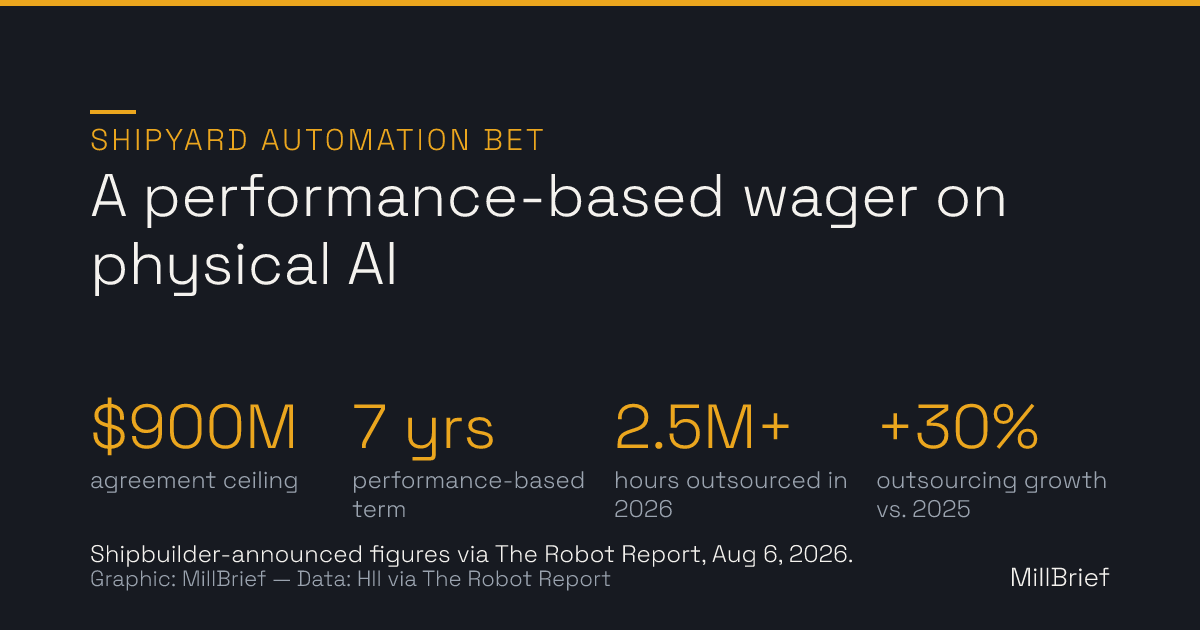
Why it matters: This is the most sophisticated buyer-side automation contract structure we’ve covered: instead of buying robots, HII is buying outcomes: the $900 million is a ceiling released against readiness milestones and then actual production performance, with a formal qualification gate before any delivery work flows. Most readers aren’t buying Navy-grade welding, but the pattern scales down: paying an integrator against acceptance criteria you specify rather than against equipment delivery shifts technical risk to the party best placed to carry it. It’s also a data point for where autonomous welding is commercially: the hard, high-mix, large-structure work that fixed cells handle worst is exactly what these agreements are paying to solve. The dollar figure is an intended maximum, not committed spend.
Source: The Robot Report, August 6, 2026.
What 58 cobot welders across three plants actually looks like
Hirebotics announced that Tate Inc., a data-center infrastructure manufacturer that has made structural ceilings, containment, and airflow products for 120 years, has deployed 58 of its cobot welding systems across facilities in Arkansas, Virginia, and Kentucky, The Robot Report writes. The rollout ran on Hirebotics’ cloud-based, no-code Beacon Pro platform, which lets Tate program, run, and monitor the welders from a phone or tablet, and share weld programs and parameters across all three plants in real time. Details from the vendor’s account worth noting: Tate evaluated roughly nine automation providers; Hirebotics shipped the first two robots in September 2023; operator training typically took 10 to 20 minutes per employee. In the Arkansas plant the cobots also handle upstream tacking and pre-assembly to feed downstream industrial robots. The headline outcome figures (a 12x increase in per-welder throughput on critical structural assemblies, elimination of rework from welder-to-welder variability, and “no production components are hand-welded anymore”) are Tate’s and Hirebotics’ own reported numbers, carried in the vendor announcement without independent verification. Tate is also an early deployment site for Hirebotics’ new Cobot Painter on the same platform.
Why it matters: Strip out the vendor framing and this is still a useful reference deployment: a mid-sized manufacturer took cobot welding from two units to 58 across three states in under three years, driven by a demand spike (data-center construction) plus a quality problem (manual weld variability), the two conditions under which automation math turns over fastest. The transferable details are the boring ones: they benchmarked ~nine suppliers with their own parts, the deciding factors were time-to-first-weld and ease of programming, and the scaling mechanism was centrally versioned weld programs pushed to every site: process discipline encoded in software, which is where the consistency gain actually comes from. Treat the 12x figure as a vendor claim to verify against your own baseline, not a planning number.
Source: The Robot Report, August 10, 2026.
Hadrian raises $1.37B for factories-as-a-service
Hadrian Automation has closed $1.37 billion in new equity financing to accelerate building out domestic manufacturing capacity for U.S. military, aerospace, and industrial systems, The Robot Report writes. The round (co-led by WCM Investment Management, Washington Harbour Partners, Valor Equity Partners, 137 Ventures, and Baillie Gifford, with JPMorganChase’s Strategic Investment Group as anchor co-lead) brings the company’s valuation to $7.87 billion, its second raise this year after a January round that valued it at $1.6 billion. Founded in 2020, the Torrance, Calif.-based company builds highly automated factories combining process engineering, AI, and robotics, and sells capacity through a “factories-as-a-service” model. Since its Series C twelve months ago it has opened new factories in Mesa, Ariz., and Muscle Shoals, Ala., bringing capacity to just under 3 million sq. ft. across four sites, and it plans further factories and new production lines (including munitions and autonomous systems) over the next year. CEO Chris Power’s framing: “Production is now the frontline of deterrence.”
Why it matters: The valuation jump ($1.6 billion to $7.87 billion inside one year) says investors are now pricing automated manufacturing capacity as a strategic asset, not pricing a robotics product company. For buyers, the factories-as-a-service model is the part to watch: if it works, some fraction of “should we automate our own shop” decisions becomes “should we buy capacity from someone who already did,” the same make-versus-buy fork we map in integrator economics, with the usual caveats about lock-in and lead-time control moving to someone else’s queue. The capacity, expansion, and capability claims here are all the company’s own statements accompanying a fundraise; the measurable facts are the round, the investors, and the four operating sites.
Source: The Robot Report, August 10, 2026.
Sources
- HII signs up to $900M agreement with Path Robotics, GrayMatter Robotics (The Robot Report, 2026-08-06)
- Tate deploys 58 Hirebotics cobot welders across multiple facilities (The Robot Report, 2026-08-10)
- Hadrian raises $1.37B to accelerate U.S. manufacturing (The Robot Report, 2026-08-10)