Industry Brief, August 14, 2026: Fleet-debugging agents, ARM call, Celona Orion
Friday’s three items are about the unglamorous layers that decide whether automation actually runs: a seed-stage startup selling AI agents that dig through fleet data to explain why a robot failed, a funded project call for anyone building robotics for the U.S. defense industrial base, and a wireless vendor arguing that your plant’s four disconnected networks should behave like one. Our own words, links to the original outlet, vendor numbers labelled as vendor numbers.
Alloy Robotics raises $8M to root-cause robot failures with AI agents
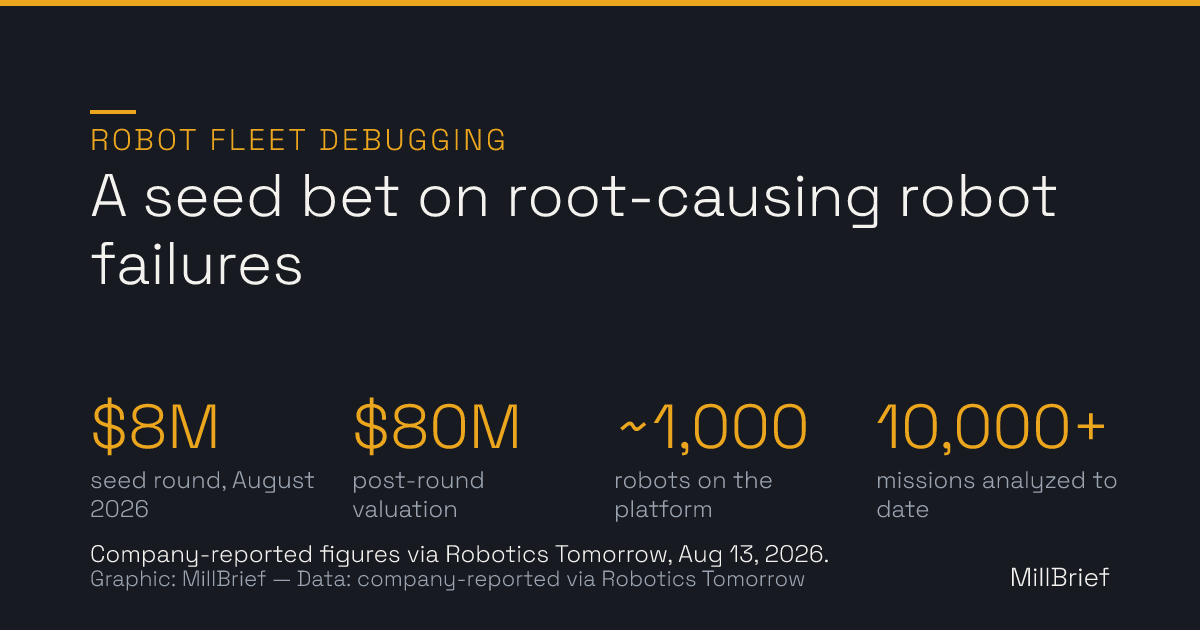
Sydney- and San Francisco-based Alloy Robotics has raised $8 million at an $80 million valuation, just over a year after its founding, Robotics Tomorrow reports. Square Peg led the round, with pre-seed backers Blackbird, Airtree, and Skip Capital returning, plus individual investors from OpenAI, Anthropic, Tesla, Waymo, and several of Alloy’s own customers; total raised is roughly $10.5 million. The product: AI agents that pull together fleet logs, telemetry, video, and sensor data with engineering context from Slack and Jira, then scan for anomalies, regressions, and recurring patterns, linking each finding back to the underlying missions and timestamps. The company says it now supports close to 1,000 robots and has analyzed more than 10,000 missions, most in the past two months (company-reported figures). Customer anecdotes from the announcement, same caveat: Advanced Navigation says field-test analysis that took a full day now takes under ten minutes, and drone startup DroneForge credits Alloy with catching a misdiagnosed component: the engineer suspected the wrong part, and both state estimators turned out to be fine. Alloy also exposes mission context to coding agents like Codex and Claude Code through an MCP server.
Why it matters: “When a robot fails, an engineer can spend days, sometimes weeks, working out why” is the founder’s pitch line, but it matches what any plant running more than a handful of robots already knows: the bottleneck isn’t the robot, it’s the integration and support labor around it. Downtime diagnosis is a real line item in total automation cost, and a tool that compresses it is worth evaluating, with the standard discipline: the 1,000-robot and ten-minute numbers are the vendor’s own, so ask for a trial on your fleet’s ugliest recurring fault before believing them on your floor.
Source: Robotics Tomorrow, August 13, 2026.
ARM Institute opens a defense manufacturing project call: concept papers due Sept. 16
The Pittsburgh-based ARM (Advanced Robotics for Manufacturing) Institute issued Project Call 27-01, seeking robotics technologies that address U.S. defense manufacturing needs in areas including metalwork, drones, munitions, and shipbuilding, The Robot Report covers. The requirements are specific: proposals must have a defense focus, sit between Technology Readiness Levels 4 and 7, include a final demonstration in a production-relevant environment, and carry a validated transition plan into the defense department’s commercial or organic industrial base. The institute states a preference for dual-use technologies that also benefit the broader U.S. manufacturing base, and for teams that include government program stakeholders. The timeline: an informational webinar August 19, concept papers through the ARM Member Community by September 16, presentation invitations around October 13, presentations about December 9, selections December 11, and awarded projects starting by February 1, 2027, with the performance period ending January 31, 2028.
Why it matters: This is one of the few standing mechanisms that pays for robotics development at exactly the maturity level where most shop-floor ideas die: TRL 4-7, past the lab demo but before anyone will buy it. If you’re a machine shop, integrator, or automation vendor with a half-proven fixture, welding, or inspection concept, the dual-use preference means you don’t need to be a defense contractor to fit; you need a credible demonstration plan and a partner in the supply chain. The catch is procedural: papers go through the ARM Member Community, so non-members have a membership step before the September 16 deadline, which is four weeks out.
Source: The Robot Report, August 13, 2026.
Celona pitches one wireless fabric for the whole plant
Private-wireless vendor Celona announced Orion, a platform that merges private 5G, Wi-Fi 7, public cellular, and Starlink satellite connectivity into what it calls a single deterministic network fabric for physical AI (autonomous mobile robots, vehicles, vision systems, and edge agents), The Robot Report covers. The claimed core innovation is identity that survives network handoffs: one SIM identity that authenticates on both Celona Wi-Fi and Celona private 5G, so a robot can, say, run the shift on 5G and switch to Wi-Fi in the garage for bulk data transfer without losing itself in the process. Alongside it: AerConnect, an open-source agent for robot OEMs that watches all available wireless interfaces and steers traffic by quality thresholds; an orchestration layer pitched as a “single pane of glass” with AI agents doing network troubleshooting via MCP; and SIM-based identity with IT/OT micro-segmentation. All of this is the vendor’s own framing; availability starts in the fourth quarter of 2026, phased, so today it’s an announcement, not a shippable product. An IDC analyst quoted in the piece endorses the category logic: enterprises increasingly need Wi-Fi and private 5G “not as separate silos, but as a unified, intelligently managed system.”
Why it matters: Wireless is the least-discussed reason AMR deployments disappoint: a robot that drops connectivity mid-aisle becomes a downtime line item no one budgeted, and today the fix usually means picking one network religion per fleet. A converged fabric attacks the same integration-plumbing gap yesterday’s brief covered from the software side: the demo is never the hard part; day one on a mixed floor is. Two things to hold onto if this crosses your desk: the seamless-handoff claim is unverified until Q4 at the earliest, and single-vendor convergence trades silo complexity for single-vendor risk. The open-source AerConnect agent is the piece that would let you hedge, so check whether it actually works with non-Celona networks.
Source: The Robot Report, August 12, 2026.
Sources
- Alloy Robotics Raises $8M to Help Engineers Debug Robot Fleets With AI Agents (Robotics Tomorrow, 2026-08-13)
- ARM Institute calls for defense manufacturing technology projects (The Robot Report, 2026-08-13)
- Celona launches Orion agentic wireless platform built for physical AI and robotics (The Robot Report, 2026-08-12)