Industry Brief, August 15, 2026: AutoStore-Amazon, Unitree's IPO, formed gearboxes
Saturday’s three items map the money flowing through automation right now: the biggest name in cube storage signs a framework (not an order) with the biggest name in e-commerce, retail investors chase a Chinese humanoid maker at 5,000 times the available shares, and a century-old German bearings company quietly attacks the component that makes humanoids expensive. Our own words, links to the original outlet, vendor numbers labelled as vendor numbers.
AutoStore signs a supply framework with Amazon, with zero committed orders
Norwegian cube-storage maker AutoStore has signed a strategic supply agreement with Amazon establishing the terms under which Amazon can procure AutoStore systems globally, Robotics & Automation News reports. Read the fine print before the headline: AutoStore itself states the agreement “does not contain any purchasing commitments at this time,” and no financial terms, volumes, locations, or timetable were disclosed; the company declined to elaborate beyond its short announcement. What the deal does do is pre-negotiate the commercial framework so future procurements don’t require renegotiating the relationship each time. AutoStore (whose robots drive across the top of a dense storage grid, delivering bins to pick stations) says it has roughly 2,000 systems installed across 68 countries (company figure). Notably, the announcement was classified as inside information under the EU Market Abuse Regulation, which tells you the company considers it price-sensitive even without a committed order.
Why it matters: For warehouse-automation buyers there are two readings. One: the world’s most demanding fulfillment operator has done the diligence on cube storage and wants a standing mechanism to buy it, about as strong a reference check as the category can get. Two: if Amazon does start drawing on this framework at scale, lead times for everyone else’s AutoStore projects could stretch. Worth asking your integrator about delivery risk before it shows up in your project timeline. And the deal structure itself is worth copying at any scale: framework terms first, purchase orders later is exactly how a well-run RFQ de-risks a multi-phase rollout.
Source: Robotics & Automation News, August 14, 2026.
Unitree’s IPO is oversubscribed 5,000 times
Hangzhou-based Unitree Robotics priced its Shanghai STAR Market IPO at 150.8 yuan ($22.40) per share, raising roughly $900 million at a valuation around $9 billion, and demand for the online retail tranche exceeded available shares by more than 5,000 times, for an allocation rate of 0.018 percent, Robotics & Automation News reports, citing CNBC. Unitree is expected to begin trading later this month as the first humanoid-robotics company listed on mainland China, with AI developer DeepSeek among the strategic investors. The sober counterweight sits in Unitree’s own prospectus: the company acknowledges large-scale commercial adoption could develop more slowly than expected, with robotic hands still lacking the precision and durability for sustained operation. The financials cut both ways too: revenue more than quadrupled last year, but first-quarter adjusted profit fell by more than 52 percent as R&D and marketing spending rose (all figures per CNBC). Competitors AgiBot and Leju Robotics are pursuing listings in Hong Kong and Shenzhen.
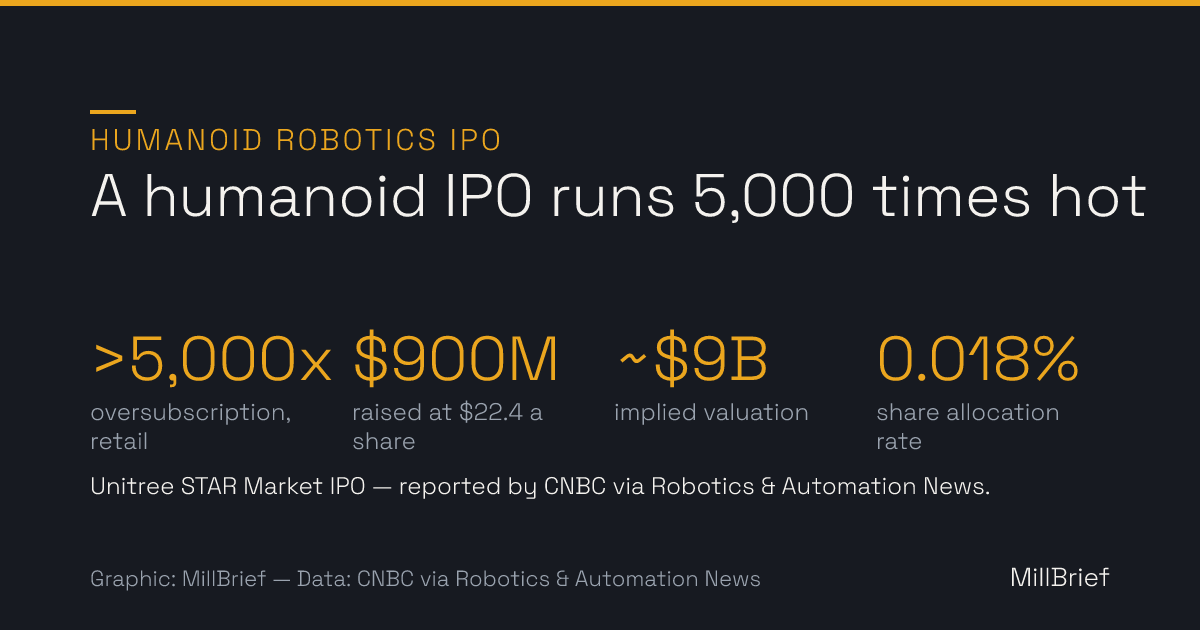
Why it matters: The gap between 5,000-times oversubscription and a prospectus that admits the hands don’t work well enough yet is the whole humanoid market in one filing. For a manufacturer weighing automation spend, the practical takeaway is unchanged: capital is racing far ahead of demonstrated factory-floor capability, which means vendor demos will keep getting more spectacular while deployment economics stay unproven. Hold every humanoid pitch to the same payback arithmetic you’d apply to a conventional cell that works today.
Source: Robotics & Automation News, citing CNBC, August 14, 2026.
Schaeffler moves humanoid gearboxes from machining to forming
Motion-technology supplier Schaeffler announced formed strain wave gearboxes for humanoid robots, replacing the precision-machining process that currently dominates manufacture of these components, Robotics & Automation News reports. The context, per Schaeffler: actuators account for around half the total cost of manufacturing a humanoid, and strain wave gearboxes (which deliver high gear reduction, torque, and stiffness in compact joints) are a key actuator component whose machining is slow and capital-intensive. Schaeffler’s forming process presses components into shape in seconds rather than machining them in minutes, which the company says cuts key-component manufacturing costs by more than 25 percent and material consumption by more than 75 percent while achieving comparable torque and efficiency (all vendor claims; validation testing is the company’s own). Credibility marker worth noting: this isn’t a lab process; Schaeffler says it has supplied more than 2 million formed strain wave gearboxes to automotive markets over the past decade. Mass production for robotics is slated to start in Germany in 2027.
Why it matters: Humanoid sticker prices will be set less by AI progress than by boring component economics like this, the same way industrial robot costs fell for decades as arms became commodity mechanics. A proven automotive supplier moving joint components from machining to forming is the kind of supply-chain shift that actually moves unit costs at volume, and it complements the price-collapse data in Wednesday’s brief (average humanoid prices down 93 percent since 2020, per Wood Mackenzie). The claims to re-verify when it ships: “comparable torque and efficiency” is doing a lot of work in that sentence, and gearbox durability under real duty cycles is exactly where formed parts have historically had to prove themselves against machined ones.
Source: Robotics & Automation News, August 14, 2026.
Sources
- AutoStore signs global supply agreement with Amazon (Robotics & Automation News, 2026-08-14)
- Unitree IPO oversubscribed more than 5,000 times as investors pile into humanoid robotics (Robotics & Automation News (citing CNBC), 2026-08-14)
- Schaeffler unveils formed strain wave gearboxes for humanoid robots (Robotics & Automation News, 2026-08-14)