How Much Does an Industrial Robot Cost? 2026 Price Ranges
The honest answer is that “the price of the robot” is the wrong number to budget against. The arm is the cheapest part of an industrial robot project, and vendors quote it because it looks affordable. What you actually pay for is the fenced, safety-rated cell around it. This guide separates arm-only prices from deployed-system prices by robot type, explains what drives each, and flags where a cobot or a used unit changes the maths.
What does an industrial robot arm cost by type?
Arm-only prices in 2026 span from roughly $5,000 to about $280,000 depending on the robot’s kinematic type and payload (the cartesian low end is a MillBrief editorial estimate). Cartesian (gantry) robots are the simplest and cheapest mechanism; SCARA and delta types sit higher; six-axis articulated arms cover the widest band and dominate spending. According to EVS International (2026), a six-axis arm costs $25,000-$180,000, with the majority of units sold in the $30,000-$80,000 band and super-heavy (250-800+ kg) arms reaching about $280,000, while Standard Bots (2025) puts SCARA arms at about $7,500 for entry-level models up to $60,000 or more for high-end cleanroom units. Treat every figure below as an indicative range as of mid-2026; actual quotes swing widely on brand origin, reach, and configuration.
| Robot type | Typical arm-only price (2026) | Typical deployed cell price (2026, MillBrief estimate) |
|---|---|---|
| Cartesian / gantry | $5,000-$15,000 | $30,000-$80,000 |
| SCARA | $7,500-$60,000+ | $40,000-$120,000 |
| Six-axis, light payload (3-12 kg) | $25,000-$55,000 | $75,000-$150,000 |
| Six-axis, mid payload (15-50 kg) | $45,000-$95,000 | $120,000-$300,000 |
| Six-axis, heavy payload (60-220 kg) | $80,000-$150,000 | $200,000-$400,000 |
| Six-axis, super-heavy payload (250-800+ kg) | $130,000-$280,000 | $300,000-$600,000+ |
Cartesian ranges are MillBrief editorial estimates, because no live public source we checked publishes them. SCARA arm prices are from Standard Bots (2025). Six-axis arm prices are EVS International’s (2026) Japanese and European ranges by payload class; Chinese tier-1 arms run lower, for example $15,000-$30,000 for a light arm. The deployed-cell column is a MillBrief editorial estimate. Delta-robot pricing is omitted here because no reliable public source was found; do not accept a delta quote without benchmarking it against a SCARA of similar payload.
What actually drives the price?
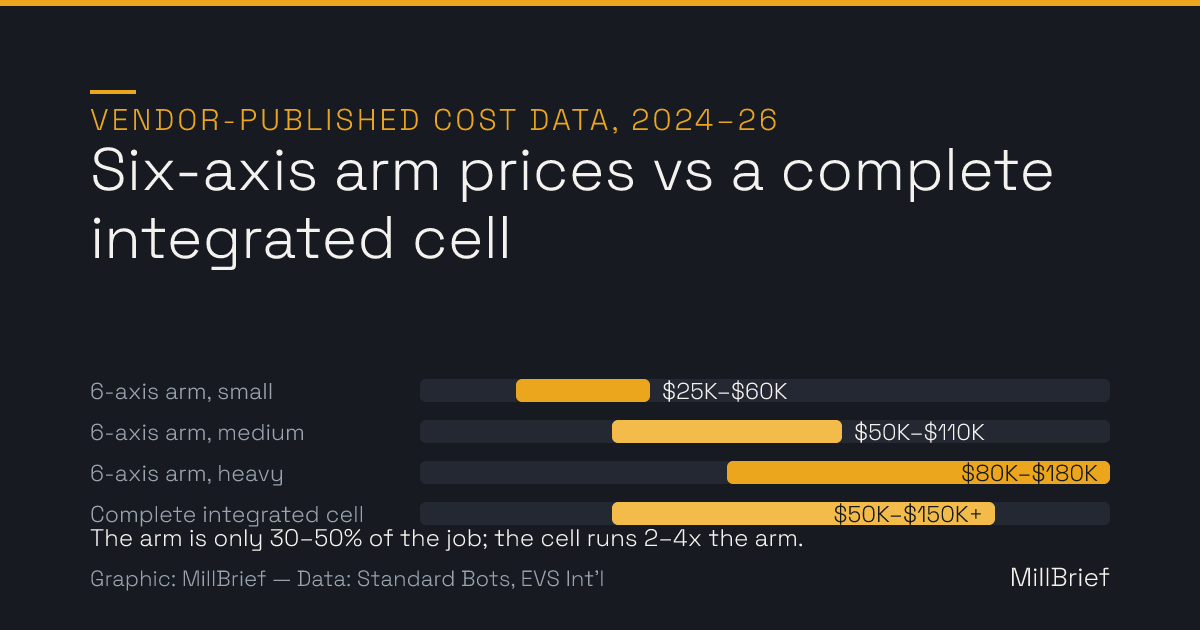
Payload is the single biggest cost driver, followed by reach, speed, and precision. A 5 kg-payload arm costs significantly less than a 50 kg+ machine, and each step up in reach or tighter repeatability tolerance raises the price again. According to EVS International (2026), Japanese or European arm prices climb from $25,000-$55,000 for light (3-12 kg) payloads to $130,000-$280,000 for super-heavy (250-800+ kg) payloads, and Standard Bots (2026) puts a total six-axis system at $150,000 to $500,000 once integration, safety systems, and tooling are included. IP rating matters too: a washdown-rated food or foundry robot costs more than a standard IP54 unit for the same payload. Brand origin is a real variable: European and Japanese OEMs typically price above emerging-market brands for comparable specs.
Do not fixate on the arm spec sheet alone. A robot that is faster or more precise than your cycle time requires is wasted money, and over-specifying payload “for future flexibility” is one of the most common ways buyers inflate a quote without a business case.
Why is the arm only part of the cost?
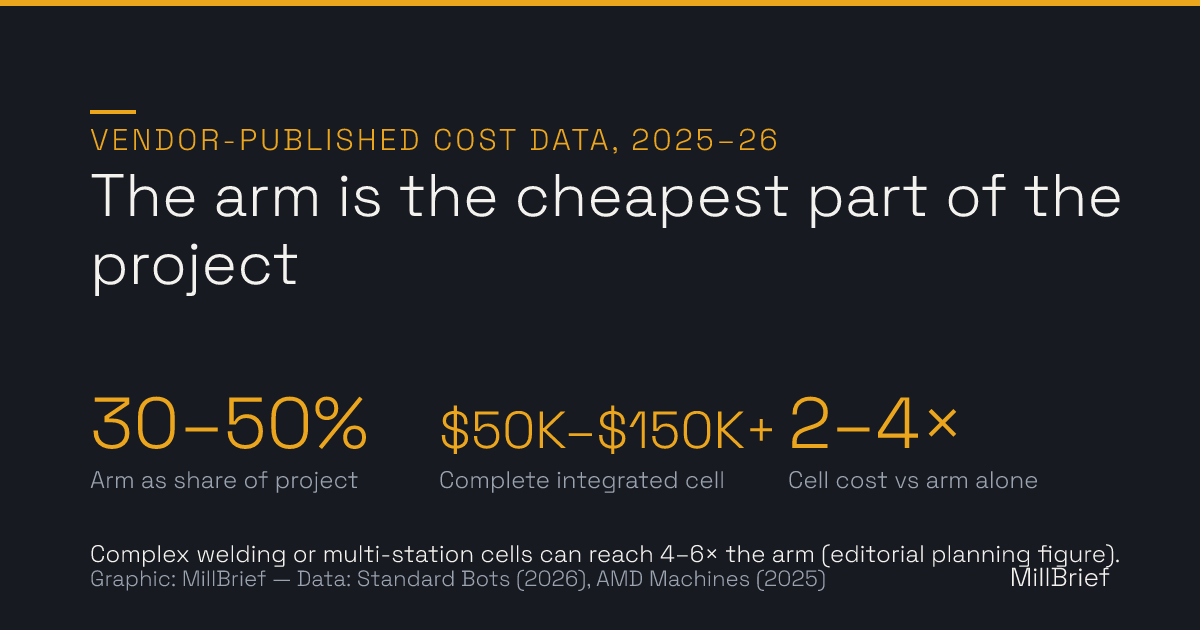
According to EVS International (2026), the robot arm represents only 30-40% of total cell expenditure in most applications, and a total deployed cell runs $80,000-$400,000 (arm, tooling, integration, and safety); a $60,000 arm for a mid-payload welding cell sits inside a $150,000-$200,000 total cell budget. The integration multiplier is where budgets go wrong. AMD Machines (2025) reports that a typical welding or assembly cell costs two to four times the robot alone once tooling, safety, and peripherals are added. For complex fenced systems, we estimate that multiplier can reach four to six times, with turnkey packages exceeding $500,000, an editorial planning figure, not a vendor-published number.
We treat 2-4x as the typical planning band and reserve 4-6x for complex welding or multi-station cells. If an integrator quotes you 1.2x the arm price, they have almost certainly left something out of scope.
Why does fencing make industrial robots cost more than cobots?
A fenced industrial robot carries a safety burden that a collaborative robot avoids, and that burden is expensive. Non-collaborative arms move fast and hard, so they legally require physical separation from people: fencing, interlocked gates, laser scanners, and often a dedicated safety PLC. According to EVS International (2026), the safety enclosure and light curtains typically account for 5-10% of total industrial cell cost, and its cobot pricing guide puts safety infrastructure for a traditional industrial robot at $15,000-$50,000 (fencing, sensors). The same guide estimates a traditional industrial robot cell can cost 3-4 times more than an equivalent cobot solution for many applications once safety fencing, dedicated safety PLCs, larger floor space, and longer integration timelines are counted.
This is the core trade-off in the cobot vs industrial robot decision: the industrial arm is faster and often cheaper to buy, but the cobot is usually cheaper to deploy. Compare against real numbers in our cobot cost guide before assuming the fenced route is cheaper.
Is a used or refurbished industrial robot worth it?
Sometimes, but the discount is smaller than the sticker implies. According to AMD Machines (2025), refurbished industrial robots are commonly marketed at 25% to 50-75% off new OEM pricing, a genuine saving on the arm. The caveats are real: warranties are often shorter (some 6-month versus 12-18 months new), buyers can face $3,000-$8,000 in unplanned repairs, and outdated controllers may lack EtherNet/IP, PROFINET, or OPC-UA support that your line needs. An arm that cannot talk to your PLC is a boat anchor regardless of price.
Buy used when the robot is a well-supported model from a major OEM, the controller supports your fieldbus, and you have in-house maintenance skill. Avoid used when the controller is end-of-life, spare parts are scarce, or the vendor cannot demonstrate the unit running under load.
When should you not buy an industrial robot?
Do not buy a fenced industrial robot if a cobot, a fixed automation device, or better scheduling would meet the need at lower total cost. The market is growing: the International Federation of Robotics (IFR, 2025) reports global installations reached 542,000 units in 2024 and are forecast at 575,000 in 2025. But volume is not a reason for you to buy. Note also that headline averages mislead: A3 (via The Robot Report, 2026) reports North American orders averaged roughly $61,200 per robot across all types in 2025, a blended order value, not a list price for any single arm.
Hold off if you lack a validated process, a payback model, or integrator capacity. Cheap arms plus expensive integration is exactly how automation projects overrun. Before signing, read our hidden costs of automation breakdown, scope the labor against real system integrator rates, and size the whole line, not one cell, using our production line automation cost guide.
Frequently asked questions
Is an industrial robot cheaper than a cobot?
The arm can be, but the deployed system usually is not. A traditional industrial robot cell can cost 3-4 times more than an equivalent cobot solution for many applications once safety fencing, dedicated safety PLCs, larger floor space, and longer integration timelines are included (EVS International, 2026). So the honest comparison is not arm versus arm but installed cell versus installed cell, and on that basis the cheaper-to-buy industrial robot is frequently the more expensive machine to actually put into production.
How much does robot integration cost per hour?
Robot installation and integration services in North America are commonly quoted at $100-$200 per hour by trade guides (IndustryX.ai, 2025), though full-project rates vary by integrator and region. See our system integrator rates page for a fuller breakdown.
Are used or refurbished industrial robots worth it?
Sometimes. Refurbished units are marketed at 25%-75% off new, but shorter warranties, $3,000-$8,000 in potential repairs, and outdated controllers lacking EtherNet/IP or PROFINET can erode first-year savings (AMD Machines, 2025).
What is the biggest driver of industrial robot price?
Payload, followed by reach and precision. A 5 kg-payload arm costs far less than a 50 kg+ machine, and EVS International (2026) prices super-heavy (250-800+ kg) Japanese or European arms at $130,000-$280,000 for the arm alone; Standard Bots (2026) puts a total six-axis industrial system at $150,000 to $500,000 including integration, safety systems, and tooling. IP rating and brand origin move the number too: a washdown-rated food or foundry robot costs more than a standard unit of the same payload, and European or Japanese OEMs typically price above emerging-market brands for comparable specifications.
Why is the arm only part of the cost?
The robot arm typically represents only 30-40% of total cell cost (EVS International, 2026). Tooling, positioners and fixtures, safety enclosure, process equipment such as vision, and integration labor make up the rest, pushing a total deployed cell to $80,000-$400,000 (EVS International, 2026).
Sources
- North American robot orders rise by 6.6% in 2025, reports A3 (The Robot Report (citing Association for Advancing Automation / A3), 2026-02-07)
- World Robotics 2025 report: Industrial Robots (International Federation of Robotics (IFR), 2025-09-25)
- How much do robots cost? 2026 price breakdown (Standard Bots, 2026)
- How Much Does an Industrial Robot Cost? Guide (2026) (EVS International, 2026)
- How Much Does a Cobot Cost? $15k-$150k (2026) (EVS International, 2026)
- True Cost of a Robot: 5-Phase TCO Breakdown (AMD Machines, 2025)
- Choosing Between New and Refurbished Industrial Robots (AMD Machines, 2025)
- SCARA robot pricing guide: From entry-level to high-end models (Standard Bots, 2025)
- Industrial Robots Guide: Types, ROI & Costs (2026) (IndustryX.ai, 2025-12-04)