Industry Brief, August 17, 2026: Humanoid economics, Neros' $250M, RoboShuttle Hyper
Monday’s three items: CNBC’s analysts put numbers on the gap between humanoid demos and humanoid work, the U.S. drone buildout gets another $250 million of private capital a day after the tariff order, and a warehouse-automation heavyweight claims a new throughput ceiling for tote-to-person picking. Our own words, links to the original outlet, vendor numbers labelled as vendor numbers.
The backflip robots’ business model, held up to the light
Ahead of Unitree’s Shanghai debut, CNBC asked the question under the IPO frenzy: can these robots make money? The assembled evidence is the best compact reality-check we’ve seen. On the demand side, a company filing shows nearly three-quarters of Unitree’s humanoid revenue in the first nine months of 2025 came from research and education, and corporate tours made up over half of its still-small industrial business. On capability, a VP Bank analyst notes advanced humanoids typically handle only a few tasks, need specific training for each, and most models run up to four hours, while sitting idle. On price, Wood Mackenzie’s figures: average humanoid prices down 93 percent from 2020 to 2025 to $58,000, a fleet projected to pass 10 million units by 2035, and China accounting for nearly 90 percent of humanoids deployed last year. SemiAnalysis estimates Unitree cut its research-grade G1 EDU price by more than 45 percent in a year to $27,300 while holding a 67 percent gross margin. And on the valuation: about $9 billion, which a CoinEx analyst puts at more than 200 times last year’s earnings, with a Unitree-linked crypto derivative trading at roughly four times the IPO price before shares even list.
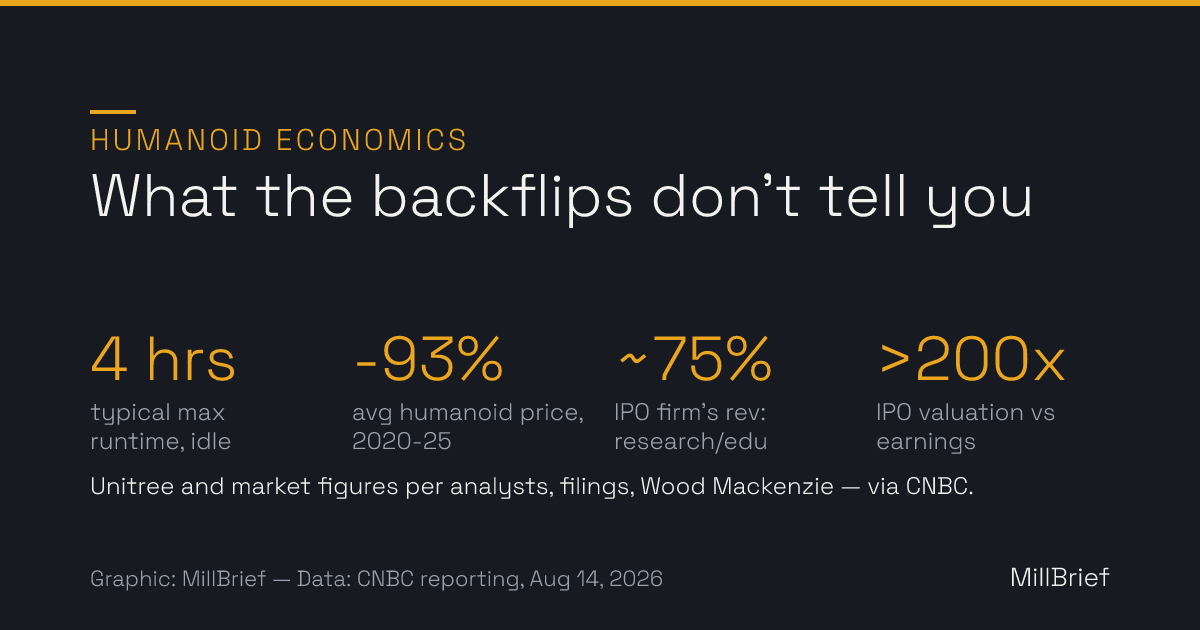
Why it matters: This is the article to hand anyone on your team who watched a humanoid demo and asked why you haven’t bought one. The revenue mix is the tell: when three-quarters of sales go to researchers and the industrial segment is mostly factory tours, the technology is real but the factory-floor product isn’t yet, which is exactly what Saturday’s prospectus caveats said in Unitree’s own words. The 93 percent price collapse still matters: hardware is commoditizing fast, and when the software catches up, adoption could move quickly. Until then, hold humanoid pitches to the same payback arithmetic as a conventional cell, and note the piece’s closing point: for repetitive industrial work, purpose-built robots are cheaper and more reliable today.
Source: CNBC, August 14, 2026.
Neros raises $250M to put U.S.-made drones into service by year-end
Defense-drone maker Neros announced a $250 million Series C at a $2.5 billion valuation, co-led by Sequoia Capital and the American Strategic Technology Fund, The Robot Report covers. The El Segundo, California-based company, founded in 2023, says it holds contracts with the U.S. Army, Marine Corps, every component of Special Operations Command, and a half-dozen allied countries. The money goes to two programs it plans to field in combat theaters by the end of 2026: Archer AI, a first-person-view platform with terminal guidance and GPS-denied position hold, and Bandit, an interceptor built to counter Class 2 and 3 drone threats including Shahed-style systems, with both platforms carrying the compute for multi-asset “swarming” control. The company’s stated target of one million drones per year by 2028 is its own claim; it raised $75 million as recently as November. The report’s context list shows how fast capital is moving into the category: Cambridge Aerospace ($300 million at $3.4 billion), Quantum Systems ($1.2 billion), Mach Industries ($300 million), HavocAI ($100 million), and Ondas’ $875.8 million DZYNE acquisition, all within roughly the past three months.
Why it matters: Put this next to yesterday’s tariff item and the industrial policy picture assembles itself: import duties on foreign drones on one side, a venture-capital flood into domestic production on the other, and a Commerce onshoring program bridging them. For manufacturers the second-order effect is the interesting one: a company promising a million drones a year needs U.S. suppliers of motors, batteries, composites, boards, and the automated lines to assemble them, and that demand lands with machine shops and contract manufacturers well before any of these vendors hit their headline numbers. The caveat cuts the same way: 2028 production targets from a three-year-old company are a funding pitch, not a forecast.
Source: The Robot Report, August 14, 2026.
Geekplus claims a new throughput ceiling for tote-to-person picking
Warehouse-automation maker Geekplus launched RoboShuttle Hyper, a climbing autonomous mobile robot system aimed at high-throughput fulfillment (e-commerce surges, cold chain, micro-fulfillment), Robotics & Automation News reports. The numbers, all the vendor’s own: up to 6,000 totes per hour per 1,000 square meters, a dual-point workstation exceeding 800 totes per hour, 1.5 meters-per-second climbing, and a 1:10 charge-to-discharge ratio for peak availability. The more technically interesting claims are about density rather than speed: retrieving a tote locks only two rack columns versus what Geekplus says is an industry norm of four to six, two robots can work the same column, and dual aisles under a single rack raise robot path density about 30 percent over the industry average, with the scheduling system claimed to coordinate up to 5,000 robots across 50,000 square meters and three million storage locations. Safety features include multi-layer fall protection limiting tote drops to 50 millimeters and real-time misalignment detection.
Why it matters: Tote-to-person throughput claims are only comparable if the conditions match, and vendor datasheets rarely publish theirs: every number above is per-1,000-square-meters or against an “industry norm” the vendor chose. The density claims are still worth attention, because rack-column locking and aisle congestion, not robot top speed, are what actually cap real-world pick rates in dense grids. If this category is on your roadmap, the practical move is to write those conditions into your RFQ (required totes per hour at your SKU profile and building footprint, measured at the workstation, with congestion at peak) and make the integrator commit to them contractually rather than quoting the brochure ceiling.
Source: Robotics & Automation News, August 14, 2026.
Sources
- China built robots that can do backflips, but can they make money? (CNBC, 2026-08-14)
- Neros Technologies raises $250M to deploy its defense drones by the end of 2026 (The Robot Report, 2026-08-14)
- Geekplus launches RoboShuttle Hyper for high-throughput warehouse fulfillment (Robotics & Automation News, 2026-08-14)