Industry Brief, August 16, 2026: Drone tariffs, LG-NVIDIA, predictive maintenance
Sunday’s three items: Washington puts tiered tariffs on imported drones and their parts, LG signs up NVIDIA’s full humanoid stack and, more interestingly, commits to validating robots on its own washing-machine line, and an editorial argues that predictive maintenance programs fail in the unglamorous plumbing after the model raises its flag. Our own words, links to the original outlet, vendor numbers labelled as vendor numbers.
New tiered tariffs on imported drones and components
The White House announced import tariffs on drones and drone parts, framed as national-security and reindustrialization policy, CNBC reports. The tiers: 100 percent on large drones with “sensitive” military capabilities like thermal imaging, 25 percent on smaller drones without such capabilities, 15 percent on drones and parts from the European Union, Japan, Liechtenstein, South Korea, Switzerland, and Taiwan, and 10 percent from the U.K. Sensitive-category duties take effect within 21 days; for drones and parts deemed not “particularly sensitive,” in 180 days. The order also lets the Commerce Department launch an onshoring program for companies investing in U.S. drone production. Context from the same report: the administration’s billion-dollar drone dominance program enters its second stage this month, and the 2027 budget request seeks $75 billion for drones within a record $1.5 trillion defense ask. Drone stocks rallied on the news: component maker Unusual Machines jumped 24 percent.
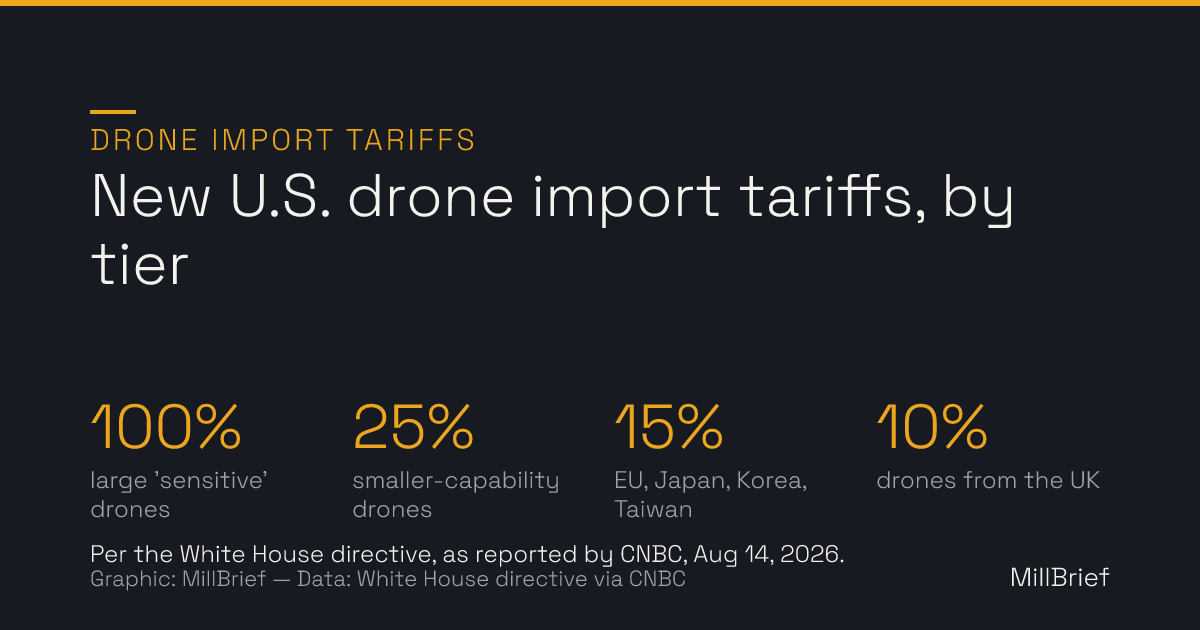
Why it matters: If your plant uses drones for inspection, inventory counts, or roof-and-flare checks (or you were pricing them in), imported hardware just got 10 to 100 percent more expensive depending on class and origin, stacking on top of the FCC’s import ban on new foreign-made mobile robots (covered in our July 29 brief). The 180-day window on non-sensitive gear is the actionable part: orders placed and delivered before the duties land avoid them, so anything already in your capital plan is worth accelerating, and any quote you’re holding should be re-checked for country of origin, including the parts inside a U.S.-assembled airframe.
Source: CNBC, August 14, 2026.
LG commits to an NVIDIA humanoid, and to testing robots on its own factory line
LG and NVIDIA signed a memorandum of understanding on August 13 covering robotics, AI factories, and mobility, Robotics & Automation News reports. The headline piece: LG is developing a bipedal humanoid on NVIDIA’s full stack (the Isaac GR00T foundation model, Jetson Thor onboard compute, and the Halos robotics safety system), with a public unveiling targeted for the first quarter of 2027, drawing actuators, sensors, and batteries from across LG Electronics, LG Innotek, and LG Energy Solution. The part a manufacturing reader should care about more: this year, LG plans to deploy its CLOiD wheel-based robot onto LG Electronics’ washing-machine production line in Tennessee for validation in a real production environment, expanding to other plants based on results. The MOU also covers an AI-factory reference site on NVIDIA’s DSX architecture in the first half of 2027 and a “robot data factory” built on LG CNS PhysicalWorks for continuous data collection and synthetic training data. All timelines are the partners’ own announcements.
Why it matters: Strip the humanoid headline and this is a major appliance manufacturer eating its own cooking: putting robots on its own high-volume line and letting production results drive the roadmap. That’s the validation model worth watching, because appliance assembly is real high-mix automation, not a demo floor. It also extends the capital-concentration pattern from Saturday’s Unitree item: NVIDIA now counts LG alongside its other GR00T partners, meaning the foundation-model layer is consolidating fast while the deployment economics remain unproven. A Q1 2027 unveiling is an announcement date, not a ship date; the Tennessee line results are the number to ask about.
Source: Robotics & Automation News, August 14, 2026.
Predictive maintenance fails after the model works
Robotics & Automation News editor David Edwards argues in an editorial that predictive-maintenance programs rarely fail at the analytics layer; they fail in what happens after the model raises a flag. The argument, condensed: a technically accurate anomaly detector creates no value if its output lands in a dashboard nobody consistently acts on; the same vibration reading means different things during startup versus steady state, two hours after a repair versus six months of untouched running, on a line-critical pump versus a redundant one. Every alert needs an owner, a priority, and an explicit next action (watch, inspect, ticket, or change operating mode), and that routing logic lives outside the model. The piece is equally sharp on rollout discipline: a threshold that generates a few extra alerts on ten test machines can flood a service operation with tickets in hours when pushed to thousands of assets, so changes should stage through a representative pilot group with a practical way to roll back, and events should flow into the CMMS, ERP, or field-service tools technicians already use rather than another parallel dashboard.
Why it matters: This is the maintenance-specific version of the integration-plumbing argument Thursday’s brief made for AI agents: the demo measures the model, but the value lives in the workflow around it. If you’re evaluating a predictive-maintenance pitch, the editorial doubles as a checklist of questions: where does an alert go, who owns it, how does it enter our existing maintenance workflow, what’s the false-positive rate at fleet scale, and how do we roll back a bad rule? A vendor who can’t answer those is selling you a dashboard, not a downtime reduction. And the honest math on both sides belongs in your ROI model before the pilot, not after.
Source: Robotics & Automation News, August 15, 2026.
Sources
- Drone stocks rally after Trump orders tariffs on foreign-made components (CNBC, 2026-08-14)
- LG to unveil new Nvidia-powered humanoid robot in early 2027 (Robotics & Automation News, 2026-08-14)
- Predictive maintenance in the real world: Why service automation and rollout discipline matter more than models (Robotics & Automation News (David Edwards), 2026-08-15)