Industry Brief, August 19, 2026: Robotic steel fab, FORT's SPAC, 1,000 palletizing cells
Wednesday’s three items: ex-SpaceX engineers put hard numbers on why steel fabrication is next in line for automation, a robot-safety company becomes the category’s first pure-play public listing, and a cobot palletizing cell crosses a milestone that says something about how automation actually spreads through factories. Our own words, links to the original outlet, vendor numbers labelled as vendor numbers.
Ex-SpaceX engineers launch a robotic steel factory, and show the math
Three former SpaceX engineers have launched 1872, a startup automating steel fabrication, with a July 22 ribbon-cutting at its Factory One facility in Cincinnati, Ohio, Ars Technica reports. The first product is deliberately unglamorous: steel skids (rectangular frames used as moveable foundations for modular buildings), aimed at customers building AI data centers and small modular nuclear reactors, with a prototype factory automating most of the process targeted for 2027. CEO Dan Summers, who ran the team integrating and fabricating Raptor engines for SpaceX’s Starship, is explicit that full autonomy isn’t the goal: “We may achieve 80 percent autonomous operations, and we may decide that it makes sense to stop there.” The driver is labor: the American Welding Society estimates the U.S. will need 320,500 new welding professionals by 2029. The economics come from welding partner Path Robotics, whose numbers are its own claims: robots keep the arc on 70 percent of working time versus 10 to 12 percent for human welders, hit 95 to 100 percent first-pass yields, and weld for about $0.12 per weld inch against roughly $0.78 manual, an 85 percent cost reduction. The bottleneck Summers actually cares about is upstream: welding a skid takes two to four hours, but staging the cut components takes four to five days. The company raised $15 million in seed funding from private funds advised by The O.H.I.O. Fund.
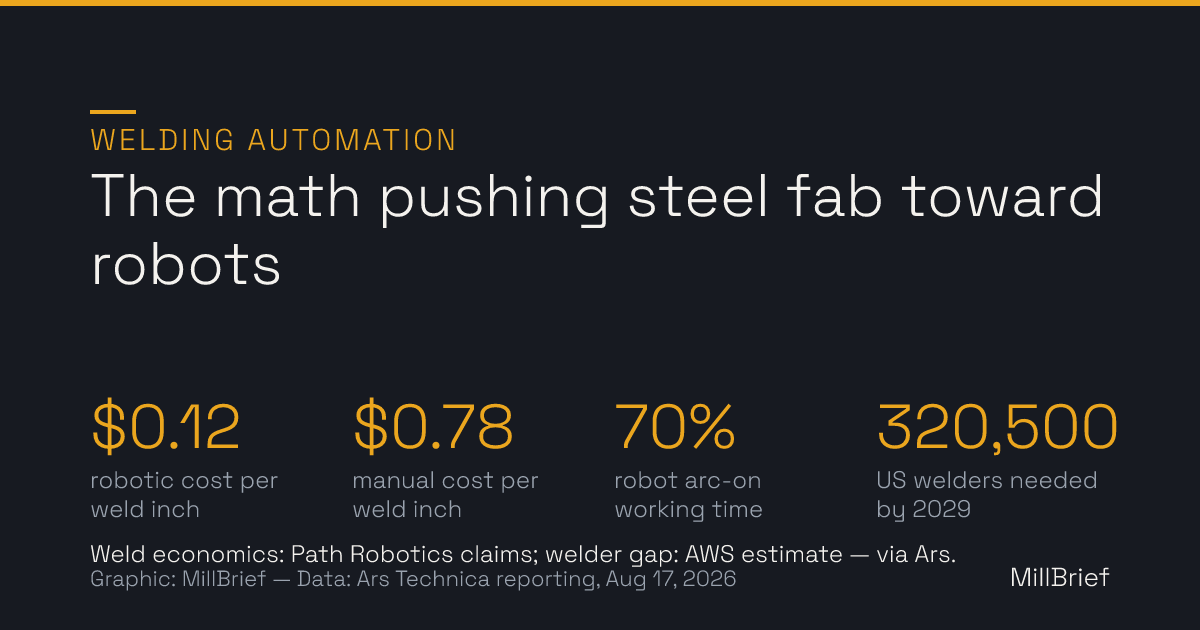
Why it matters: Two things transfer directly to any shop weighing welding automation. First, the arc-on comparison (70 percent versus 10-12 percent) is the honest way to frame robotic welding ROI: the robot doesn’t weld better, it welds more of the time, which is why the payback arithmetic works even at high cell prices. Second, Summers’ bottleneck observation is the one integrators keep repeating: the weld takes hours, the staging takes days, so automating the glamorous step without fixing material flow buys little. Worth pressure-testing in any RFQ for a welding cell. And note the target autonomy level: 80 percent, from people who built rocket engines. If they’re not chasing lights-out, your first automation project shouldn’t either.
Source: Ars Technica, August 17, 2026.
FORT Robotics takes its safety stack public via SPAC
Philadelphia-based FORT Robotics is merging with SPAC Newbury Street II Acquisition Corp to list on Nasdaq at a $556.6 million valuation ($500 million pre-money), The Robot Report covers. The deal is expected to deliver about $201 million in gross proceeds (including roughly $31 million of PIPE and non-redemption investment from Tiger Global, Prologis Ventures, and Mark Cuban) and about $182 million in net cash assuming no redemptions, with closing expected in the fourth quarter of 2026. Existing shareholders roll 100 percent of their equity and keep roughly 67 percent. FORT, founded in 2018 out of a landmine-clearing robotics company, sells what it calls a machine-agnostic “Trust Layer”: safety controllers and wireless e-stops certified to Safety Integrity Level 3 under IEC 61508, backed by 25 patents, plus cloud telemetry and, since its May acquisition of Mapless AI, remote human-in-the-loop teleoperation. The growth figures are the company’s own: 2025 revenue up 62 percent year over year with operating expenses up only 19 percent, gross margins of 70 percent in 2024 and 66 percent in 2025, more than 19,500 units deployed, and 600 customers including Agility, Google DeepMind, Zoox, Ocado, and DoorDash, with no customer above 9 percent of revenue.
Why it matters: A pure-play functional-safety company clearing a half-billion-dollar public listing tells you where the industry thinks the bottleneck to autonomy is, and it isn’t the robots. For buyers there’s a practical angle: FORT’s pitch is safety that works across machine brands, which is exactly the gap you hit when a facility runs AMRs from one vendor and cobots from another and each ships its own e-stop ecosystem. When you scope a multi-vendor line, put cross-machine safety interlocks in the integrator’s scope explicitly; it’s a real cost line, and the existence of a $556 million company built on it is the proof. The company claims are worth their usual discount, but the certification level (SIL 3) is an auditable fact, and the customer list spans warehousing to humanoids, the same adoption wave covered in Monday’s brief.
Source: The Robot Report, August 18, 2026.
Robotiq passes 1,000 palletizing cell installations
Cobot tooling maker Robotiq announced its lean palletizing cell has reached 1,000 installations worldwide, a vendor milestone, announced in the company’s own words via Robotics Tomorrow. The Québec-based company attributes the number to manufacturers wanting palletizing automated across multiple lines without treating each installation as a standalone engineering project; a UK distributor quoted in the release calls it “one that can be rolled out at pace across multiple lines within a factory.” Robotiq is hosting a webinar on August 27 on lessons from the thousand deployments, pitched at manufacturers whose ROI case “stalls in budget review” or who aren’t sure their line qualifies for a cobot.
Why it matters: Strip the marketing and there’s a signal in the number: palletizing keeps winning the race for first-cobot-project because it’s repetitive, end-of-line (so it doesn’t disturb upstream processes), and ergonomically nasty for humans, the same reasons we flag it in what to automate first. The “repeatable cell” framing matters too: the second and third installations of an identical cell are where cobot economics actually improve, because integration, not hardware, is the cost that shrinks on repetition. If palletizing is on your shortlist, the useful question for any vendor is the one this milestone implies: show me an installation running at a company my size, and tell me what the second cell cost versus the first.
Source: Robotics Tomorrow, August 18, 2026.
Sources
- Former SpaceX engineers are building a robotic factory for making steel parts (Ars Technica, 2026-08-17)
- FORT Robotics to take safety stack public via SPAC merger (The Robot Report, 2026-08-18)
- Robotiq Hits 1,000 Palletizing Cell Installations Worldwide (Robotics Tomorrow, 2026-08-18)